30, March 2021
As Franck Biya prepares to succeed his father: A look at who’s who of his inner circle 0
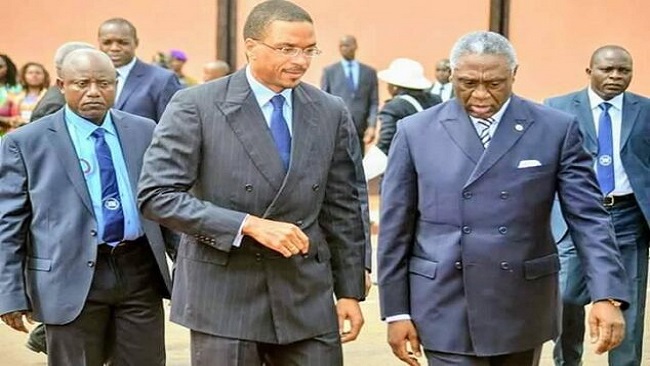
Officially, Franck Biya, the son of Cameroon’s President Paul Biya, has no political ambitions. As discreet as he is influential with his father, he has made efforts to surround himself with childhood friends and relatives, most of whom have economic or financial backgrounds.
Franck Biya has never run for political office and does not appear in any official organisation chart. However, he regularly finds himself on the front page of Cameroonian newspapers, which tend to view him as a potential successor to his father, 88-year-old Paul Biya, who has served as Cameroon’s president since 1982 and is the leader of the powerful Rassemblement Démocratique du Peuple Camerounais (RDPC).
49-year-old Biya is nevertheless careful not to reveal any of his intentions. He is very discreet as he avoids the media and has never given an interview. Biya’s entourage is also careful to deny any rumours about his political ambitions.
A movement called the “Friends of Franck Biya” began in Cameroon and spread throughout the diaspora. What is its objective? To support the 2025 presidential candidacy of the eldest son of Paul and Jeanne Irene Biya (who died in July 1992).
Some view it as a test run, as a means of gauging public opinion. Others see it as a means of exerting pressure on this businessman who has so far shown little interest in public affairs.
In Central Africa, family successions are a regular occurrence. For example, in neighbouring Gabon, Ali Bongo Ondimba took over from his father, Omar.
And in Equatorial Guinea, Teodoro Nguema Obiang Mangue, the country’s vice-president and Teodoro Obiang Nguema Mbasogo and Constancia Mangue Nsue Okomo’s son, is biding his time.
Although he has always stayed out of the spotlight, Biya has not hesitated to use his influence with his father to promote members of his mother’s family to prominent government positions.
Robert Nkili, who served as minister of labour and transport between 2002 and 2015, is his mother’s younger brother and Louis-Paul Motaze, the current finance minister, is his cousin. Both owe their positions to Biya.
The latter also serves as a gateway to the head of state. For instance, Biya invited Yannick Noah to the president’s birthday celebration on 13 February. The former tennis champion, whose real estate project – “La Cité des Cinquantenaires” in Yaoundé – is entangled in bureaucratic red tape, was able to plead his case in between glasses of orange juice.
One of the reasons why Franck Biya has remained under the radar for so long is that he left Cameroon in the 1990s to study in Los Angeles. He then moved to South Africa and France, where he lived until March 2020, when he returned to Cameroon just before the country’s first Covid-19 lockdown.
In each of these countries, Franck Biya has taken care to live in a tight-knit circle, surrounded by childhood friends and relatives who are mostly technocrats with an economist profile or working in finance.
For example, he met Modeste Mopa Fatoing, the director-general of the tax department, through Alamine Ousmane Mey, a mutual friend. In South Africa, he rubbed shoulders with Acha Leke, who has been a member of McKinsey’s Shareholders’ Council since May 2020.
Now based in Yaoundé, he is close to Samuel Mvondo Ayolo, the director of the head of state’s civil cabinet, and Paul Elung Che, the deputy secretary-general of the presidency. This 52-year-old English-speaking man, who trained at Enam and Harvard, was the head of the Caisse de Stabilisation des Produits Pétroliers et des Hydrocarbures (CSPH).
After a stormy beginning, his relationship with his father’s wife, Chantal, has calmed down. On the other hand, relations with his cousin, Bonaventure Mvondo Assam, a former deputy and ex-partner in the Compagnie Forestière Assam (Cofa), have become more tenuous.
However, many people make up Franck Biya’s inner circle. Listed below are some of the most prominent ones.
Ghislain Samou Nguewo
Aged 44, he is one of Biya’s closest collaborators. An economics graduate from the University of Yaoundé II, Ghislain Samou Nguewo took over the board of directors of Boissons Vins et Spiritueux (BVS) in February 2019. This agro-industry was launched by Guillaume Sarra and his wife Virginie Palu-Sarra, the latter whom is French industrialist Pierre Castel’s niece.
Based in Douala, the company is managed by Stéphane Soumahoro, former Ivorian president Robert Gueï’s son.
Christian Mataga
Christian Mataga is the son of Philippe Mataga, a former ambassador and ex-director of Paul Biya’s civil cabinet. Philippe Mataga also previously served as President Biya’s minister of labour and foreign affairs. The two men are so close that Paul Biya agreed to be Christian’s godfather.
Biya considers this finance graduate from the University Paris 1 Panthéon-Sorbonne as his own brother. Mataga runs the Société Commerciale Industrielle et Forestière (Scifo), which specialises in the production, processing and marketing of tropical wood species from concessions granted by the Cameroonian Ministry of Forests.
Alamine Ousmane Mey
The current finance minister is a long-time friend of Ghislain Samou Nguewo, who introduced him to Biya. Alamine Ousmane Mey trained at the RWTH Aachen University in Aachen, Germany, served as director-general of Afriland First Bank, the second largest bank in the country, and then – on Franck Biya’s recommendation – became President Biya’s minister of finance.
In the latest government reshuffle, Mey moved from managing the finance portfolio to the economic one, swapping with Louis-Paul Motaze.
Serge Akounou
One of Biya’s childhood friends, Serge Akounou followed him to the US, where the president’s son pursued his university studies. He received an MBA in Finance from the UCLA Anderson School of Management in California and returned to Cameroon to work for the local branches of Standard Chartered Bank and City Bank before moving to Gauteng, in the Johannesburg region of South Africa.
However, their friendship is reportedly going through a rough patch. Perhaps this is because Akounou is the son of Gervais Mendo Ze, a former director-general of Cameroon Radio and Television (CRTV) and former minister of communication, who has been imprisoned since 12 November 2014.
Culled from The Africa Report



















2, April 2021
La Republique Du Cameroun: No country for young men 0
Tongues have been wagging in Yaoundé following the re-election of some ailing octogenarians to the helm of Cameroon’s two houses of Parliament last month.
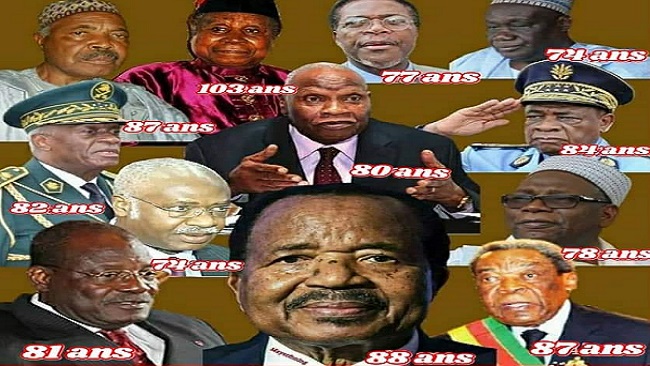
Recent footage from the Upper House of Parliament showed 86-year-old Senator Marcel Niat Njifenji teetering to the podium on March 18. He was going to assume office following his re-election as president of the Senate, which he has headed since it went operational in 2013.
Earlier the same day, 81-year-old Hon Cavaye Yeguie Djibril retained his position as Speaker of the Lower House of Parliament, the National Assembly, a post he has held since 1992.
Hon Nafissatou Alim, the 30-year-old Member of Parliament of Mayo Louti constituency in the North region, and her colleague, Hon Dague Aicha Blanche Jacqueline of Mayo Kani South constituency in the Far North region of the country, were both just a year old when Hon Djibril was first elected Speaker.
The two youngest MPs of the current (10th) legislative period in Cameroon assisted the eldest member and head of the provisional bureau of the Lower House of Parliament, Hon Laurentine Nkoa Mfegue, CPDM MP for the Mefou and Afamba in the Centre region in the election of the Speaker which Hon Djibril contested unopposed.
Both Senator Niat and Hon Djibril, all members of the ruling CPDM party, were earlier approved for the jobs by party leader and Cameroon president, 88-year-old Paul Biya, who is also Africa’s oldest and second longest-serving leader.
In their inaugural speeches, delivered in very faint voices, the duo thanked Biya for appointing them to the positions.
Some had expected that Biya, who in February this year said “2021 is beginning on a positive note for our youth”, would propose younger people for the posts.
Though a lone candidate, Hon Djibril garnered 147 of the 162 valid votes cast, with 15 void ballots to retain his post as Speaker of the 180-member legislative institution, making him the longest-serving House Speaker in the country.
President Biya, Mr Njifenji and Mr Djibril are in order of state protocol, the first, second and third public personalities of the country. According to the Constitution, if President Biya is incapacitated, resigns or dies, the President of the Senate will take over power.
The re-election of the octogenarian men, however, did not come as a surprise to some MPs. Hon Koupit Adamou, a member of the opposition Cameroon Democratic Union (CDU), said he was not surprised with their re-election.
Old guards in power
“Looking at how our Parliament functions since independence, you realise that those who are elected at the beginning of a legislative period like this one are re-elected each year till the end of the mandate. So, anyone who thought anything will change is naive,” he said.
Another member of the Lower House of Parliament who did not take part in the election, said if he was present, he would have still voted for Hon Cavaye because he was the party’s candidate for the post.
“Party discipline is not only in Cameroon. It is all over the world,” the MP said, explaining he was on the field doing an assignment for the ruling party when the election took place.
However, the heads of the two houses of Parliament are not the only old guards in power in the Central African country.
The police boss, Martin Mbarga Nguele, is 89; head of National Hydrocarbons Company Adolphe Mudiki is 82; Justice Minister 78; Secretary General of ruling party 77; and Environment Minister 75, among others.
In Cameroon though, the World Bank says, the median age is 18.7 years and six in every 10 people you meet is aged below 35 years, the line that defines youth. Yet the country’s most powerful positions are held by frail, elderly men.
Ruled by ‘club of friends’
According to Prof Willibroad Dze-Ngwa, a Historian and Political Scientist at the University of Yaoundé, the country is ruled by “a club of friends who have been together for more than 50 years and just share power amongst themselves.”
Mr Dze-Ngwa reckons none of the old guards wants to leave the scene before the other, except if nature intervenes.
“You can see that such is reflected not only in the National Assembly and the Senate but at every level of public administration. Let me say that I have no particular bias against these so-called old people because they have been placed there by the young people,” he said.
The young people, Mr Dze-Nwa says, have not been doing enough politics or using their numbers and youthfulness to take over leadership of the country.
“Of course, when there is such a vacuum, the octogenarians as you call them take advantage and play politics. Remember politics is coining policies to gain power and govern. So if the octogenarians have been able to dominate politics, then they are succeeding in their game and staying on,” he says.
“That is why we are taking too much time to advance in democracy, that is why the old laws in the National Assembly and the Senate cannot be changed, that is why the electoral laws in Cameroon have remained virtually the same because we have the same people who have gained so much power and want to sustain that power,” Mr Dze-Ngwa adds.
Source: The East African