18, April 2021
Cameroon: As the cabinet reshuffle looms large on the horizon 0
There have been rumors about a cabinet reshuffle in Cameroon for a long time now, but the “monarch” neither seems to be under pressure to change his collaborators nor willing to reverse the current unfortunate trend of events.
The monarch is used to functioning as a typical government machinery which needs to be jolted into action by external factors and this has been the trend for some four decades and this could account for some of the sluggishness in the civil service, in particular, and the country, in general.
As the president’s collaborators age, it is imperative for him to replace them with some experienced and humble hands that have been working quietly and honestly in the system.
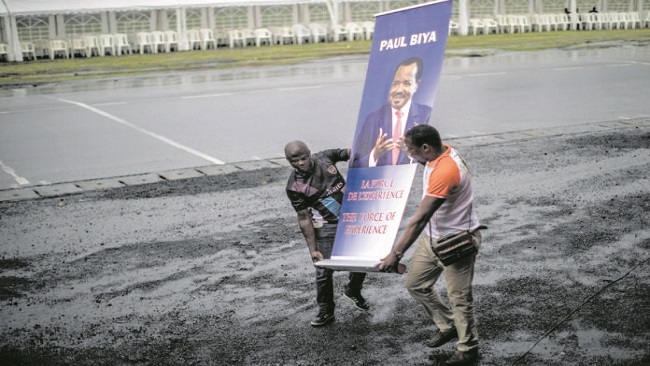
Cameroonians need youthful, energetic and selfless hands to ensure the country weathers the many storms many around the world have said will hit Cameroon like a ton of bricks after the current president, Paul Biya, bows to the inevitable.
Of course, age is just a number, but when age is accompanied by illnesses, the actors must be humble and courageous enough to exit the political scene in a very honorable manner.
Age has a way of robbing humans of their vitality. It deprives them of that enthusiasm that is a characteristic of many young people and it is that enthusiasm and energy which drive young people and spur them to achieve a lot for their families and country.
It is, therefore, not an error when many Cameroonians hold that a new political class should emerge in Cameroon if the country has to be prepared for a future that will be very challenging for people who are showing signs of senile decay.
Of course, there are many young, determined and ambitious Cameroonians who are willing and ready to put their time and energy at the service of their country, but many argue that the current political dispensation makes it hard for them to jump into the political arena where they can demonstrate that they have what it takes to help put Cameroon on the right track to prosperity and sustainable development.
But even within the ruling CPDM that has been indicted of so many crimes and sins, there are still some young, competent and hardworking Cameroonians who have kept their noses to the grindstone and if given the opportunity, they could make their country proud.
As a cabinet reshuffle looms large on the Cameroonian horizon, many forces of evil are at work to ensure that the good and competent young men do not make the president’s list of ministers.
The Cameroon Concord News Group has noticed that some shady characters, working under the cover of darkness, are at work and they are using all the tools available to them to sling mud at anybody who has made hard work his hallmark.
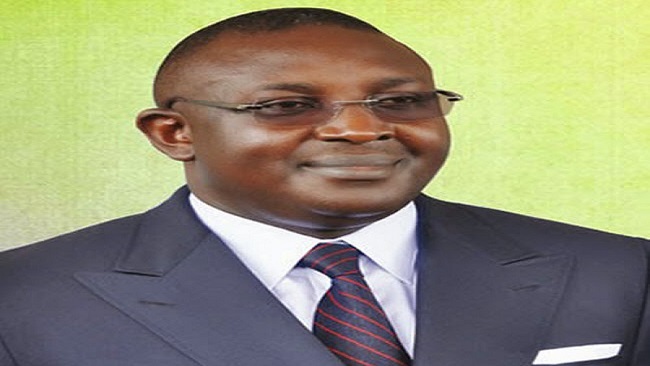
A voice note recently sent to the Cameroon Concord News Group London office has been indicting the Assistant Secretary General at the Presidency, Elung Paul Che, of crimes that have never been reported or documented.
Through its Yaoundé correspondent and other sources, the Cameroon Concord News Group have conducted a thorough investigation of the allegations and it has not found any evidence of such malfeasance.
The Cameroon Concord News Group is not just a platform that reports negative things. It also brings out the hidden good news when it finds it and Elung Paul Che’s honesty is worth reporting.
Before being appointed in 2015 as the Minister Delegate to the Ministry of Finance, Elung Paul Che had held numerous positions and interviews with those who worked with him revealed that he always demonstrated a rare form of honesty that kept many wondering, especially as corruption spreads across the country like wildlife.
Not many Cameroonians will see money and be indifferent to it. But Paul Elung Che shocked many people in the Southwest region when he was the Assistant paymaster in the Southwest treasury in Buea. He exhibited the same discipline and rigor when he was the paymaster general for the Northwest region in Bamenda and the Southwest region.
Many Cameroonians are honest people, especially when money is not involved. Bring money where Cameroonians are working and their discipline takes French leave of them. But Elung Paul is different and has always demonstrated that state property is not his property and that it must be properly managed and this has earned him great admiration and promotions.
After having served without blemish as the paymaster general in both the northwest and southwest regions, he was promoted as the Acting Director of the Treasury in Yaoundé, and later as the Director of Treasury.
Hard work pays off and Elung Paul knows this only too well. After having distinguished himself at the state treasury, he was appointed Director General of the Treasury, Finance and Cooperation in the Ministry of Finance; a post he held till 2009.
Four years later, he was appointed as the Director General of the Hydrocarbons Prices Stabilization Fund (CSPH) in 2013. From CSPH, he became a Minister in 2015, while still serving as the Director General of CSPH.
With such a brilliant career and experience, it is worth mentioning that Mr. Elung Paul Che could be one of those young, competent and hardworking ruling party members who still inspire hope.
It is, indeed, rare to find such civil servants in the country’s current civil service. The Cameroon Concord News Group investigation has proven that Elung Paul Che has never been linked with any corruption scandal.
The investigation has also proven that he has many enemies in the system because of his carefulness and honesty. He is being fought by many regime insiders who accuse him of seeking to be a “clean fish in a dirty ocean”.
A source in the Ministry of Finance hinted the Cameroon Concord News Group correspondent in Yaoundé that many people in the finance ministry fought him so hard when it was rumored that President Biya wanted to appoint him as the Minister of Finance; battles which have left him psychologically bruised. However, he remains unbowed and determined to make his contribution to the country’s development without disappointing his friends and family.
The source added that his detractors did all they could to ensure that he did not become the country’s finance minister, adding that “a good player will never lack a team and Elung Paul was appointed to other duties.”
Many people at the finance ministry accuse him of being too strict and too ‘clean’ for their liking. Yet, regardless of how murky the Cameroon waters may be, those who place themselves above the corruption that has become the country’s cancer, will always be noticed and it was because of his clean records that many Cameroonians, especially the francophones the Cameroon Concord News Group talked to, thought that in addition to his dynamism, he could one day be a good Prime Minister for the country.
By Joachim Arrey in Canada and Soter Tarh Agbaw-Ebai in the United Kingdom
















25, April 2021
Cameroon: Opposition outsources the destruction of the CPDM to COVID-19 0
When the Coronavirus started spreading across the globe, nobody ever thought it would become a political weapon of mass destruction.
In Cameroon, the insidious virus was seen as something that could disrupt people’s life and faithful to their naivety, most Cameroonians thought the virus was just a fleeting problem that was limited to Western countries because of the biting cold that makes life miserable in those countries.
As the weeks and months went by, it became clear that the virus was all over the world and that it had come to stay.
As the virus swept through Europe and North America, ridding the world of old people who were still hanging on to life, as well as obese and immuno-compromised people, it became clear that it could help to cleanse Cameroon of the lazy, sick and senile politicians in Cameroon who are more of a liability to the country.
The country’s opposition parties, which are replete with young and healthy youths, have always been thinking of how to rid the country of the ruling party which is a refuge for corrupt, greedy and immuno-compromised politicians who see their party and the state as their ATM which they can use to hang on to life at the expense of the taxpayer.
For close to forty years, the CPDM has monopolized political power and has been effective and efficient at rigging elections. The country’s president, Paul Biya, has lost every election and sometimes even in his own village.
The country’s Parliament is replete with a bunch of illiterates who know nothing about law-making, but are sitting in parliament today because of their affiliation to the ruling crime syndicate that has worked very hard to institutionalize corruption.
The country’s economy has been run aground by the ruling criminal enterprise and this is hurting Cameroonians so bad to the extent where most young Cameroonians are permanently looking outward.
They want to leave their country due to their anger and frustration against the CPDM criminal enterprise led by Mr. Paul Biya. Their country holds out no hope for them. The country is simply ruled by their “living ancestors” who should not be anywhere close to the corridors of power, but are in no rush to yield the saddle to young people.
While it has been challenging to kick out these crooks out of power via the ballot boxes, the country’s political opposition is now engaged in serious prayers, calling on the Coronavirus to cleanse the Augean Stable manufactured by Mr. Biya and his group of ‘political rats.’
News that the virus is merciless when it attacks ailing old people has been good music to the ears of the youthful political opposition.
The ruling CPDM is not only packed with old people, it is replete with old and immuno-compromised ‘living ancestors’ who want to empty State coffers before they leave this world.
The virus has been very slow at cleansing the political arena, but it has finally gotten into higher gear. In a rear and deadly alliance with other diseases, it has started sweeping the political stage as CPDM stalwarts are already dropping like flies.
Speaking to the Cameroon Concord News Group correspondent in Bamenda, a youthful Social Democratic Front (SDF) party official clearly expressed his joy that the CPDM, considered as a colony of diseases, was being torn down by an invisible enemy.
He pointed to the death of Member of Parliament, Emilia Lifaka Monjowa, who last week organized a COVID-19 super-spreader event which has sent her to a local mortuary in Buea.
The SDF stalwart said Ms. Lifaka was aware that the virus could mangle her, especially as her body was a conference center for diseases such diabetes, asthma, cardiovascular disorders and chronic obesity.
He pointed out that her death has left many who attended that super-spreader event in fear, especially as most of them were women of size and were rich in distended butts and stomachs which have been serving as storages of food and drinks.
He stressed that there was panic in Yaounde, especially at the national assembly where many Members of Parliament are hosting diabetes and high blood pressure.
He reiterated that stress was killing CPDM parliamentarians as most of them know they do not deserve their positions. Many of them had to bribe their way to the Parliament. The financial hardship of the past has weaken most of them and many are yet to pay off the debt they contracted just to secure a place in the current Parliament.
News of the death of their party members has left many worried. They have been losing sleep and they know the virus will not be going away anytime soon.
For the men, their diabetes was already a huge problem in their bedrooms, but the arrival of the Coronavirus has caused their erectile dysfunction to be full-blown.
Below is a list of those CPDM members who could not stand the presence of the virus and their demise is a constant reminder to those who harbor those deadly diseases that facilitate things for the virus. Those who are a little healthy now have sex with their side-chicks with masks over their faces.
Pictures of a CPDM stalwart having sex with a mask on have landed in our London office and this story will make a good read and will be the subject of the next editorial.
Edmond Félix Etoundi was the Chief Executive Officer of Finexs S.A., one of the largest intercity transport companies in Cameroon. He leaves behind a rich CPDM heritage that reveals a fantastic Biya regime success story of a self-made man.
Garga Alim Hayatou, Secretary of State to the Minister of Public Health responsible for the fight against Epidemics and Pandemics and Lamido of Garoua was brought down by the coronavirus.
Monkam Pascal, an industrialist, a businessman. He had a special attachment to the Biya regime and the Cameroon’s corrupt institutions.
Martin Aristide Okouda, the former Minister of Public Works, died on Friday 9 April 2021 in France. Aged 70
Chief Mukete, former traditional ruler of the Bafaws
Gervais Mendo Ze, Former cabinet minister and general manager of the Cameroon Radio and Television (CRTV) died after he was released from the Kondengui Maximum Security Prison.
Princess Rabiatou Mamboune Njoya, sister of the Sultan of Bamoun, Ibrahim Mbombo Njoya, died on 9 April 2021,
Gargoum Adoum Deputy Minister of Foreign Affairs,
Alim Boukaro Business tycoon
Essomba Pierre, Secretary General at the Ministry of Territorial Administration
Hon. Emilia Monjowa Lifaka, Vice President National Assembly
Beatrice Elom, Vice President of Transparency International-Cameroon.
By Soter Tarh Agbaw-Ebai