
29, May 2021
Ambazonia: Yerima issues statement saying there should be unity among self-defense forces 0
IG STATEMENT ON AUDIO ORDERING MURDER AMONGST SELF-DEFENCE FORCES
Fellow Ambazonians,
There is an audio circulating on social media from an agent of darkness in the United States instructing Ambazonian self-defense forces to attack and kill one another. The Interim Government of Ambazonia strongly condemns this appalling and unacceptable request and calls on all self-defense forces to ignore this shocking appeal. The notion that Ambazonians should be encouraged to attack and exterminate one another is shameful, distasteful, outrageous, and unacceptable. And the perpetrators of these sorts of actions shall one day face the Southern Cameroons justice system.
Our self-defense forces are an essential component of our liberation struggle. Their sacrifices are worthy and have brought us this far. As leaders and the Diaspora, our role is to promote unity amongst them, not divide them. Unfortunately, last year, we witnessed the senseless killings of many self-defense forces by people who claimed to fight for our flag. These killings are unacceptable.
To Our Self-defense Forces
My dear restoration forces, you must STOP attacking each other! Our common enemy is La Republique du Cameroun. Your task as self-defense forces in this struggle is to free our people and defend Ambazonia from grave danger. Your paramount loyalty is to the nation above any frontline movement or so-called leader in the Diaspora. We cannot aid and abet the enemy by fighting amongst ourselves. This war requires our sustained loyalty and self-restraint.
In this war for freedom, you have all chosen to bear the duty of self-defense. Yet, your actions must be guided by a vision of unity and collaboration on the battlefield of many dangers. Ambazonia cannot afford to lose any more lives in avoidable circumstances. Millions of Southern Cameroonians have confidence in you and are praying for you as you undertake this gigantic task to free our nation. Unity amongst you will be a decisive blow to the rogue advisers passing for leaders in the Diaspora. Ambazonia is watching you, and in you, her hope for victory lies. That trust is well placed, and you cannot afford to let your nation down with infighting.
There are difficult days ahead, yet we must remain strong. But above all, you at the forefront of this struggle must remain united. So, we must confront this dangerous enemy with unity and purpose. We must unite to defeat this evil of tyranny. Fellow Ambazonians, we will not fail. Instead, we will unite, persevere, and defeat this common enemy with all its collaborators in the Diaspora.
Thank you, and may
God bless the Federal Republic of Ambazonia.
Dabney Yerima
Vice President, Federal Republic of Ambazonia














30, May 2021
Ambazonia Military Information Operations: First open letter to soldiers of La Republique du Cameroun 0
An Open Letter to the Soldiers of La République du Cameroun from the Ambazonia Independent Secret Service Squad
The Ambazonian Independent Secret Service Squad is a team that was formed 6 months ago. We are all over Ambazonia. We are not influenced by any individual or group. We are patriotic Ambazonian citizens. We support all groups and individuals that advocate for the sovereignty of former British Southern Cameroons. We are not going to tell anyone who exactly we are, what we do, what we have been doing and what we shall do. In the recent days, La République du Cameroun have faced serious blows by some brave Ambazonians. We hail the efforts of these brave Ambazonians. We do not claim responsibility of those very sweet actions. But we support them, and we enjoy the outcome.
Before we address the soldiers of La République du Cameroun, permit us tell Ambazonians that all kidnaps and ransom taking in Ambazonia must stop immediately. Special warning to those criminals in Ndop, those taking ransom between Kumba and Muyuka must immediately stop attacking and threatening Ambazonians. Those guys in Idenau who get into people’s plantations and demand money from them must retreat. The leaders of this struggle must put their acts together; by defending Ambazonians and going after these kidnappers. If nothing is done by these leaders, we shall intervene, and the outcome will be devastating for those calling themselves leaders. As of now, we are supporting you. Do not let us turn our backs on you.
Let us now address La République du Cameroun
Fellow Soldiers of La République du Cameroun,
Some of you are from French Cameroon while some of you are from Ambazonia. It does not matter to us where you come from. We are all brothers.
The difference between you and Ambazonians is that you are fighting to defend an 88-year-old dictator, his family members, his few friends, and France, while Ambazonians are indirectly fighting to defend you, and to guarantee a better future for you, your children, your family, and your country. Ambazonians are fighting for a better future for our Ambazonian children. A prosperous Ambazonian would lead a way for a prosperous La République du Cameroun as well. We shall be very good neighbours when we regain our freedom.
Dear soldiers of La République du Cameroun!
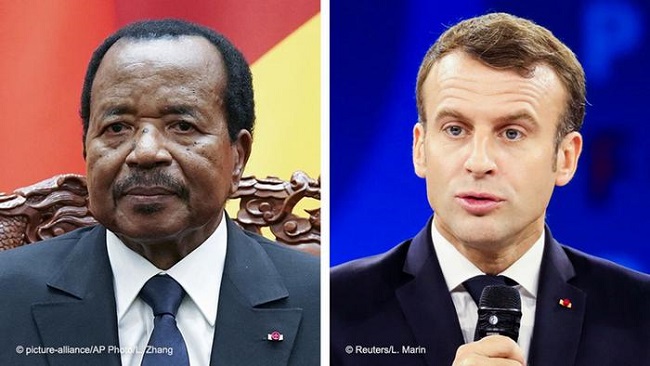
You are not our enemies. Ambazonians understand that as soldiers, you think you are defending your territory. Unfortunately, you are defending France. You are fighting for France and for Paul Biya who do not care about you. President Emmanuel Macron and President Paul Biya are using you. They are deceiving you. If you do not know, Biya and Macron are laughing at you. They see you all as fools. How can you be sent to go and kill innocent people and you are going?
Fellow brothers in the Cameroun military,
Tell Paul Biya it is over. Tell him you have killed innocent people and you are not ready to kill your brothers just to enrich France. Innocent soldiers have died because of President Biya’s and President Macron’s greed, lies and wickedness.
Fellow brothers and soldiers of La République du Cameroun,
As you know, children have lost their soldier parents who are fighting a senseless war. Many women have lost their soldier husbands in a war that makes no sense. Family members who have nothing to do with this war have lost relatives. You have been fighting to defend Paul Biya who has done nothing for his people in 39 years.
Our brother soldiers
You know soldiers defend a country led by a good President. Your allegiance as soldiers is not to the President, but to the people, and the country. Paul Biya is not a country. Paul Biya is corrupt and wealthy. He is a dictator who practices tribalism and kills anyone whom he dislikes. President Biya has destroyed a beautiful country. He is responsible for all what is happening in Cameroon and with your life.
It is your responsibility as soldiers to defend the people against a bad President. It is time for you to stop the war. It is time for you to end the fighting and drop down your arms. It is time for you to tell the government that you are not going to kill Ambazonians anymore.
To all Cameroonians. If you have a friend, a brother or a sister or a husband or a relative in the Cameroon army, advise them not to go to Ambazonia. They will die. Where are all the Beti soldiers? Why are all the Bulu soldiers hiding away from the war zone? Soldiers from Maroua, Ngaoundéré, Garoua, Adamawa, Yagoua and Kousseri should not fight for Paul Biya and France. Biya and France are responsible for the death of President Ahidjo. Paul Biya has locked up Mister Marafa in Kondengui. You people should stand up for Marafa. You should all stand against President Biya.
To our Bamiléké brothers and sisters,
Biya deceived you and you joined him to fight and kill our people. We Ambazonians protected your fathers of UPC who were being persecuted by France. Look at what Biya has done to Professor Maurice Kamto. You must all join forces with the northerners. Stop fighting for Biya. To the Basas and the Douala people. You must not join Biya. You must stand against Biya because France and Biya only care about Beti and Bulu people. Ambazonians are not your enemies.
Our brother soldiers
Put down your weapons and walk away. If Paul Biya and his generals insist, you know what to do next. Remember that your colleagues who have died at the battlefront were the unlucky ones. You are lucky to still be alive. Do not allow yourselves to end like your colleagues who are no more, and who shall never return to see their family members. This is the biggest opportunity for you. You just need to surrender now. If not, you will soon be a casualty. You will end up like your colleagues who have gone to hell and to return no more. This is the time to say ‘no’ to Yaoundé.
Do not be afraid. Do not be shy. Everything you do in life is a risk. Take the courage and surrender now. Do not go and kill innocent people. You will end up die in a war that makes no sense.
Let President Biya send his children to the war zone. Paul Biya’s children are out of the country enjoying beautiful life. Why are you fighting to defend someone who does not care about you? Biya does not care about you and your children. There are soldiers and government workers who do not have salaries. You are riding ben-sikin after school. All ben-sikin riders and taxi drivers and teachers in La République du Cameroun must stand up. From Maroua, Ngandere to Garoua through Bafoussam to Mbouda and Nkongsamba. You must all rise like one man. You should all join the military and chase out President Biya.
Colonel Bamkoui Emile Joël, Police Chief Superintendent Eko Eko Maxime Léopold and Brigadier General Nka Valère should take note. Go and tell Ferdinand Ngoh and Atanga Nji Paul that you cannot stand this war anymore. Yaounde must listen to you and you must not take orders from Yaounde anymore. Atanga Nji goes around with heavy military protection. Governor Lele L’Afrique and Governor Okala Bilai it is now time for you to leave Ambazonia. Take your colonial Divisional Officers and Senior Divisional Officers away from Ambazonia. The Ambazonia Independent Secret Service Squad does not do propaganda and does not make promises. We act and we do not make claims. That is why we are a Secret Squad. We hope you have understood us.
Our dear brothers in the Cameroun army
Look at Tanzania. Look at the good roads in Rwanda, and the good life people in Rwanda are living. Look at small countries like Botswana and Namibia. Look at the roads in South Africa. The whole of French Africa is useless; made up of useless and corrupt leaders and citizens who think poverty and hardship are normal. Even your own children do not have a good future. Poor roads, no water, bad hospitals, dilapidated school buildings and no jobs are what Biya has offered you in 39 years. What did you do to Paul Biya?
Why are you defending a criminal who hates you? It is time for you to repent. Go and pray to God to save you from this slavery. You are a slave to France. For how long will you keep being slaves? Biya, his family and his ministers have bought houses in Europe and America using your stolen money.
Our dear brothers in the military,
Ambazonians do not hate you. Ambazonians have the right to defend their territory. As you know, we Ambazonians asked Paul Biya for respect and equality. Biya decided to kill us, beat up our teachers and our lawyers, and his soldiers raped our children just to defend Biya. We are fighting back. We shall fight. You will not win this war. Ambazonia will win this war. You will be in your graves when we shall have our sovereignty if you do not surrender. We shall celebrate our victory and your children, mothers, brothers, sisters, and wives will be crying because they will say, you lost your life for nothing.
Our brothers in Cameroun
Why do you treat Biya like a God? Biya is laughing at you all. Biya does not care about you. Biya and Macron see you all as grown-up fools. You were a fool. After five years, you should not be a fool except you want to act like a fool. No amount of killing will stop Ambazonia from fighting back. So, why do you go for a war that you will not win? Do you remember Vietnam? Do you remember Afghanistan? In Syria, they thought they were going to win. They are not winning in Syria. You will not win in Ambazonia.
You should all put down your arms or turn them against the real enemy. The real enemies are Biya, Atanga Nji and France. Soldiers in other countries are living good life without war. You are in Ambazonia killing people who have committed no crime. You will all die in Ambazonia if you stay or go there.
Our brothers in La Republique du Cameroun
If La République du Cameroun was supposed to win this war, they should have won the war in 2017. You cannot win and you will not win. Paul Biya and the Betis are using you to stay in power. The Bulus and the Betis are enjoying while you are suffering.
Dear Cameroon soldiers
You must take the courage. Ambazonians do not hate people from Cameroun. We hate your government. And your government does not even treat you well. So, why fight to defend a President who thinks only about himself and his family? If you and all citizens of Cameroon stand against your President, you will have a better life for your children. Instead of Biya to offer you jobs, good health services, good roads, good schools, better electricity supply and portable water, he offers you bread, and sardine and you accept it.
Do not accept to be fools anymore. Paul Biya cannot be above you all. Mubarak reign came to an end because his soldiers told him it was enough. You should stop defending France. The most useless Africans are those that come from French-speaking African countries. You are all responsible for the poor living conditions of the African people. Africans deserve better. Cameroonians deserve better. Your wife, children, and grandchildren deserve better. Understand this! Biya, Betis, Bulus and Macron are your enemies.
You can make a difference in the lives of your children by turning against the criminals in the Cameroon government. Macron does not have children even. Let Frank and Brenda go and fight for Biya and Macron. Biya is the Commander-in-Chief of the Armed Forces. Let him go to Ambazonia and lead the military as late President Idris Deby of Chad did. We are waiting for Biya in Ambazonia. Tell Biya to go and fight as he is responsible for everything that went wrong in Cameroun and in Ambazonia.
This is the time to tell Biya that you will not go to Ambazonia anymore, and that you are not going to kill your Ambazonian neighbours/brothers.
Dear Soldiers of La République du Cameroun
Your enemies are not in Ambazonia. Your enemies are in Yaoundé and Paris.
Good luck to you and bad luck to Biya and his supporters.
NB: This public message is from the newly created Ambazonia Independent Secret Service Squad