25, June 2026
Martinez Zogo Affair: Missing phone remains a major gap in murder trial 0
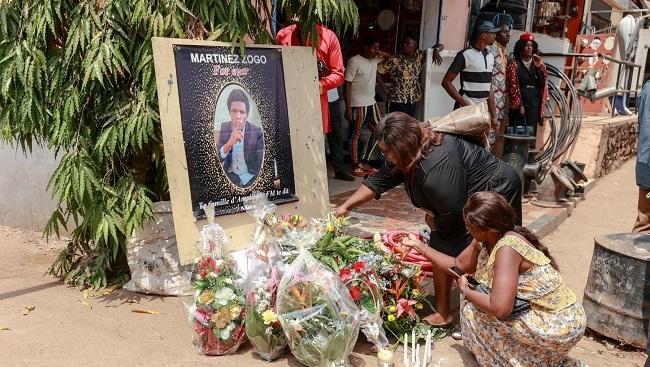
Digital evidence again took center stage on June 22 before the Yaoundé Military Court in the trial over the murder of journalist Martinez Zogo.
During further questioning by the government prosecutor, cybercrime expert Georges Bell Bitjoka reaffirmed what has become one of the central issues in the case: investigators never recovered the phone allegedly used by businessman Jean Pierre Amougou Belinga in exchanges with Lieutenant Colonel Justin Danwe, the former head of operations at the General Directorate for External Research (DGRE).
Military prosecutor Cerlin Belinga asked the expert to clarify which device had been used to exchange messages between the two men. Bitjoka told the court that investigators were never able to formally identify the phone used by Amougou Belinga.
Messages Recovered Only From Danwe’s Phone
According to the expert, investigators recovered deleted WhatsApp messages after examining one of Justin Danwe’s phones. They also identified frequent calls involving a recurring phone number. Using that number, investigators traced the unique identifier of the corresponding device, which Bitjoka described as an iPhone 12. He added that the phone had been located “at a gentleman’s home,” but investigators did not consider it necessary to recover it.
“We did not recover Amougou Belinga’s phone,” Bitjoka told the court. He added that, in his view, the device used for those exchanges had been “removed.”
An Incomplete Digital Investigation
The testimony builds on statements Bitjoka made during a June 1 hearing. At that time, he said investigators had examined only a limited share of the phones linked to Amougou Belinga. According to his testimony, less than 30% of the devices associated with the businessman had been analyzed, while a significant portion of his digital footprint remained either unidentified or inaccessible. The expert stressed that the digital mapping of Amougou Belinga’s communications remained incomplete and that potentially important evidence had never been fully recovered or examined.
An Indirect Digital Link
Bitjoka also testified that one of the phone numbers that communicated most frequently with Justin Danwe before Martinez Zogo’s abduction and murder on January 17, 2023, belonged to Amougou Belinga’s secretary. According to the expert, however, that phone had been completely reset before investigators received it. As a result, investigators were able to establish a technical link between Danwe and Amougou Belinga only through the deleted messages recovered from Danwe’s phone.
Even then, Bitjoka maintained an important qualification before the court. “I did not find explicit evidence linking Justin Danwe and Amougou Belinga regarding the Martinez Zogo case,” he testified.
A Key Issue for the Prosecution
The incomplete digital investigation continues to shape the case. While the recovered data strengthens suspicions surrounding communications between several defendants, the absence of the phone allegedly used by Amougou Belinga prevents investigators from directly examining what could have been a critical part of the evidence.
The issue extends beyond a technical question. It goes to the strength of the prosecution’s case. Earlier in the trial, another cybercrime expert, Jean Pierre Ouloumou, testified that phones presented as belonging to Amougou Belinga contained no data.
At this stage of the proceedings, the June 22 hearing has highlighted one of the prosecution’s biggest challenges. Investigators have reconstructed part of the digital exchanges, but without full access to the devices allegedly used by one of the case’s main defendants.
In a trial where electronic evidence plays a central role, that gap continues to fuel both suspicion and questions about the completeness of the prosecution’s case.
Source: Sbbc


















26, June 2026
$1.12 billion highway for Cameroon 0
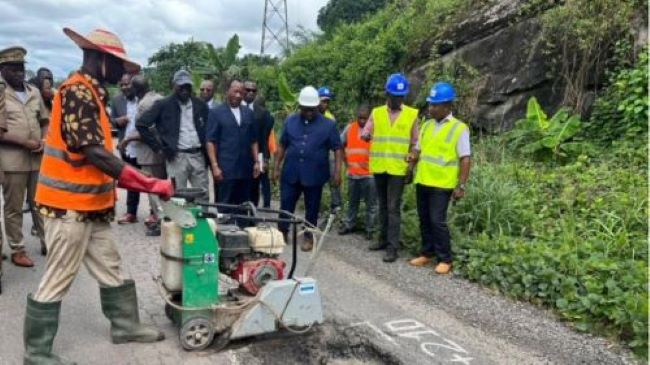
The World Bank has approved a $1.12 billion project to upgrade the Douala-Bangui Corridor in Cameroon. This will be carried out under the Multiphase Programmatic Approach (MPA) programme.
The Douala-Bangui Corridor is of importance to Cameroon as well as the neighbouring Central Africa Republic (CAR), so the project will deliver major benefits to both nations for transport and economic growth. Carrying up to 80% of Cameroon’s goods transport, the route is crucial for the region. But years of neglect have resulted in the road surface becoming deteriorated and in poor condition.
The first phase will be worth $525 million and will be used to upgrade infrastructure, road safety, and road maintenance.
Source: Global Highways