23, June 2026
Football: Algeria beats Jordan 2-1 to clinch its first World Cup win since 2014 0
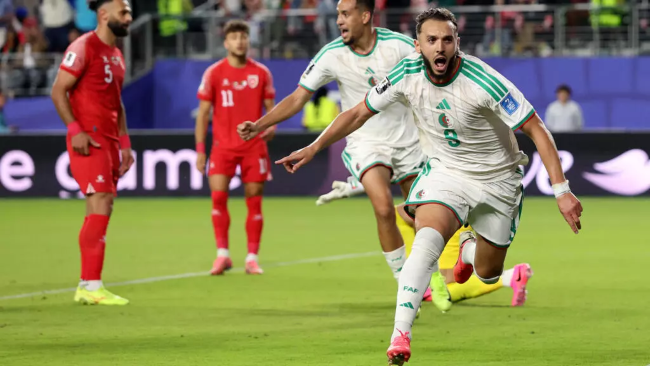
Algeria scored off two corner kicks in the second half to rally from an early deficit and defeat Jordan 2-1 on Monday night to bolster its chances of advancing to the knockout round of the World Cup.
Second-half substitute Nadhir Benbouali headed in a corner kick in the 69th minute and Amine Gouiri provided the game-winner in the 82nd to give Algeria its first win at the World Cup since 2014.
The Jordanians had taken the lead for the first time at a World Cup on a first-half goal by Nizar Al Rashdan but couldn’t withstand the continual pressure from Algeria in the second half.
This marked the first time Algeria had ever won a World Cup game after conceding the first goal. They had seven losses and two draws previously when that happened.
Algeria bounced back after a 3-0 to Argentina in its opening game and can finish second in Group J – and clinch a spot in the knockout round – with a win on Saturday against Austria.
Jordan is out of contention for the knockout rounds with a second straight loss. It opened with a 3-1 defeat to Austria but put up a strong effort in its first appearance on soccer’s biggest stage.
Momentum clearly swung after Benbouali equalized when Riyad Mahrez’s corner kick found him in the middle of the box and he sent a header into the corner that Yazeed Abulaila couldn’t stop.
Algeria kept up the attack and took the lead when Gouiri got a touch on a ball in the box that deflected off Abulaila and into the net, setting off an Algerian celebration with their fans just behind the goal at Levi’s Stadium.
Source: AP












23, June 2026
Owona Nguini’s attacks on Samuel Eto’o are becoming increasingly unconvincing 0
Professor Mathias Éric Owona Nguini is among the many French Cameroun political elites facing war crime charges in Southern Cameroons. The so-called professor has every right to criticize the leadership of the Cameroon Football Federation (FECAFOOT) and its president, Samuel Eto’o.
Frankly speaking, healthy debate is essential in football administration. However, Owona Nguini’s recent attacks increasingly appear driven more by personal and political motives than by a balanced assessment of the realities facing Cameroonian football.
In the aftermath of the Indomitable Lions’ failure to qualify for the 2026 FIFA World Cup, Owona Nguini publicly blamed the Cameroon Football Federation and Eto’o for the disappointment. The Cameroon Football Federation responded by rejecting his accusations and defending its role during the qualification campaign.
What is very disturbing is that the so-called professor’s interventions rarely come with practical solutions. Cameroon football has suffered from administrative conflicts, CPDM government interference, poor infrastructure and institutional rivalries for decades. Reducing every problem to Samuel Eto’o is an oversimplification that ignores the broader challenges that existed long before Eto’o arrived at FECAFOOT and deliberately ignoring the destruction that was caused by Owona Nguini’s late dad Professor Joseph Owona and his gang during their time at the FIFA Normalization Committee.
Many football commentators and observers are beginning to wonder whether Owona Nguini’s constant criticism is linked to a desire to maintain the influence once exercised by his late father within Cameroonian football circles. Whether that perception is fair or not, the so-called professor’s repeated attacks risk looking like a campaign against a man rather than a constructive contribution to football governance in Cameroon.
Samuel Eto’o’s tenure has not been free of controversy. He has faced criticism and disciplinary issues during his time as FECAFOOT president, and those matters deserve scrutiny. But criticism should be accompanied by credible alternatives and concrete proposals.
For those who do not know like Owona Nguini, Cameroon football does not need endless personal battles. It needs ideas, reforms and unity. If Mister Owona Nguini wants to be taken seriously as a stakeholder in the future of the Cameroonian game, he should spend less time launching personal attacks and more time presenting solutions. So far, many of his interventions have generated headlines and controversy, but little in the way of a roadmap for improving Cameroonian football.
The future of the sport in Cameroon will not be built through nostalgia, Owona family legacies or media confrontations. It will be built through competence, accountability and results—standards that should apply equally to President Samuel Eto’o, CPDM Professor Owona Nguini and anyone else seeking influence in the Cameroonian game.
By Soter Tarh Agbaw-Ebai