3, May 2022
Southern Cameroons Crisis: Archbishop Nkea says Cameroonians, not foreigners, causing country’s problems 0
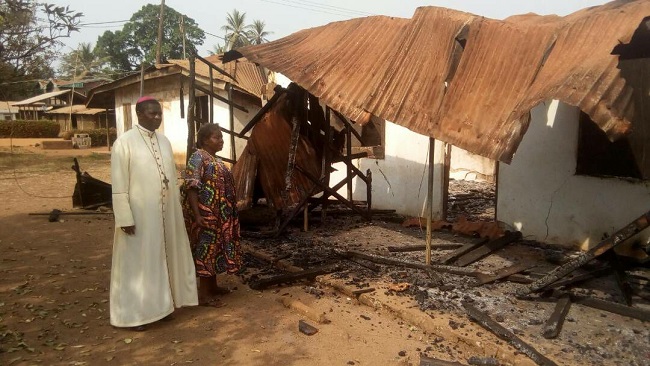
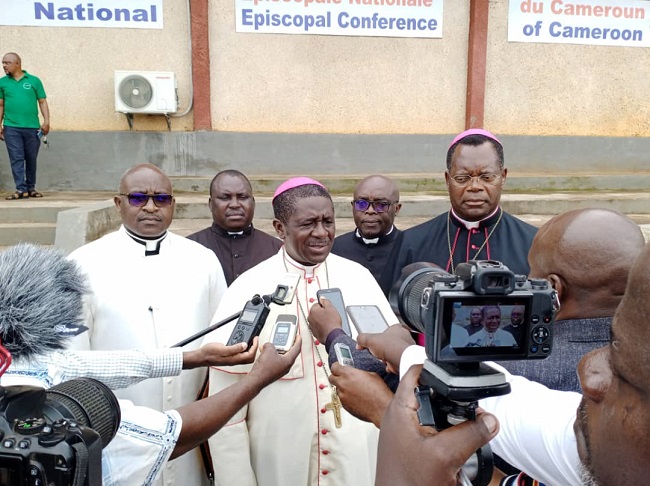
Archbishop Andrew Nkea Fuanya of Bamenda, the newly-elected president of the Bishops’ Conference of Cameroon, says Cameroonians must “look to themselves” when dealing with the various crises facing the country.
Cameroon is facing a separatist war in the west, Boko Haram attacks in the north, a refugee crisis in the east, as well as rising insecurity across all parts of the country.
Speaking on April 30 at the end of the bishops’ conference’s 47th plenary assembly, Nkea said the crises in Cameroon are not caused by some foreigners, but by Cameroonians. He invited his countrymen to own up to their responsibilities.
Nkea’s archdiocese is in the heart of the country’s English-speaking North West Region, where separatists are seeking independence, citing discrimination by a central government dominated by the French-speaking majority.
“We pray as hard as all depends on God, and we work as hard as all depends on us. Peace will come at God’s time. Our role is to pray and remain open to the will of God and to work doubly hard to make sure that peace reigns amongst us,’ Nkea told Crux.
“That is why I say that everyone is supposed to look at themselves personally, not to look at the community, not to look at others. Each person needs to ask himself/herself: What is my responsibility in fostering this crisis situation in our country, and how can I work doubly hard to restore peace? This is a matter of individual responsibility, and at the same time a collective responsibility. It’s not people from outside who have come to take away our peace. It is we who have taken away our own peace. We can bring that peace back to the peace,” he said.
The archbishop spoke to journalists alongside Bishop Philippe Alain Mbarga of Ebolowa, the newly elected vice president of the bishops’ conference.
“Our mandate is to work and seek peace in Cameroon,” Nkea said.
Mbarga emphasized the bishops’ commitment to service.
“We are just but humble servants to the Church and the people of God in Cameroon. We are at the disposal of the bishops of Cameroon and the population of our country,” the bishop said.
Although the country is facing several problems, the most challenging remains the separatist war in the North West and South West regions.
People from the two regions have long complained about decades of marginalization by the predominantly Francophone administration in Yaoundé.
The simmering tensions exploded in 2016 when teachers and lawyers in the two regions held protests over what they considered government efforts to assimilate the British-based education and common law systems practiced in the areas.
Government soldiers responded with lethal force, leading to an armed uprising. The fighting has dragged on now for six years, leaving over 4,000 people dead, and more than a million displaced.
In addition, thousands of children have gone without an education due to a schools boycott enforced by the separatists.
“If our children don’t go to school, then we don’t know the kind of future we are preparing for them,” said Susan Neh, a member of the Catholic Women’s Association.
“We can’t possibly stand by and watch the future of our children being mortgaged this way. We hope Mother Mary, to whom our country has been re-consecrated, will help restore peace to our country,” she told Crux.
Archbishop Jean Mbarga of Yaoundé said any sustainable solution to the problem hinges on a return to peace.
“Without peace, no solution can be found,” he told Crux.
“That is why the Church has decided to pray non-stop for peace to return to the North West and South West regions. The Church has been participating in dialogues to search for solutions, but only prayer can bring about sustainable peace,” the archbishop said.
Adolph Lele L’Afrique, a Catholic and governor of the North West region, told Crux all human endeavors without God’s blessing will come to naught.
“We are all turning to God our creator. It’s obvious that without Him, we labor in vain. Whatever we are doing, we are doing under His control, under His supervision. … We hope that a new page in the history of this country will be open, and as Christians, we must be endeavoring to be agents of peace wherever we go. Whatever God authorizes, is the way to solve the problem,” he said.
Culled from Crux









3, May 2022
Cho Ayaba Criminal Gang: Pro Yaoundé senator kidnapped in Bamenda 0
A senator from President Paul Biya’s ruling party has been kidnapped along with her driver in Cameroon’s troubled anglophone northwest, military and administrative sources said Monday.
“Elizabeth Regina Mundi was kidnapped late Saturday morning by terrorists in Bamenda,” capital of the northwest, a senior official with the region’s governor told AFP.
He said two wings of the separatist Ambazonian Defence Forces (ADF) had claimed responsibility for the abduction. Ambazonia is the republic the rebels would like to proclaim after independence.
One called for the release of some of its detainees, the other sought a ransom, he added, asking to remain anonymous.
“The senator was going from Bamenda to her village for a funeral, the separatists kidnapped her and her driver on the road” said a regional army official, confirming both demands.
A video on social media, dated Saturday and verified by the senior regional official, shows Regina Mundi clearly forced to read a statement in English calling for the independence of the Ambazonia republic.
She is from the northwest and is a member of the politburo of Biya’s Cameroon People’s Democratic Movement (RDPC).
The “Ambazonians” carry out frequent kidnappings, usually of civil servants, and some are killed. Church leaders and politicians have also been adducted, but mostly later freed.
In January, the bullet-riddled body of opposition senator and lawyer Henry Kemende was found in Bamenda.
The authorities accused the separatists of his murder but no one claimed responsibility.
Cameroon’s northwest and southwest are populated mainly by the anglophone minority in the predominantly French-speaking country.
The country has been ruled with an iron fist for nearly 40 years by 89-year-old Biya, who has cracked down on the rebellion.
In the past five years, after the repression of peaceful demonstrations accusing Yaounde of ostracising English speakers, armed separatists and the military have clashed repeatedly.
Civilians have suffered abuses committed by both sides, according to international NGOs and the UN.
The conflict has killed more than 6,000 people and displaced around a million, according to the International Crisis Group (ICG) think-tank.
Source: AFP