29, April 2022
Former tennis star Boris Becker sentenced to jail by UK court over bankruptcy 0
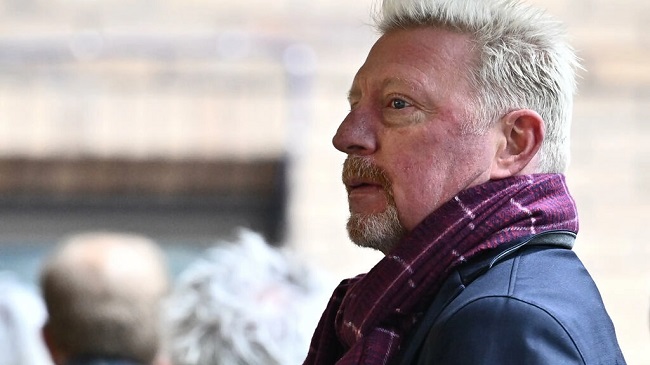
Former tennis star Boris Becker was on Friday jailed for two and a half years after being found guilty by a British court of charges relating to his 2017 bankruptcy.
The six-time Grand Slam champion, 54, will serve half of the term having been convicted at Southwark Crown Court in London over his transfer of huge amounts of money from his business account.
He also failed to declare a property in Germany and concealed 825,000 euros ($866,500) of debt and shares in a tech firm.
He was acquitted earlier this month of a further 20 charges, including nine counts of failing to hand over trophies and medals he won during his glittering tennis career.
Becker told jurors he did not know the whereabouts of the memorabilia, including two of his three Wimbledon men’s singles trophies.
Judge Deborah Taylor had released Becker – who won Wimbledon as an unseeded teenager – on conditional bail ahead of her sentencing decision on Friday.
He arrived early for the hearing, wearing a striped purple and green tie in the Wimbledon colours, a white shirt and a charcoal grey suit.
He held hands with his partner Lilian de Carvalho Monteiro as he walked into court past a bank of waiting reporters and cameras.
The former world number one told the jury how his $50 million (£40 million) career earnings were swallowed up by a costly divorce from his first wife Barbara Becker, child maintenance payments and “expensive lifestyle commitments”.
Becker said he was “shocked” and “embarrassed” when he was declared bankrupt in June 2017 over an unpaid loan of more than £3 million on his estate in Mallorca, Spain.
The German, who has lived in Britain since 2012, said he had cooperated with trustees trying to secure his assets, even offering his wedding ring, and relied on the advisers who managed his life away from tennis.
But the former player, who was supported in court by his partner and eldest son Noah, was found guilty of four charges under the Insolvency Act.
‘Vast amount’
Giving evidence, Becker said he earned a “vast amount” of money during his career, paying cash for several properties.
But the German, who went on to coach current world number one tennis player Novak Djokovic, work as a TV sports commentator and act as a brand ambassador for firms including Puma, said his income “reduced dramatically” following his retirement in 1999.
Becker, who was resident in Monte Carlo and Switzerland before moving to the UK, said his financial commitments included his £22,000-a-month rented house in Wimbledon, south-west London.
He also owed the Swiss authorities five million francs (about $5.1 million) and separately just under one million euros in liabilities over a conviction for tax evasion and attempted tax evasion in Germany in 2002.
He said bad publicity had damaged “brand Becker”, meaning he struggled to make enough money to pay off his debts.
His lawyer Jonathan Laidlaw said at the time of his bankruptcy that Becker was too “trusting and reliant” on his advisers.
Becker, with a shock of strawberry-blond hair, shook up the tennis world in 1985 when he became Wimbledon’s youngest men’s singles champion at 17 and repeated the feat the following year.
Nicknamed “Boom Boom” Becker for his ferocious serve, he won Wimbledon for a third time in 1989.
He also won the Australian Open twice and the US Open during his glittering career, becoming the top-ranked player in the world in 1991.
Becker turned to commentary after his retirement, landing a high-profile role on the BBC, but he returned to the court in 2013 to guide Djokovic, helping the Serb win six more Grand Slam trophies before the pair parted ways in 2016.
Source: AFP






















29, April 2022
Four months on, an ongoing nightmare for MSF colleagues detained in Southern Cameroons 0
Four months ago today, Marguerite M. and Ashu D. plunged into a nightmare which continues. They are Médecins Sans Frontières (MSF) staff; Marguerite a nurse and Ashu an ambulance driver, in the South-West region of Cameroon. The area is impacted by violence that started almost five years ago, between separatist armed groups and state armed forces, where MSF provides access to free healthcare to people.
On the morning of 26 December 2021, Marguerite and Ashu were sent with an MSF ambulance to the Tinto area to pick up a man with a gunshot wound. While the vast majority of MSF ambulance movements are not related to the impact of the violence – most are linked to the urgent transport of children with malaria, women in labour or those injured in road accidents – taking care of victims of gunshot wounds is not unusual for MSF in the area. Yet, Marguerite and Ashu could not have imagined what awaited them this time.
The ambulance had some trouble locating the injured man, but finally found him at around eight o’clock in the morning. They stabilised him and put him in the ambulance, which then headed towards Kumba, in case the patient needed to be transferred to a higher-level hospital for complex surgery. The 27-year-old patient had no identification documents, which is not uncommon in Cameroon.
MSF communicated, as agreed with the authorities, this movement: the departure point of the ambulance, its destination, the type of patient it was transporting, whether or not the patient had an identity document, and whether or not they were accompanied by anyone. Despite this not being standard MSF practice, this procedure was vital in this context to prevent ambulances from being blocked at checkpoints for long periods of time, which could be detrimental to patients. Since October 2021, when the procedure for communicating with the authorities was formalised, 132 MSF ambulance transfers involving patients in various emergencies have taken place without any problems.
Neither Marguerite nor Ashu knew who the patient was, or what was his role within the separatist group. They only knew that he was a wounded man in need of medical emergency assistance. The ambulance set off at around nine o’clock in the morning, with Ashu driving and Marguerite in charge of the patient. She began to fill in the transfer forms on the patient that would later be handed over to the hospital in Kumba. While Marguerite was still filling in the form with the name given by the patient, they were stopped at the Nguti checkpoint.
Despite the explanations they gave, they were denied passage, ordered to turn around and escorted back to Mamfe. The two MSF colleagues were subsequently arrested and detained in Buea prison, where they remain four months later.
Culled from MSF