9, March 2026
Biya regime secures $195 million loan to expand national fiber backbone 0
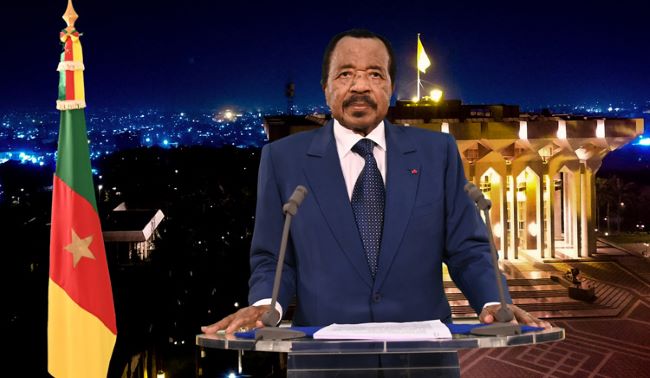
Cameroon’s President Paul Biya signed a decree on Friday, March 6 authorizing the Minister of Economy, Planning and Regional Development to finalize a loan agreement of about 1.35 billion yuan (around $195 million) with the Export-Import Bank of China. The funding will support phase four of the country’s national fiber optic backbone expansion.
A fiber network built gradually since 2011
The financing continues Cameroon’s national fiber deployment program, launched more than a decade ago to build a nationwide data transport network. According to the Ministry of Posts and Telecommunications, about 6,000 km of fiber were installed between 2011 and 2016 during the first two phases of the project.
A third phase completed in 2017 added another 4,000 km, bringing the national network to around 10,000 km. An additional 1,000 km were deployed along the Chad-Cameroon oil pipeline.
Since then, further extensions, cross-border interconnections, and additional deployments by public and private operators have continued to expand the network. Cameroon now has more than 15,000 km of fiber infrastructure connecting regions across the country and linking with several neighboring states, including Chad, Gabon, Equatorial Guinea, the Central African Republic, and Nigeria.
Infrastructure still underused
Despite the steady expansion of this infrastructure over the past decade, its use remains limited, and the quality of connectivity continues to draw criticism from users.
According to DataReportal’s latest figures for early 2026, internet penetration in Cameroon stands at about 45%. The data highlight a gap between a relatively strong backbone network and limited last-mile access for many of the country’s 12.6 million internet users.
Phase four of the project is expected to address these disparities by expanding distribution networks to better connect government institutions, businesses, and rural areas that remain poorly served.
A strategic pillar for the digital economy
Completing the national backbone is seen as a key step for the growth of Cameroon’s digital economy and the structural transformation outlined in the country’s National Development Strategy 2020–2030.
Expanding fiber infrastructure is considered essential for supporting tech startups, digital services, e-commerce platforms, and the digitalization of public services.
The renewed partnership with the Export-Import Bank of China, which has already financed several earlier phases of the project, underscores the government’s ambition to strengthen nationwide coverage and accelerate digital inclusion.
Source: Business in Cameroon
















10, March 2026
Manyu Solidarity Group: understanding its modus operandi 0
Ma Druscillia Achuo, a respected and committed member of the Manyu community in London, once delivered a line that has since taken on near-philosophical status among Manyu people in the UK. She said, “When you get die, and you know say £10,000 di come for support you, the cry di different”. Translated loosely, it means, the tears will fall during grief, but at least the panic lessens. Her words may sound humorous, but they capture a truth many Manyu people in the diaspora understand all too well. When someone dies in the West, grief rarely travels alone. It arrives with invoices from funeral directors and in some cases outstanding bills and unpaid debts. It is not an exaggeration to say, in many circumstances, dead of a loved one has even become thornier and embarrassing.
For many in Europe, the loss of a loved one sets off a chain reaction of difficult questions. Do we hold the funeral in Europe, or do we repatriate the body to Cameroon? If the answer is repatriation, the next question arrives immediately, how do we pay for it? And how do we support the family back home with expenses? Sorrow, in other words, quickly transforms into worry, stress and a long list of problems that seem to arrive precisely when people are least equipped to deal with them.
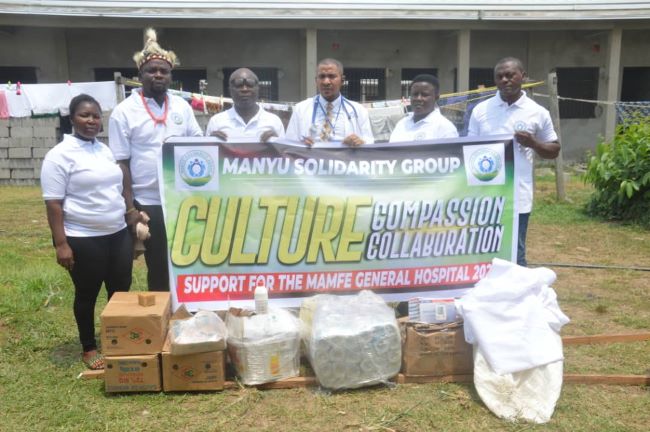
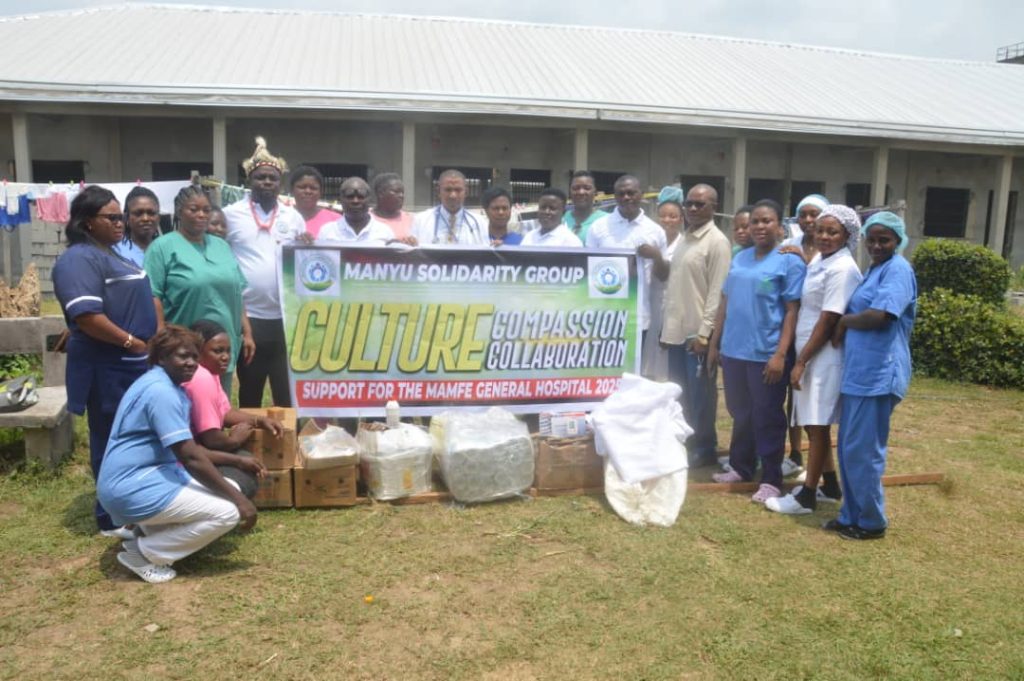
This is where organizations like the Manyu Solidarity Group quietly step in. Manyu Solidarity Group, founded in 2021 by Manyus and friends of Manyu in Europe, offers practical support before the funeral of a fallen member. While many bereavement associations prefer to present their financial package during the wake or funeral itself, often with ceremonial speeches, Manyu Solidarity Group has adopted a refreshingly simple approach. They send the money early.
Manyu Solidarity Group delivers £10,000 to the bereaved member’s nominated next-of-kin at least two weeks before the funeral with no dramatic presentations. Funeral homes cost and the cost of the wake require payment before service. Therefore, offering financial support during the wake is like arriving at Douala Airport with a plane ticket after the Camair-co flight has already departed. It may be well intentioned, but its practical value is somewhat limited.
Manyu Solidarity Group releases the funds early so that families can organize dignified funerals without scrambling to raise money while still processing their loss. So far, this approach has already made a tangible difference. In less than three years, the group has provided £30,000 in bereavement support to three different families. That may not make headlines in the world of billion-pound transactions, but within the Manyu diaspora community, it is significant.
Grief is already overwhelming, so Manyu Solidarity’s philosophy with its Manyu Bereavement Support Fund (MABSOF) is simple; support should actually support. The organization is the classic community safety net, but perhaps the most notable aspect of the system is its refusal to turn grief into a public spectacle. The Board of Manyu Solidarity understands that loss is not just emotional; it can also be financially devastating. Manyu Solidarity Group is a community in its most practical form and perhaps that is why Ma Druscillia Achuo’s remark continues to resonate. Her observation may have been delivered with her typical smile, but its wisdom is difficult to dispute. Knowing that help is coming does not erase grief, it does not bring the deceased back, but it does remove one layer of anxiety at a moment when people are already carrying more than enough.
At its core, the principle guiding Manyu Solidarity Group is beautifully straightforward. Families need help in organizing wakes and funerals, give them the support before, not during the wake or burial because compassion is not measured by how publicly it is displayed, it is measured by timing, dignity and quiet common sense.
To this I put my name
Soter Tarh Agbaw-Ebai