
29, January 2021
African Nations Championship in Cameroon: Rich in Armored tanks, pick-up trucks and heavy weapons 0
Ahead of the football tournament the African Nationals Championship in Cameroon, one initial incident forced Cameroonian authorities to impose strict security measures in the North-West and South-West provinces to ensure the games will go on.
The Cameroonian defence and security forces are particularly vigilant in the English-speaking regions, especially in the South-West, where the African Nations Championship (CHAN) is taking place until 7 February.
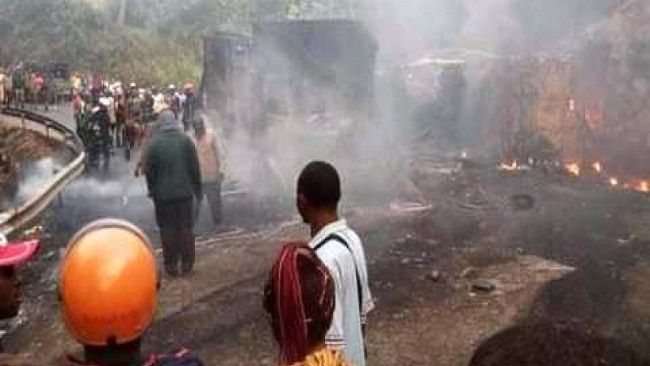
After the fire in front of one of the training stadiums in Limbe – allegedly caused by separatists on the eve of the tournament – Joseph Beti Assomo, the minister in charge of defence, decided to strengthen the security measures for CHAN 2021, introduced on 8 January.
Armoured tanks, pick-up trucks and heavy weapons
Under the leadership of a trio made up of Air Brigade General Benoît Eba Eba, commander of the second joint military region, General Elias Toungue, commander of the second gendarmerie region, and Colonel Séverin Eyenga, commander of the 21st motorised infantry brigade based in Buea (South-West), the personnel deployed on the ground have been reinforced and distributed around the host cities, hotels and stadiums.
The troops are supported by an armoured tank and pick-up trucks equipped with heavy weapons. Five checkpoints have been set up around the Limbé stadium and the presidential guard dogs have also been made available to detect dangerous objects. In the Fako department, the prefect has banned the use of motorbike taxis – which are the preferred mode of transport for the separatists – until further notice.
Biya’s commitment
Beti Assomo has informed President Paul Biya of these new provisions. On 15 January, the Head of State had guaranteed the officials of the Confederation of African Football (CAF) and the International Federation of Association Football (Fifa) that measures would be implemented to ensure the success of the tournament.
However, not all bets are off. While no major incident has been reported so far, a bomb did explode on 26 January near the Rwandan team’s training camp that wounded three on-duty policemen. After the first round, Limbe is expected to host a quarter-final match and one of the two semi-finals of the tournament.
Culled from the Africa Report
















29, January 2021
Thousands are suffering; many are out of reach of aid, CHAN highlights just how pervasive the Southern Cameroons conflict has become 0
African Nations Championship (CHAN) continues in Cameroon despite Ongoing conflict. Cameroon’s government has deployed its troops to serve as security for the African Nations Championships (CHAN), which began on January 16, 2021, citing concerns of violence from threats levied by separatist groups.
The factions vow to stop the football matches in English-speaking regions, just the latest development in a nearly five-year-long armed conflict. The Cameroonian government, led by Paul Biya and regional governors of English-speaking areas such as Bernard Okalia Bilai in South West Cameroon, is ensuring the public that games will be played in safety (Africanews 2021). Securing the games is a complicated endeavor, though, because it forces officials to guard against hazards from the ongoing COVID-19 pandemic as well as the possibility of violence from dissenters.
While the Cameroon people are, sadly, somewhat accustomed to violence stemming from Boko Haram that grips the Northern part of their Nation, they now face an increasingly dangerous conflict from the separatists. Cameroon’s government officially declared war against the Anglophone separatist movement at the end of 2017, yet the conflict continues. As of 2019, as many as 20 emerging separatist groups, including the Ambazonia Military Forces (AMF), joined the fight to carve an independent nation out of Cameroon along the Country’s Nigerian border (Foreign Policy 2019). It has drawn little international attention despite the displacement of hundreds of thousands of people since the beginning of the Nation’s internal struggle in 2016 (UN 2020).
The Anglophone Conflict has pitted Cameroon’s two English-speaking regions, the Northwest and Southwest, against the Francophone-dominated government. It began due to frustration and resentment toward the French-speaking government among Cameroon’s English-speaking communities due to what they see as systemic, Anglophonic discrimination in the Country’s education and legal systems. The government violently cracked down on Anglophone minority protests five years ago, and these disputes soon turned into a full-fledged armed conflict in 2018 (IDMC 2020).
Aggression has not been one-sided, however, as the separatist groups have launched many attacks. In October 2020, it was likely a group of these fighters who attacked an international bilingual school, Mother Francisca, in the Southwestern region of Cameroon that killed eight children and injured a dozen more (UN 2020). In response to these types of raids, government forces have often resorted to using live ammunition, detainment, torturing, and other tactics on English-speaking, military-aged men and those they suspect to be AMF collaborators.
In addition to these human rights violations, the vital economic and military routes from Cameroon to Nigeria have become the primary pathways for refugees fleeing unrest caused by both separatist and government forces.
Innocent civilians in rural areas are suffering, and many are out of reach of aid organizations (FP 2019). The fighting is displacing Anglophone and Francophone communities. This upheaval has depopulated vast rural, Anglophone regions and brought the combat closer to urban centers (FP 2019).
Cameroon Football Federation in the English-speaking southwest region, are working with government officials to keep the CHAN events safe. Thus far, this has been relatively effective. A year-long pandemic, years of Boko Haram terror in the North, and other pressing issues facing Cameroon notwithstanding, the main priority during CHAN will be continuing to prevent the separatist threats of violence from materializing. This reality highlights just how pervasive this conflict has become.
Source: The Organization for World Peace