12, March 2020
Champions League: Liverpool sunk by Atletico extra-time triple 0
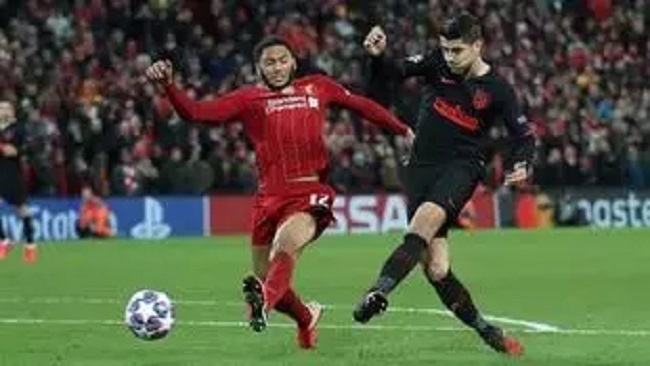
Holders Liverpool crashed out of the Champions League in the last 16 after Atletico Madrid scored three goals in extra time to earn a shock 3-2 victory at Anfield on Wednesday that sent them through 4-2 on aggregate.
After falling 2-0 down on the night, substitute Marcos Llorente struck twice in extra time and Alvaro Morata added a late third to ensure a famous victory for Diego Simeone’s side against a Liverpool team unbeaten in their last 25 home games in European competition.
Premier League leaders Liverpool enjoyed the greater possession, created more chances, drew a series of saves from Atletico keeper Jan Oblak and scored through Georginino Wijnaldum and Roberto Firmino.
Yet after last season’s memorable comeback by Liverpool against Barcelona in the semi-finals, it was the Spaniards who turned the tables this time.
Simeone’s Atletico are famed for their defensive solidity and their superb organisation and those qualities were on full display, but it was their clinical finishing and remarkable spirit that proved the key elements.
“We don’t know where our limit is,” said Llorente who had only scored once for Atletico before this game.
“We all defended until the death and when a team all digs in like this, things like this happen. I cannot describe this feeling,” he said.
Liverpool manager Juergen Klopp was not impressed with Atletico’s approach, however.
“I don’t understand with the quality they have the football they play. They could play proper football but they stand deep and have counter attacks,” said the German.
“We accept it of course but it doesn’t feel right tonight,” he said.
After allowing an early chance for Diego Costa, which the former Chelsea forward drove into the side-netting, Liverpool, trailing 1-0 from the first leg, laid siege to the Atletico goal.
They powered forward in waves of attacks but Atletico were resilient with central defenders Stefan Savic and Felipe foiling everything Klopp’s side threw at them.
The home team broke through two minutes before halftime when Alex Oxlade-Chamberlain burst to the byline and pulled back a cross to Wijnaldum who powered an angled header into the bottom corner.
Little change
There was little change to the pattern of the game after the interval with Liverpool peppering Oblak’s goal but the Slovenian proved himself up to the task, denying efforts from Mohamed Salah, Firmino and Sadio Mane while Andy Robertson headed against the bar.
Atletico thought they had grabbed a stoppage-time winner when Saul Niguez headed in a Renan Lodi cross but the effort was rightly flagged for offside, ensuring the game went to extra time.
It took just four minutes for Liverpool to take the lead in the tie with Firmino heading against the post and driving home the loose ball as Anfield got ready for a night of celebration.
Yet then it all went wrong for Klopp’s side.
Goalkeeper Adrian, standing in for the injured Alisson Becker, passed the ball out straight to Joao Felix who fed Llorente and the substitute punished the Spanish keeper with a precise shot into the far corner.
Llorente produced a carbon-copy finish following good work on the counter from Morata to end Liverpool’s hopes of defending their European crown.
Morata put the icing on the cake in the final moments with a cool finish after Liverpool had thrown all their players forward.
The pain of this exit will surely ease for Liverpool, who are 25 points clear in the Premier League and will soon win their first domestic league title for 30 years.
But for Atletico, who have never won Europe’s premier club competition, this was a triumph which will have them dreaming of even greater things.
“This will go down in our history,” said Simeone.
“It fills us with pride as a club, to be once more one of the top eight clubs in Europe.”
(REUTERS)























12, March 2020
COVID-19: International Conference on the armed conflict in Southern Cameroons postponed 0
The Coalition for Dialogue and Negotiation(CDN), has concluded consultations with Washington D.C. local health officials and George Washington University event management team about the ongoing spread of COVID-19 and the prospect of holding the three (3) day “International Conference on the Armed Conflict in the Southern Cameroons” at the George Washington University from March 19-21, 2020.Putting the safety of all participants first, the Coalition hereby announces its decision to postpone the conference to June 18-20, 2020 at the same venue. During this time the Working Groups will continue to meet and deliberate.
The Coalition also assessed current measures, including online classes and work from home options, taken by different universities and corporate institutions in the U.S. and worldwide, limiting travel by staff and in some cases their families. These life saving measures impact the ability of many conference participants to travel within the U.S. and from around the world to the U.S. As we closely monitor the evolution of actions taken by the U.S. and other governments, we will continue to build momentum for the conference as well as maintain pressure for the international community to engage forcefully to end the ongoing armed conflict in the Southern Cameroons.
Continued fighting in the Southern Cameroons has since 2017 reportedly resulted in more than 12,000 deaths, arbitrary arrests, and imprisonment of Southern Cameroonians. The government of Cameroon reported the killing of at least 700 of its security forces and administrative personnel. Over 300 villages have been razed forcing the displacement of more than 900,000 and over 60,000 seeking refuge in other countries including Nigeria and the United States. An estimated one million children have been unable to attend school for the past three years, and approximately 1.9 million face severe hunger. Several attempts of the government of Cameroon to quench the armed conflict without addressing the root causes have continue to fail.
The Coalition will keep you updated with every new information pertaining to this armed conflict and the international conference. The conference website https://aic.coalitionfdn.org/will also be updated regularly.Thank you for your support and we look forward to seeing you in June 2020. We are deeply sorry for the inconveniences this postponement may cause you.
Sincerely,
For the Steering Committee,