7, March 2020
Cameroon’s language war 0
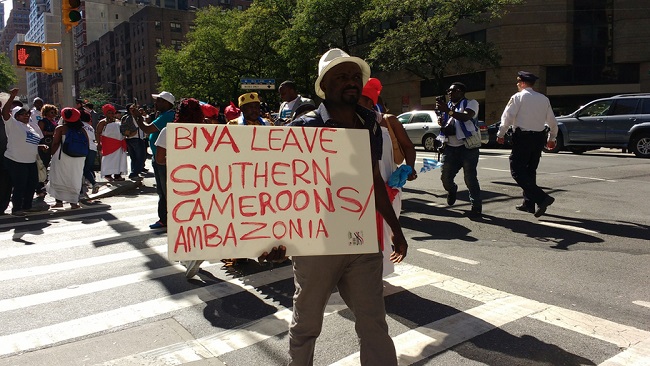
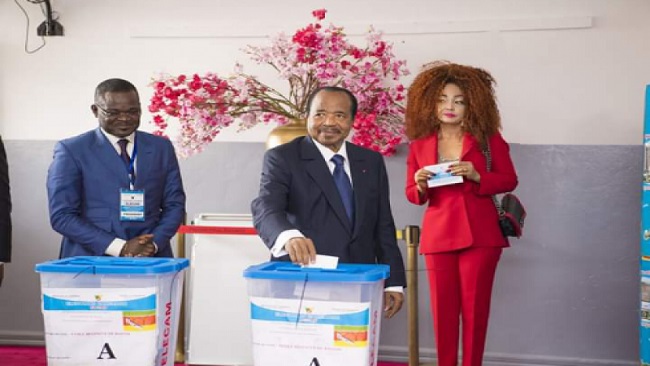
President Paul Biya of Cameroon is, in many ways, your bog-standard African “authoritarian ruler”, or, as diplomats don’t say, “dictator”. He has held on to power for almost forty years and is now in his seventh term as head of state, the oldest and longest-standing ruler in Africa. In 1983, as sole candidate, he won 99.98 per cent of the votes. He followed the example of other one-party states in the 1990s, allowing opposition parties to emerge and simply rigging subsequent elections.
At present, his troops are committing atrocities against an embattled English-speaking minority. They are rampaging through English-speaking villages in a French-speaking country whose economy is de facto controlled by French companies (over a hundred in almost all sectors including off-shore oil).
Cameroon has a civil war on its hands. Anglophone grievances came to a head in 2016, when the Francophone-dominated regime imposed French-speaking judges on Anglophone courts and Francophone teachers in Anglophone schools. Swiss and Commonwealth representatives have tried to mediate but President Biya thinks he can solve his problem militarily and has told both, in no uncertain terms, to go away.
Until 1960, there were two Cameroons. The larger territory was governed by France using the French legal and education systems and language. But in the smaller south and west territories, English common law took precedence, with English judges and English school exams. The present conflict dates back to decolonisation in 1961, when a UN-backed independence referendum offered the Anglophones the choice between joining Nigeria or joining French Cameroon. Thus 20 per cent of the population were not even offered the option of self-determination.
Under President Biya, the Francophone-dominated government, based in the capital of Yaoundé, has marginalised the mainly Anglophone northwest and southwest regions. Only one of 36 cabinet posts is held by an Anglophone. Since 2017, despite the constitution guaranteeing human rights, reputable human rights organisations have recorded the repeated use of force against Anglophone demonstrations. Journalists are arrested and tortured. Government troops, notably the Rapid Intervention Force, have been burning down English-speaking villages, with the result that 656,000 people have fled, between 35,000-50,000 of them into Nigerian refugee camps. Meanwhile, secessionist militias have become increasingly violent. Banditry is rampant. Civilians — including Catholic priests — have been kidnapped, some tortured. Catholic-run schools and clinics have closed, with 800,000 children deprived of schooling. Casualties on both sides have mounted: some 2,000-5,000 have been killed in the violence.
By October 2019, Biya was talking about a “major national dialogue”, but the Anglophone leadership was by now flying under the flag of a “Government Council of Ambazonia’, its name for the two secessionist regions. A paper promise of “special status” on the Quebec model for the two Anglophone regions was refused; few Anglophone leaders were willing to attend the talks while the repression continued, and “special status” left real power centred on the largely Francophone capital, Yaoundé. Biya is France’s man. He is housing 350,000 refugees from the Central African Republic and Nigeria, while deploying Cameroonian troops to fight Boko Haram. He is useful.
But what is France’s role? France never really left Cameroon. It has never shed a certain chauvinistic pride in the merits of its language, so Cameroon with a majority speaking French is an asset. The French Foreign Legion is dotted around the region.
I remember a high-level exercise in “entente cordiale” on Africa in the early 1990s when John Major was Prime Minister. It was held in one of the grand reception rooms of the Quai d’Orsay, resplendent with the decorative arts of the Second Empire, the ornate home of the French Ministry of Foreign Affairs. The British delegation comprised the FCO, Dfid and international developmental NGOs. We were duly impressed. The French fielded staff from quite different government directorates, notably their intelligence services and military plus a lonely anthropologist. That also spoke reams.
An international group of Catholic bishops, brought together by the Toronto-based — non-partisan — Global Campaign for Peace and Justice in Cameroon, has recently signed an open letter to President Biya. They call on the president to join Swiss-led negotiations to address Anglophone concerns and claims. Increased international pressure is necessary if this is ever to happen. But Biya rejects what he claims is foreign interference in a domestic issue, insisting on a “home-grown peace initiative only”.
As the bishops wrote: “When the international community ignores escalating atrocities of the kind happening in Cameroon, it often ends up paying a massive bill. Sooner or later, we must fund refugee camps and peacekeepers, host negotiations, accommodate thousands of migrants seeking asylum, and then help rebuild shattered nations. It makes more sense to use diplomacy to stop the violence at an early stage, finding a political solution to a political problem through inclusive peace negotiations”.
Europe, including Britain, remains distracted by Brexit, but the US has begun to apply pressure, distancing itself from the Biya regime by reducing military aid and removing favourable trade status. It is time for another visit to the Quai d’Orsay and for a little more entente cordiale.
Source: The article.com


















8, March 2020
Coronavirus outbreak: Italy locks down regions in north, quarantines 16mn 0
Italy has placed entire areas — including the financial capital, Milan — under forced quarantine in an attempt to contain an already widespread outbreak of the new coronavirus.
The new measures, announced by Italian Prime Minister Guiseppe Conte early on Sunday and taking immediate effect, imposed a lockdown on Lombardy, Italy’s northern rich region, as well as 14 provinces in four other of the country’s 19 regions. Some of the major cities included are Milan, Venice, Modena, Parma, Piacenza, Reggio Emilia and Rimini.
The measures included the closure of all museums, cultural centers, cinemas, theaters, and other public venues and events in the affected areas, impacting a total of 16 million people in the country of 60 million.
“We want to guarantee the health of our citizens. We understand that all these measures will create inconveniences… But this is a time when we must take responsibility for ourselves. We need to understand that all of us need to adhere to the measures. We need to protect our own health, the health of our dear ones,” the Italian prime minister added.
The decree also banned city commute within the designated areas other than for emergencies or “essential work reasons.”
Italy’s Civil Protection Agency announced in a statement that the number of coronavirus cases in the country reached 5,883 on Saturday, the biggest daily rise since the epidemic began just over two weeks ago.
Angelo Borrelli, the head of the agency, also told a news conference that the number of fatalities had risen to 233 people, up by 36.
Italy is now the country with the highest deaths after China, where the virus first emerged.
The measures taken by the Italian government on Sunday are similar to those adopted in China’s central Hubei Province, whose nearly 60-million-strong population has been kept under quarantine since late January.
The total number of the people diagnosed with the coronavirus, known as COVID-19, has passed 100,000 worldwide, while 3,500 people have lost their lives across 95 countries and territories.
China quarantine hotel collapse claims six lives
Meanwhile, six people were confirmed dead on Sunday following the collapse of a hotel used as a coronavirus quarantine facility in the eastern Chinese city of Quanzhou.
The Chinese Ministry of Emergency Management said rescuers had also retrieved 38 survivors from the rubble — with five in critical or serious condition — out of the 71 people initially trapped in the building.
The hotel’s first floor had been under renovation before the collapse of the building in the coastal city on Saturday evening.
Over 3,600 released from quarantine in North Korea: Reports
Also on Sunday, media reports said North Korea had released some 3,650 people quarantined over the new coronavirus after imposing strict restrictions and closing its borders in order to prevent the outbreak.
The individuals had been kept under quarantine in Kangwon and Chagang provinces, North Korea’s state radio reported, according to Yonhap news agency.
North Korea’s official KCNA news agency also announced on Friday that 221 out of the 380 foreigners who were under “strict medical monitoring” had been discharged from isolation.
Pyongyang has banned tourists and suspended international trains and flights to and from the country.
Maldives reports first coronavirus cases
In a related development, the Maldives reported its first two cases of the coronavirus infection on Sunday.
Local authorities said the two infected individuals — both of them staffers at a Kuredu Island resort facility — had tested positive late on Saturday and were suspected to have contracted the disease from an Italian tourist who had also tested positive after returning to his home country.
The Maldives restricted movement on Kuredu and several other resort islands.
Ali Waheed, the tourism minister of the country, said the two individuals had been quarantined.
“The period for the temporary restrictions will be decided by the medical teams. Right now, we have identified people who were in contact with the patients and they are in self-isolation along with secondary contacts. At this time we can say that these individuals will be monitored for 14 days,” he added.
The Maldives had already suspended direct air links with China, the epicenter of the virus.
Source: Presstv