14, March 2020
Western couple seized in Burkina Faso two years ago found in Mali 0
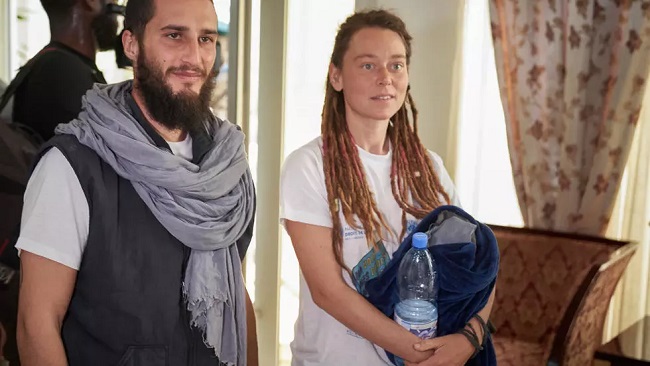
A Canadian woman and her Italian partner kidnapped in Burkina Faso in 2018 have been found in good health in the northwest of Mali after fleeing their captors and were set to be repatriated, diplomatic and UN sources said on Saturday.
Tedith Blais and Luca Tacchetto, both in their thirties, managed to escape near the northern city of Kidal on Friday and were taken to the local base of the UN mission in Mali, known by its French acronym MINUSMA.
The pair were then flown out on Saturday afternoon on a special plane to Mali’s capital Bamako.
They appeared in good spirits but seemed taken aback when greeted by the Malian, UN and Canadian officials with extended elbows. The pair were then informed about the coronavirus crisis and the new social etiquette.
A health official sporting a mask and protective gear then took their temperature. The couple, who were wearing white T-shirts, did not speak to reporters.
They were then due to be taken to the presidential palace before being repatriated.
Malian Foreign Minister Tiebile Drame told AFP at the airport that no ransom had been paid.
– No ransom paid –
“I can assure you that nothing was paid,” he said.
MINUSMA mission head Mahamat Saleh Annadif explained some of the details surrounding their reappearance.
“We have good news. Yesterday around three in the afternoon our Kidal staff informed me they had found two hostages — a Canadian and an Italian,” said Annadif.
“We have conducted medical tests. They are keeping really well and we let them rest,” he said.
The pair were dressed like Tuaregs and apparently stopped a passing car and told the driver to take them to the nearest UN post. There was no detailed information on their escape or the identity of the kidnappers.
“From preliminary information they must have managed to escape. They were picked up by a civilian vehicle which drove them to the MINUSMA camp.”
Blais, from Sherbrooke — about 160 kilometres (100 miles) from Montreal — and her partner Tacchetto, from Venice, disappeared in mid-December 2018 while travelling through the west African country.
The couple were driving by car to Ouagadougou from Bobo-Dioulasso, more than 360 kilometres west of the capital, when all trace of them was lost, according to Blais’s family.
They had been planning to go to Togo to work on a humanitarian project.
In April 2019, a Burkina government spokesman said the two had been abducted and probably taken out of the country, but that they were not in any danger.
Burkina Faso, which had been a safe destination for years, has been wracked by jihadist violence since 2015 and several foreigners have been kidnapped.
An Australian and a Romanian national still remain missing.
– Mali ‘stabilising’
It was not immediately clear how the couple were found in the vicinity of Kidal, about 1,500 kilometres northeast of Bamako which was under the control of Tuareg rebels who waged war against the Malian government from 2012 until 2015, when they signed a peace accord.
The violence has since spread from northern Mali to the centre of the country and spilled over to neighbouring states such as Burkina Faso and Niger.
But foreign minister Drame said their escape was the latest bit of “good news” in Mali.
Mali’s neighbouring governments are often wary of former rebel groups, for example, suspecting them of cooperating with jihadists. They view Kidal as a rear base for Islamist militants.
Source: AFP













14, March 2020
Rocket attack hits US-occupied Taji base in Iraq for 2nd time in a week 0
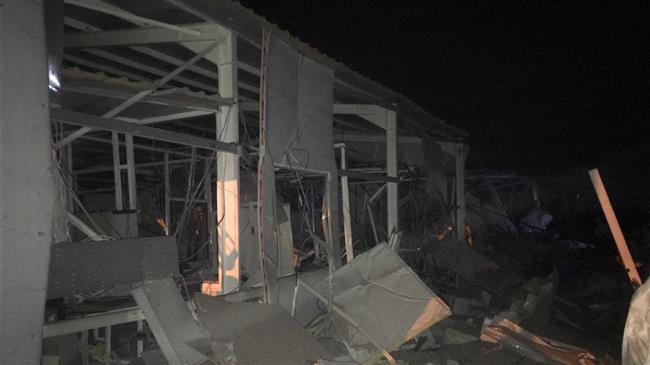
A barrage of rockets hit a base housing U.S. and other coalition troops north of Baghdad, Iraqi security officials said Saturday, just days after a similar attack killed three servicemen, including two Americans.
At least two Iraqi soldiers were wounded in the attack at Camp Taji, according to the Iraqi officials, who spoke on condition of anonymity in line with regulations.
The officials said over a dozen rockets landed inside the base. Some struck the area where coalition forces are based, while others fell on a runway used by Iraqi forces.
The was no immediate comment from the coalition regarding Saturday’s attack.
The attack was unusual because it occurred during the day. Previous assaults on military bases housing U.S. troops typically occurred at night.
The previous rocket attack against Camp Taji on Wednesday also killed a British serviceman. It prompted American airstrikes Friday against what U.S. officials said were mainly weapons facilities belonging to Kataib Hezbollah, the Iran-backed militia group believed to be responsible.
However, Iraq’s military said those airstrikes killed five security force members and a civilian, while wounding five fighters from the Popular Mobilization Forces, an umbrella organization including an array of militias, including some Iran-backed groups.
Iran-backed Shiite militia groups vowed to exact revenge for Friday’s U.S. strikes, signalling another cycle of tit-for-tat violence between Washington and Tehran that could play out inside Iraq.
America’s killing of Iraqi security forces might also give Iran-backed militia groups more reason to stage counterattacks against U.S. troops in Iraq, analysts said.
“We can’t forget that the PMF is a recognized entity within the Iraqi security forces; they aren’t isolated from the security forces and often are co-located on the same bases or use the same facilities,” said Sajad Jiyad, a researcher and former managing director of the Bayan Center, a Baghdad-based think tank.
“Now the (Iran-backed) groups who supported the initial strike in Taji, who were the most outspoken, feel obliged, authorized, maybe even legitimized to respond, ostensibly to protect Iraqi sovereignty but really to keep the pressure up on Americans,” he added.
“There are no red lines anymore,” Jiyad said.
Wednesday’s attack on Camp Taji was the deadliest to target U.S. troops in Iraq since a late December rocket attack on an Iraqi base, which killed a U.S. contractor. That attack set in motion a series of attacks that brought Iraq to the brink of war.
After the contractor was killed, America launched airstrikes targeting Kataib Hezbollah, which in turn led to protests at the U.S. Embassy in Baghdad.
A U.S. drone strike in Baghdad then killed Iranian Gen. Qassem Soleimani, a top commander responsible for expeditionary operations across the wider Mideast. Iran struck back with a ballistic missile attack on U.S. forces in Iraq, the Islamic Republic’s most direct assault on America since the 1979 seizing of the U.S. Embassy in Tehran.
The U.S. and Iran stepped back from further attacks after the Soleimani incident. A senior U.S. official said in late January, when U.S.-Iran tensions had cooled, that the killing of Americans constituted a red line that could spark more violence.
(AP)