27, August 2019
Yaounde: Trial of soldiers for killing women and children must lead to justice for victims 0
The Cameroonian authorities must leave no stone unturned in their pursuit of justice for two women and two children who were brutally murdered by the military, Amnesty International said today. Seven soldiers allegedly caught on video carrying out the killings are set to go on trial tomorrow.
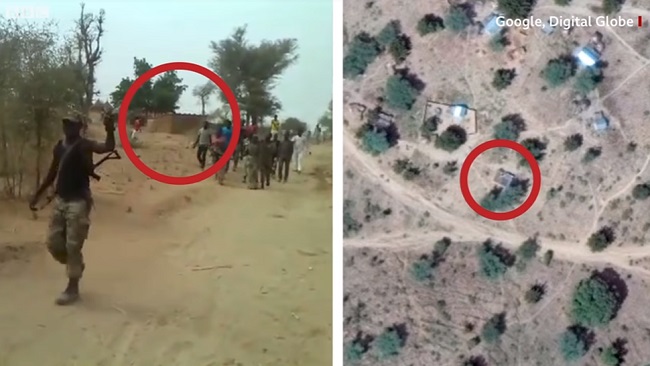
When the video went viral in early July 2018, Cameroonian authorities initially dismissed it as “fake news”. But Amnesty International revealed credible evidence that the Cameroon military was responsible, and the authorities later announced that the seven soldiers depicted in the video had been arrested and would be prosecuted. The seven are due to appear on 27 August before a military court in the capital Yaoundé on charges of joint participation in murder, breach of regulations and conspiracy.
“This horrifying video shone a spotlight on the way civilians in Cameroon’s Far North have been ensnared in atrocities amid the fight against Boko Haram. Security forces who are supposed to be protecting people have instead carried out arbitrary detentions and extrajudicial executions,” said Samira Daoud, Amnesty International’s West and Central Africa Deputy Regional Director.
“The Cameroonian authorities must draw a line and ensure no army personnel responsible for atrocities will escape from prosecutions. Tomorrow’s trial is a first step towards justice and reparations for victims and their loved ones. Authorities must also ensure that all those reasonably suspected of crimes against civilians are brought to justice in fair trials before civilian courts.”
Amnesty International experts analyzed the video of soldiers shooting dead two women and their two children as soon as it went viral in July 2018. Relying on multiple strands of evidence – including expert analysis of the uniforms and weapons used, and linguistic and other contextual clues in speech that gave away the identities and ranks of the soldiers – within days the organization was able to begin to build a case to counter the official narrative. The evidence strongly suggested that Cameroonian soldiers were the ones extrajudicially executing civilians in the video.
Subsequent research by Amnesty International bore this out, and a community of open source investigators collaborating on the case pin-pointed the exact location near the town of Zelevet, and narrowed down the date to late March or early April 2015. The case was immortalized by the September 2018 BBC Africa Eye documentary “Anatomy of a Killing”.
While playing an important role in defending people threatened by Boko Haram, the Cameroonian security forces’ response has too often been heavy-handed and rife with human rights violations. Amnesty International is calling on authorities to bring all those suspected of criminal responsibility to justice in fair trials, before ordinary civilian courts and without recourse to death penalty.
Source: Amnesty International












27, August 2019
What is the British Council doing in Africa? 0
From the southern tip of the black continent to West Africa and the Horn of Africa, the British Council is actively promoting British interests through ostensibly “cultural” and “educational” programmes.
But why does the British Council have such a strong interest in the African continent and how does it go about using “soft” power to realise both avowed and disavowed British foreign policy objectives in the black continent?
Cultural outreach, or cultural penetration (depending on the reader’s perspective), constitutes a core British Council activity. It is the Council’s bread and butter work.
But whereas the British Council frames its cultural outreach programmes as part of a broader narrative centred on local “empowerment”, the reality is that the Council seeks to identify and manipulate emerging cultural trends with a view to creating political and economic spaces for British interests.
Take East Africa as an example, where the British Council has been exceptionally active since the dawn of the twenty first century.
A recent British Council document entitled “Scoping the Creative Economy in East Africa” gives much insight into the thinking of the Council’s leadership, and by extension, the leadership of the Foreign and Commonwealth Office.
Describing the “creative economy” in a primarily sub-national context, the document essentially calls for interventions at local or community levels in order to effect the greatest change.
The document identifies Kenya, Tanzania and Uganda where the “creative economy” offers the greatest potential. Conveniently, these are also the countries which Britain has aggressively targeted as part of post-Brexit trade deals.
On a trip to the African continent in August 2018, the former Prime Minister, Theresa May, announced that Britain had secured its first post-Brexit trade deal in Africa.
Writing in the Guardian on September 04, 2018, the British-Ghanian writer and broadcaster, Afua Hirsch, heaped scorn on May’s sweeping statements and assumptions in relation to the African continent.
Hirsch wrote: “If Britain wants to be a friend to Africa, it needs to stop looking to the continent to boost its self-esteem – “the shared history and cultural ties” of which May talks allude to Britain’s imperial domination – and its coffers”.
The British Council is also highly active in West Africa where, in recent years, it has aggressively promoted the English language. This strategy is set out in detail in a 2013 British Council document entitled: “The English language in Francophone West Africa”.
The aggressive promotion of the English language in fragile nation-states, beset by ethnic and cultural divisions, comes at a high political cost.
Take Cameroon for example, where a rebellion in the country’s western Anglophone regions has resulted in the deaths of nearly 2,000 people since October 2017.
Last week a Cameroonian military court sentenced 10 Anglophone separatist leaders to life imprisonment on wide-ranging national security charges, including terrorism and secession.
Source: Presstv