
22, December 2018
Yaounde Suspends 16 Journalists, 7 Media Outlets 0
Cameroon has suspended 16 journalists and seven news outlets for periods ranging from one month to six months for what it calls media offenses.
The National Communication Council suspended Vision 4, a privately-owned television station in Cameroon’s capital Yaounde, and two of its journalists for one month each. Ernest Obama was suspended for what the NCC said was the use of hate language that could have ignited tribal conflicts in Cameroon. Nadine Patricia Mengue was suspended for erroneously announcing the death of Gabon President Ali Bongo Ondimba during its primetime news program Oct. 25.
On Oct. 30, Gabon also suspended the station from broadcasting for six months on its territory after it again reported the death of Ondimba, who was said to be in hospital in Saudi Arabia suffering from exhaustion.
Gabon’s broadcasting authority said the incorrect and false report had undermined its national unity, social cohesion and public order.
Praise for suspensions
Journalist Melvis Kimbi of Cameroon state broadcaster CRTV says the sanction on Vision 4 was long overdue.
“This particular media house was spreading false information, an information of that magnitude which could have actually triggered a diplomatic crisis between Cameroon and Gabon, and there has been a lot going on on the Vision 4 media that has not been punished,” Kimbi said.
The NCC also suspended Maneh Mirelle of the TV station Canal 2 International for 6 months, Joseph Roland Djotie of Le Quotidien de L’Economie for one month, and Zebaze Benjamin for two months.
Dom Pipelassi Michael Doppas was suspended for two months for repeatedly reporting that Cameroon football star Samuel Eto’o is a homosexual.
Journalist Etienne Ngalle of La Nation newspaper says the NCC did a good job by suspending the media outlets and journalists who were highly unprofessional in doing their jobs.
He says he appreciates the NCC for suspending a journalist of the radio station Soleil FM who declared, without presenting any evidence, that Eto’o is a homosexual. Ngalle says journalists should stop spreading slander and telling lies intended to destroy public figures.
Previous action
Reporters Without Borders has accused Cameroon’s Communication Council of taking a tougher line toward journalists and media. But the recent sanctions have been hailed by some media professionals, especially as those sanctioned were asked to defend themselves in front of the NCC.
In 2017, the NCC suspended 35 journalists and media outlets, accusing them of failing to respect professional norms and ethics.
Cameroon has more than 500 newspapers, and 100 radio and TV stations, which express divergent views about the presidential election.
The Reporters Without Borders 2018 World Press Freedom Index ranks Cameroon 129 out of 180 countries in the world.
Source: VOA












23, December 2018
French Cameroun cannot attain any goals from military attacks on Ambazonia 0
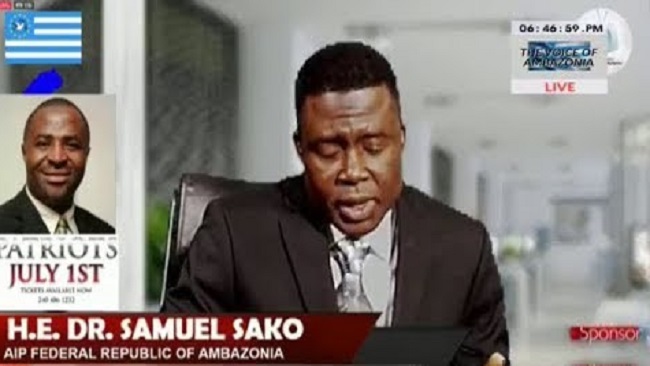
Acting President Ikome Sako of the Federal Republic of Ambazonia says the French Cameroun regime has failed to achieve any goals from its more than 2 years military campaign on conflict-ridden Southern Cameroons.
“We have effectively denied our adversaries the military victory they promised their western Masters! We have convinced all that Biya cannot retain Ambazonia by use of force any more. Hence the new solution: “Dialogue without precondition”. President Sako noted recently in the US.
The Ambazonian Acting President further pointed out that the French Cameroun assaults on Batibo, Nkambe, Bali, Kembong and Ekok were meant to break the will of the Southern Cameroons nation and restoration forces, but instead increased their resilience and steadfastness.
Dr Ikome Sako noted that “From UN to USA, From Uk Parliament to Germany’s Bundestag, From the Scandinavia to Switzerland, the ultimatums are raining on Biya. Those who love this revolution should actively shame all demagogies against the IG and fearlessly defend it against destructive lies.”
He stated that Biya and his gang of inexperienced French Cameroun political elites rushed to launch a military campaign against Southern Cameroonians because they knew their claims of a one and indivisible Cameroon was plain fiction and groundless.
The Ambazonian Interim Government has slammed the numerous French Cameroun attacks on Southern Cameroons as a flagrant violation of Southern Cameroons’s sovereignty. “The war that Biya and his Francophone army are waging against Southern Cameroons, against its people and the Ambazonian restoration forces will not realize its goals” Dr Sako added.
By Soter Tarh Agbaw-Ebai