22, October 2021
Biafra: Nnamdi Kanu’s trial for treason adjourned 0
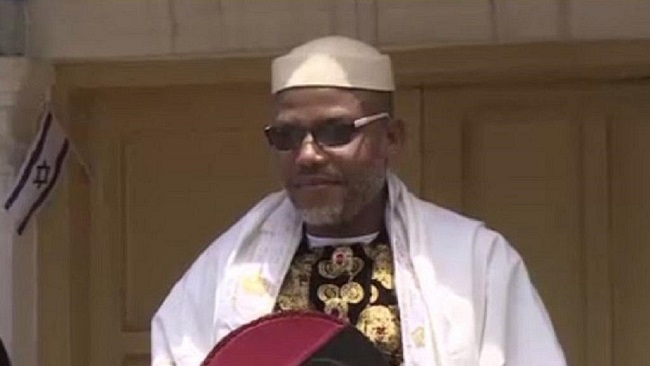
A high-profile case against Nnamdi Kanu, a Nigerian separatist accused of terrorism and treason was adjourned Thursday, lawyers said, after a court appearance under heavy security in the capital Abuja.
Kanu, 53, leader of the proscribed Indigenous People of Biafra (IPOB) group, which wants a separate state for the ethnic Igbo people in the southeast, was arrested abroad in June and brought back to Nigeria to face trial.
Leaving the courtroom Thursday, his lawyers Ifeanyi Ejiofor and Aloy Ejimakor told AFP that Kanu had pled “not guilty” to seven charges including terrorism and treason before the case was adjourned to November 10.
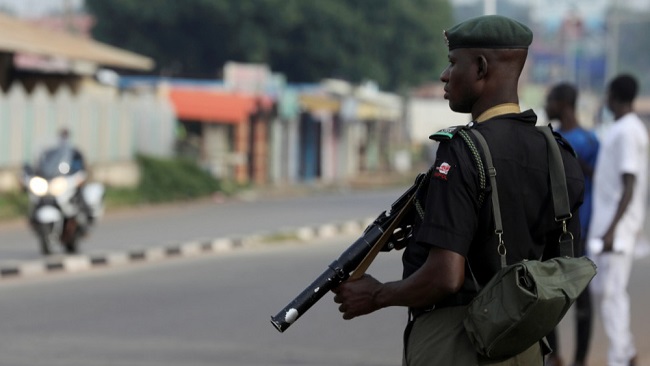
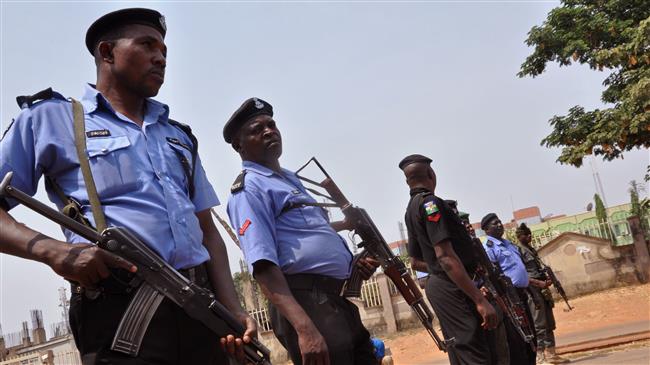
Dozens of heavily armed police, balaclava-wearing security operatives and Nigerian soldiers were deployed all around the federal high court.
Journalists were barred from entering the premises and threatened by police with tasers, an AFP reporter saw.
Lawyer Ejiofor said he urged the court “to dismiss the seven count charges… acquit our client and discharge him.”
Kanu’s family and lawyers say he was illegally extradited from Kenya, though Nigerian officials have not given any details.
He is a British citizen and used to work as an estate agent in London, where he also ran the outlawed Radio Biafra.
Separatist movements in Nigeria are particularly sensitive, after a unilateral declaration of independence in 1967 in Biafra sparked a brutal 30-month civil war.
More than one million people died, most of them Igbos, from the impact of conflict, hunger and disease.
Southeast Nigeria has seen a spike in violence with at least 127 police and other security personnel killed by gunmen this year, according to a local media tally.
Authorities have blamed the attacks on IPOB and its armed wing, the Eastern Security Network, a claim the groups deny.
Kanu was first arrested in October 2015 but was released on bail and fled the country in 2017.
IPOB called for a “sit-at-home” on Thursday across the southeast, to protest the arrest of their leader.
Another separatist, Sunday Igboho, who advocates for independence for the southwestern Yoruba people, was also recently arrested.
Igboho was taken into custody at the airport in neighbouring Benin, police and airport sources said.
He was on the run after a gun battle with security forces at his home, where weapons and ammunition were discovered.
Source: Africa News















13, November 2021
Nigeria’s National Security Adviser says Ambazonia crisis enjoying global sympathy 0
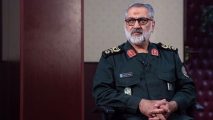
The National Security Adviser (NSA), Major General Babagana Monguno (Retd), has said that separatist agitations in some parts of the West African region were gaining global attention due to international sympathy.
Monguno stated this in paper he presented at the Nigeria International Partnership Forum in Paris, France, titled: “Combating Persistent and Emerging Threats to Regional Peace and Security in Africa: Pivotal Role of Nigeria”.
He said most of Nigeria’s contemporary security problems are influenced or heightened by external threat factors in the global environment.
Therefore, “We are also exploring the feasibility of setting up a border security force in the foreseeable future to secure Nigeria’s border areas,” he said.
He added: “The activities of the Indigenous People of Biafra (IPOB) in Nigeria as well as the activities of Ambazonian separatists in Cameroon have attracted international sympathy mainly from sympathisers in the Diaspora.
“It should however be noted that the Nigerian government has never prevented the freedom of expression or agitation; however, the violent confrontation and engagement of security forces by these groups usually translates into fatalities and other grave consequences.
“While we continue to extend dialogue as the main medium for resolving conflicts in the country, the Nigerian government will continue to discharge its responsibility of ensuring the safety of lives and property against any criminal activity by IPOB or any separatist group.”
He expressed concern that rapid population growth which puts tremendous pressure on states to compete for energy, water and food to support life and economic and societal development; a growing cyber awakening in which perceptions of inequality and other grievances are heightened, leading to social tension and conflicts; a continuation of ideological extremism, driven by religious or ethnic differences; and climate change that could prompt shifts in agricultural patterns and food production are likely to trigger humanitarian crises, if not appropriately addressed.
“All these global security challenges have the potential to undermine national security and by implication national development,” he said.
The NSA said Africa’s porous borders remain a major source of concern as this has aided smuggling of prohibited items and irregular migration as well as other transnational organised crimes.
On present efforts, he said the Nigeria Customs Service has developed the E- Customs strategy while the Nigeria Immigrations Service has equally put in place an Integrated Border Management System (IBMS).
He noted that both strategies place premium on employing technology to complement other existing physical border security arrangements.
Source: Gistmaster