1, February 2018
Power cut leaves hundreds of gold miners trapped underground in South Africa 0
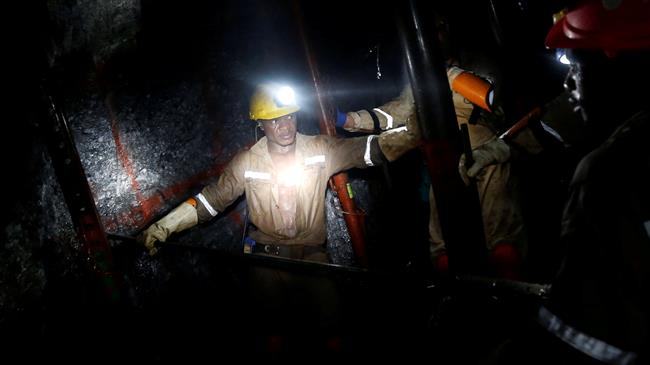
About 950 gold miners were stuck underground in South Africa on Thursday after a power cut, the mine’s owner said, though the workers were not reported to be in immediate danger.
The Sibanye-Stillwater mining company said a massive power outage had prevented lifts from bringing the night shift to the surface at the Beatrix gold mine, near the city of Welkom.
“We sent rescue teams down, accounted for all the people and we obviously are trying to get them out of there as soon as possible,” James Wellsted, spokesman for Sibanye-Stillwater, told ENCA television.
“All employees appear to be fine. We are supplying food and water,” Wellsted added in a telephone message to AFP.
He said the depth where the miners were trapped was uncertain, but the mine has 23 levels, going down to about 1,000 meters (3280 feet) below ground.
About 65 people were rescued during the day, with 950 remaining trapped by early evening, the company said.
Wellsted said that engineers were struggling to get emergency generators to operate and re-start the lifts.
“We are having some issues — probably related to the power surge linked to the storm — in getting the winders working, so we are busy working on that issue at the moment,” he added.
“Last night there was a severe storm in the Free State that affected two different power cables… and cut off all electricity supply to the mine, so we were unable to bring the night shift up.”
One cable was restored during the day.
‘Serious concern’
The Beatrix mine is in Free State province, 290 kilometers (180 miles) southwest of Johannesburg.
AMCU, the Association of Mineworkers and Construction Union, said that the workers stuck underground were facing major health and safety risks.
“AMCU views this incident as extreme due to the sheer number of workers involved,” it said in a statement.
“The incident raises serious concern regarding the lacking emergency contingency plans at the mine for alternative and back-up power generation.”
It said workers’ lives could be in danger from dehydration and lack of nutrition, especially if they were on medication.
Last August five mineworkers died after sections of a gold mine collapsed outside Johannesburg.
The country possesses rich mineral reserves and has some of the world’s deepest gold mines.
Gold was for many decades the backbone of South Africa’s economy, but production has declined sharply due to depletion of reserves.
(Story by AFP)
























2, February 2018
Ambazonia Crisis: UN slams Nigeria over Sisiku Ayuk Tabe extradition 0
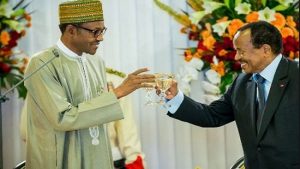
The UN refugee agency on Thursday criticised Nigeria for breaching international agreements after the leader of a Cameroonian anglophone separatist movement and his supporters were extradited at Yaounde’s request. The UNHCR said it learned “with great concern” about the case of Sisiku Ayuk Tabe, who was sent back to Cameroon this week with 46 others. They were arrested in Nigeria’s capital, Abuja, on January 5.
Cameroon has called the 47 “terrorists” and said they would “answer for their crimes”, as tensions mount in the Southwest and Northwest Regions, home to most of the country’s English-speakers. They have complained about decades of economic inequality and social injustice at the hands of the French-speaking majority.
Ayuk Tabe wants the two regions to separate from the French-speaking part of the country. On October 1 last year, his movement made a symbolic declaration of independence. The UNHCR said most of the 47 sent back to Cameroon had submitted asylum claims in Nigeria. “Their forcible return is in violation of the principle of non-refoulement, which constitutes the cornerstone of international refugee law,” it said in a statement. Non-refoulement, a French term, is the practice of not forcing refugees or asylum-seekers to go back to a country where they could be persecuted.
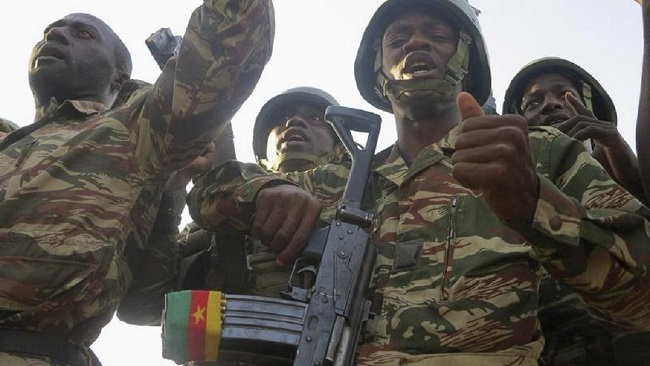
“The returns were carried out despite UNHCR’s efforts and engagement with the authorities,” the agency said. “UNHCR reminds Nigeria of its obligations under international and Nigerian law, and urges the Nigerian Government to refrain from forcible returns of Cameroonian asylum-seekers back to their country of origin.” Human rights groups have called on Cameroon to ensure those detained get a fair trial and are well-treated. Cameroonian President Paul Biya strongly opposes secession and has flooded both regions with troops, imposed curfews, conducted raids and slapped restrictions on travel. An estimated 30,000 English-speakers have fled Cameroon to Nigeria.
www.vanguardngr.com