
18, January 2018
Exposed: Nigerian Secret Service boss preventing lawyers from meeting President Ayuk Tabe 0
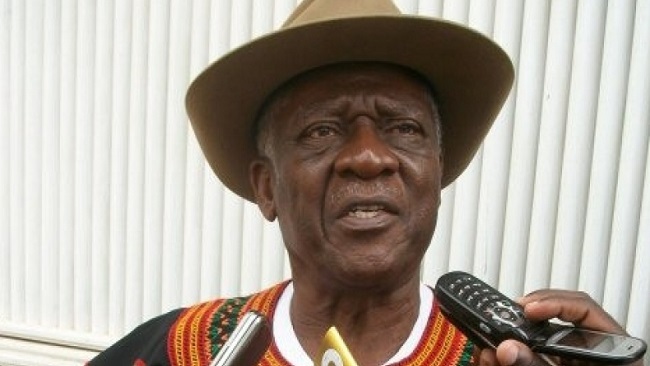
Two weeks after their arrest in Nigeria, Interim Government of the Federal Republic of Ambazonia have alleged that its leaders have been denied access to their lawyers and family members by the head of the DSS Lawal Daura. Ambazonian Secretary for Communication and IT, the Right Honorable Chris Anu, issued the alarm in a statement in Abuja.
The Interim Government hinted that the Buhari administration had no right to arrest their leaders since most of them were on refugee status in Nigeria. The statement noted:“The interim government of the Federal Republic of Ambazonia (the former British Southern Cameroon) notes with dismay the fact that since abducted at gunpoint on January 5, 2018, President Julius Tabe and 10 other members of his cabinet have not been granted access to any lawyers and family members by the Nigerian Government which we are now aware that in complicity with the Cameroon regime in Yaounde, engineered their abduction.
“We condemn vehemently, the fact that the Nigerian Government, more than a week after the abductions has not as much considered a press statement on the abductions even when the majority of those abducted are duly registered refugees in Nigeria. “Nigeria is a signatory to international conventions on human rights and to be acting recklessly as it is doing in this case is a breach of those conventions.”
The Ambazonian leaders – Sikiku Ayuk Tabe, Prof. Che Awasum, Barrister. Nalowa Bih, Dr. Fidelis Che, Dr. Nfor Nfor, Dr. Henry Kimeng, Prof. Che Awasum, Mr Tassang Wilfred, Dr. Ojong Okonghor, Barrister Shufai Berinyuh, Barrister Eyambe Elias and Dr. Cornelius Kwanga – were arrested at Nera hotel by the DSS in Abuja on January 5 while holding a meeting.
By Kinsley Betek with files from the Nigerian Vanguard



















18, January 2018
UN says last three years were hottest on record 0
The last three years were the hottest on record, the United Nations weather agency said Thursday, citing fresh global data underscoring the dramatic warming of the planet.
Consolidated data from five leading international weather agencies shows that “2015, 2016 and 2017 have been confirmed as the three warmest years on record”, the World Meteorological Organization (WMO) said.
It added that 2016 remains the hottest year ever measured due to the warming effect of El Nino, while 2017 was the warmest non-El Nino year, beating out 2015 by less than one hundredth of a degree.
“The long-term temperature trend is far more important than the ranking of individual years, and that trend is an upward one,” WMO secretary-general Petteri Taalas said in a statement.
The 21st century has so far been a period of the hottest weather, accounting for 17 of the 18 warmest years on record.
“And the degree of warming during the past three years has been exceptional,” Tasslas added.
The WMO also highlighted the intensification of weather and climate related disasters, which hit record levels in the United States last year, while multiple countries were devastated by cyclones, floods and drought.
The WMO findings were based on data provided by the US National Oceanic and Atmospheric Administration, US space agency NASA, Britain’s Met office, the European Center for medium range weather forecasts and the Japan Meteorological Agency.
Using those inputs, the UN said that the average global surface temperature last year was 1.1 degrees Celsius (1.98 degrees Fahrenheit) above pre-industrial levels.
Reacting to the results, experts warned that the planet was moving closer to a set of red lines laid out in the historic 2015 Paris climate agreement.
That treaty calls for capping global warming at “well under” two degrees Celsius (3.6 degrees Fahrenheit).
“When even ‘colder’ (non-El Nino) years are rewriting the warmest year record books we know we have a problem,” said Dave Reay, the Carbon Management chair at the University of Edinburgh.
“Global temperatures will continue to bob up and down from year to year, but the climate tide beneath them is rising fast.”
‘Focus’ needed
There is mounting global consensus on the need to slash CO2 and methane emissions, improve energy efficiency, and develop technologies to remove CO2 from the air.
But US President Donald Trump’s decision to withdraw from the Paris accord has rattled the international community and complicated efforts at forging joint action — even though many US state governments insist they remain committed to cut emissions.
Since industrialization took off in the early 19th century, CO2 concentrations in the atmosphere have increased by nearly half, from 280 parts per million to 407 parts per million.
Trump will head to the World Economic Forum in Davos next week, an annual gathering of global elite, where he will confront some of the political and civil society leaders who fought hard for the Paris deal.
“Collaborative efforts” to combat unprecedented shared challenges will be a major theme of meeting, WEF boss Klaus Schwab said this week.
“The record temperature should focus the minds of world leaders, including President Trump, on the scale and urgency of the risks that people, rich and poor, face around the world from climate change,” said Bob Ward, policy director at the Grantham Research Institute on Climate Change and the Environment and the London School of Economics.
(Source: AFP)