28, August 2021
Despite Biya regime’s claims that the Ambazonian conflict is under control, recent developments suggest otherwise 0
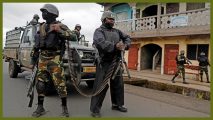
The Anglophone regions’ relatively quiet start to 2021 was shattered in March by an intense series of IED attacks. Marking a new development in the Cameroonian conflict that has simmered for four years, at least one harrowing new video emerged every day. Each showcased the same pattern: the lumbering roll of a military convoy down a muddy forested road; the explosion underneath a lightly armoured Toyota; the immediate covering fire laid down in anticipation of an ambush; and, eventually, a silence punctuated by the cries of the wounded.
Improvised explosive devices (IEDs) have been used by separatists in the Anglophone conflict since at least late-2018, but the tactic has now reached maturity. Extensive video evidence reveals increasingly sophisticated use of the explosives, including the deliberate targeting of the army’s least protected vehicles, remote detonations, and the use of multiple IEDs. These attacks have been more frequent, more deadly and, most importantly, have not stopped.
This is potentially devastating for the military. Cameroon has only a limited number of mine-protected armoured vehicles and so soldiers are largely left to patrol in Toyota pickup trucks with improvised armour that is entirely ineffective against IEDs. Western forces learned similarly painful lessons in Afghanistan and Iraq, with ‘Snatch’ Land Rovers referred to as “mobile coffins” by troops.
These attacks must weigh heavily on the morale of Cameroonian forces, and recent reports suggest that some units have resorted to extreme measures to counteract the threat. It has been alleged that the elite Rapid Intervention Battalion (BIR) has forced civilians to act as human minesweepers near Kumbo, Northwest region, in what would clearly be an egregious abuse of human rights.
The military is known to have defused dozens of IEDs, but the threat remains. It is therefore likely the government will look to acquire new armoured vehicles this year, with Cameroon’s contingent in the UN mission in the Central African Republic receiving several Mine-Resistant Ambush Protected (MRAP) vehicles in May.
Separatists growing stronger
This increase in IED attacks fits into a broader pattern of some separatist groups’ growing combat strength. Larger forces such as the Ambazonian Defence Forces (ADF) and Ambazonia Restoration Forces (ARF) have managed to replace their locally produced hunting rifles with more effective firepower. Over time, they have acquired weaponry from multiple sources such as corrupt or sympathetic local officials and military personnel, dealers and allied groups in neighbouring Nigeria, following attacks and ambushes, and even from the diaspora in the US. Most recently, secessionists have acquired several light machine guns and, for the first time, rocket-propelled grenade launchers (RPGs).
This has marked a step-change in rebels’ offensive capability and has led to deadlier attacks. In early-May, it was reported that 24 soldiers and civilians had been killed by IEDs in the previous two weeks. In late-June, ten soldiers were killed and a gendarmerie post was attacked in South West region in one day. Two recent raids by ‘General No Pity’, a feared commander of the Bambalang Marine Forces, at Galim in the West region and Bamali in the North-West left several soldiers dead. In July, grisly footage showing members of a separatist group celebrating around beheaded military personnel was released. And an attack in Bali on 19 July left five senior policemen dead.
Since March, it seems that around 60 to 80 service personnel have been killed, with many more wounded. This would likely make it the deadliest period for government soldiers since the crisis began. Separatist attacks have been particularly effective in the North West region, where large armed factions are believed, at times, to be working with some degree of cooperation, though not quite in harmony. In the South-West, by contrast, fighting between separatist factions remains common. In late-June, for instance, the Fako Mountain Lions killed ‘General Opopo’, a commander of the rival SOCADEF group. Disunity and distrust among secessionists in most areas, which is exacerbated through online attacks among separatist leaders in the diaspora, remains a yoke around the neck of the campaign for Ambazonian independence.
Biya’s legacy
The government’s line that the Anglophone crisis is an internal matter that is under control or has even been resolved is miles away from the current reality. There have been widespread losses of personnel and equipment recently, and the military even briefly deployed the Armoured Reconnaissance Battalion (BBR) to the region. This move neither projects strength nor suggests a military nearing victory.
That said, the separatists’ recent successes are unlikely to alter the long-term trajectory of the conflict. The kind of turnaround witnessed in Ethiopia’s Tigray region or Afghanistan is not going to be repeated; Cameroon’s separatist groups are not on the verge of capturing Bamenda or Buea. Instead, the conflict risks leaving the Anglophone regions frozen in time for a generation amid a desperate quagmire in which neither side can prevail, and as the international community looks on. Meanwhile, the military continues to recruit heavily, limiting the strategic impact of the increasing losses. As the conflict becomes ever more entrenched and intractable, resolution becomes harder to imagine. The North-West and South -West regions risk becoming to Cameroon what Kivu is to the Democratic Republic of Congo.
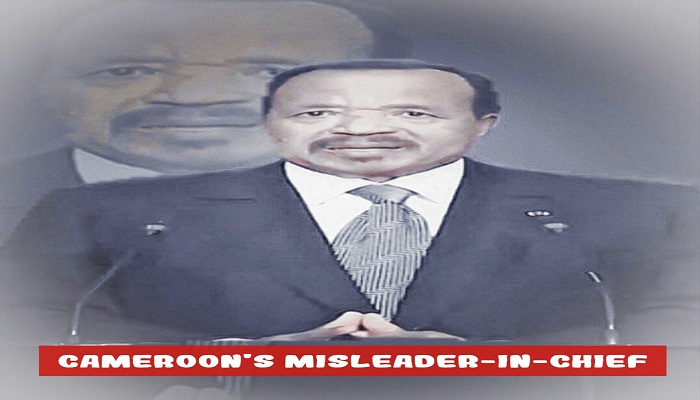
A common phrase heard about the Cameroonian government is that it feels “time is on its side”. From the perspective of the insular, highly centralised regime, this may seem logical. Yet to other actors, it reads as a potentially fatal miscalculation. Time is not on the side of the 1.1 million children out of school or the 3 million residents of the Anglophone regions caught in the crossfire. Nor is it on the side of the 88-year-old President Paul Biya, whose 38 years in charge make him the longest-ruling non-royal leader in the world. His rule is likely to come to an end in the next election cycle, and a transition of power for such a long-standing regime is fraught with the highest risks imaginable.
Cameroon already faces immense challenges with the fight against Boko Haram in the Far North, a tense security situation on the Central African border and thousands of associated refugees, and the immense humanitarian pressures created by all of these separate crises. The strain on the Cameroonian state is enormous, and without a change in strategy, Biya’s forthcoming transition will rightly set alarm bells ringing across the world.
After nearly four decades in power, the greatest legacy the president could leave behind would be to bring the full weight of the state to the table in pursuit of a negotiated, sustainable end to the Anglophone crisis. The alternative is more smouldering armoured vehicles, soaring humanitarian need, and an increasing flow of coffins draped in the Cameroonian flag. As always, the power is with President Biya and his government, yet it is those in Anglophone Cameroon that are paying the heaviest price.
Culled from African Arguments.org


5, September 2021
Afghanistan and Southern Cameroons: Watch, Time, Corruption and Determination 0
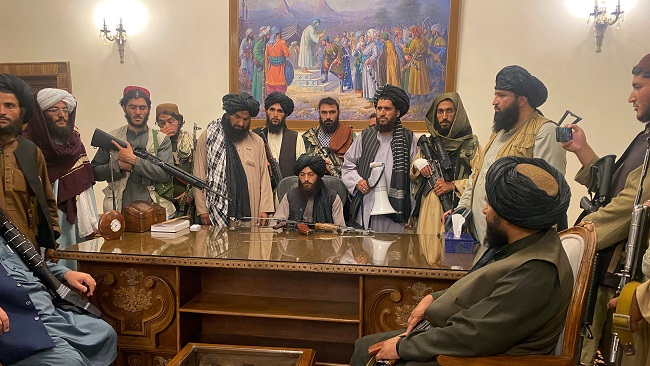
The Taliban has a saying: “you have the watch; we have the time. We were born here. We will die here. We are not going anywhere.” As the Taliban has demonstrated, if a fighting force, weak on paper, is willing and able to wait its enemy out, it can defeat a much superior force. If the guerrilla can withstand suffering and live to fight another day, many battles can be lost while still achieving ultimate victory. The Vietnam conflict was no different, and the Taliban outlasted the might of US and Western forces for 20 years.
In Afghanistan, the West fought an enemy that will not die. America fought a nemesis that had nowhere else to go. In the Southern Cameroons, French Cameroun army soldiers are also fighting an enemy they cannot see and won’t go away. What are the similarities in both wars? Corruption and Determination! Corruption within the Afghan government and French Cameroun establishment, and Determination from the Taliban and Ambazonia Self-defence forces.
Corruption
The Taliban’s lightning advance was based on dysfunction in the government and armed forces. The same can be said of the successes of Ambazonia self-defence forces in their pursuit of independence. Corruption at the top of the Cameroon government military is doing as much damage to its adventure in Southern Cameroons. A former Afghan diplomat recently said, “From your birth certificate to your death certificate and whatever comes in between, somehow you have to bribe.” Anyone with some knowledge of Cameroon under Biya would think the diplomat was talking about the CPDM crime syndicate.
As the Taliban seized territory after territory, government soldiers dropped their uniforms, firearms and ran. On paper, the Afghan army had hundreds of thousands of US-trained fighters. But the fact is that soldiers in Afghanistan went unpaid as senior military and government officials simply siphoned military finances. Afghanistan fell easily than many expected to the Taliban because corruption was endemic in the government and military. The disease of corruption is so badly embedded in the Francophone dominated political and military establishments and this evil is a blessing to the Southern Cameroons quest for independence.
Just as the Taliban exploited the weaknesses in the Afghan army, Ambazonian self-defence forces have exploited a fragile, fraudulent, and hopeless army that has no belly for the fight. The parading of captured weapons by the Taliban on international media is evocative of the videos on social media posted by Ambazonian self-defence forces.
Procurement fraud was rife in the Afghan government, and the same crime is at a more sophisticated stage in Yaoundé. By the time of the Taliban’s final onslaught, Aghan state officials were so corrupt that most of them cut deals with the Taliban. The Afghan army was in a miserable shape to fight as its numbers were inflated by ghost soldiers. The presence of ghost soldiers deep within the Cameroon government military is very well established as the senior commanders pocket the salaries of these ghost army soldiers. The similarities between Afghanistan and Cameroon are striking, and the results, however long it takes, will be parallel.
Determination:
After the Taliban was toppled in 2001, it maintained a strong presence in parts of Afghanistan and played the long game of prolonged combat. When the Southern Cameroons leadership was abducted in Abuja, Nigeria, in January 2018, it appeared as if the Southern Cameroons liberation struggle was a pipedream that would never be realized, but the Southern Cameroons Diaspora community and self-defence forces have reorganised themselves and are deadlier now than before.
For twenty years, the Taliban maintained its structure and survived the deaths of senior leadership figures. It maintained a base in Pakistan and at home in many provinces. They also received considerable moral and financial support from states in the Middle East. Similarly, despite the leadership of the Southern Cameroons movement being incarcerated in Yaoundé, the Interim Government of Ambazonia has continued to function satisfactorily in exile.
The Taliban did not accept the legitimacy of the US-supported government, and the people of Southern Cameroons do not accept the legitimacy of French Cameroon’s rule over the territory of Southern Cameroons. Since Mr Biya and his regime have ruled out genuine negotiation with the Southern Cameroons leadership in their detention centres, the jungles of Southern Cameroons will be their unending nightmare over the next decades as the mountains, hills and valleys of Afghanistan was to the Americans.
Just as many US right-wing policymakers believed for twenty years that the US would win militarily in Afghanistan, the hawks in Yaoundé are defiantly lying to themselves and anyone who would listen that they will emerge from the jungles of Southern Cameroons victorious and politically stronger. France will soon realise the folly of sustaining a corrupt army in a war that they will not win. Whether the political elite in Yaoundé accepts it or not, the Southern Cameroons struggle would still linger long after Mr Biya exits the scene, and the solution like the one in Afghanistan is not on the battlefield.
Paul Biya will not be the only Francophone Cameroonian president to fight the war in Ambazonia. Like Afghanistan, there is an exit strategy. The Americans talked to the Taliban and exited. Are the French Cameroun elite humble enough to do the sensible thing?
The speed and success of the Taliban shocked both Afghans and the US that had backed the Afghan government with money and military support. The US spent over $88bn on training and equipping Afghan security forces over the years. Conservative estimates say France has spent over $11 billion in equipping the Francophone dominated Cameroon army over the last four years, and the figure is growing as the enemy in the jungles in Southern Cameroons is just not going away.
La Republique du Cameroun has not a fighting chance against a liberating force that has time and nowhere to go. If the success of the Taliban is anything to go by, Southern Cameroonians are unlikely to let this great opportunity to attain freedom pass them by. Having a watch and money doesn’t guarantee that one has time. La Republique du Cameroun and France have the watch and money; Southern Cameroonians must know that, like the Taliban, they have the time.
IsongAsu
London Bureau Chief
Cameroon Concord News Group