23, June 2021
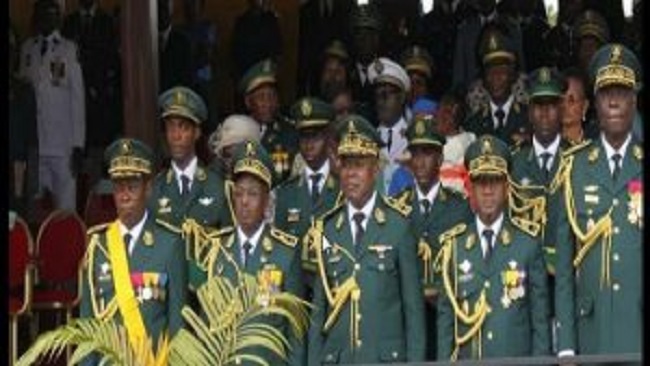
There are reasons why the Francophone dominated army is losing the battle against Amba fighters 0
The bloodshed unleashed by Cameroon government army soldiers in Southern Cameroons where thousands of people, if not more have been killed is yet to raise any worrying question about Biya regime’s continued deployments and the Francophone dominated army’s inability to crush the Ambazonian fighters controlling nearly all rural settlements and border posts in Southern Cameroons.
Recent attacks in Otu, Bamali, Ekondo Titi and Nguti proceeded like many others carried out by Southern Cameroons Self Defense Forces in it’s over four-year-long resistance against the Cameroon government military.
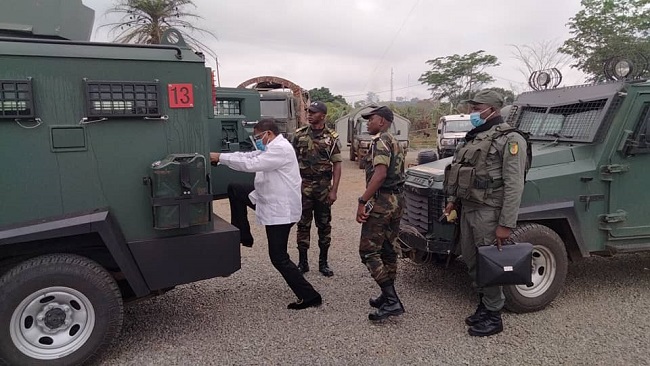
The Amba fighters raided check points; military convoys burned down armored vehicles and killed several elements of the Rapid Intervention Battalion before striking the National Gendarmerie Force. On Saturday, a large number of Amba fighters overwhelmed a gendarmerie checkpoint at Ngoketunjia and three gendarmes who were at the checkpoint were killed.
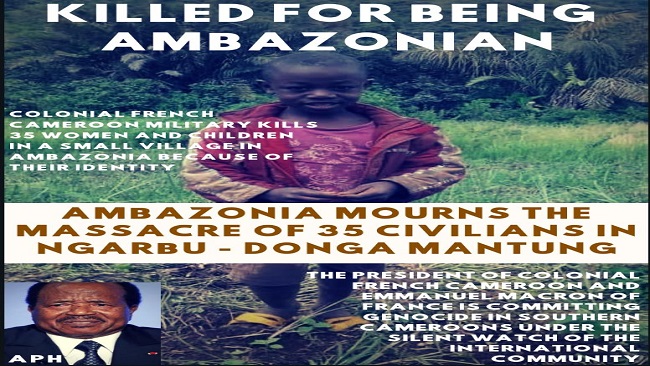
Since 2017, Cameroon government army soldiers have used explosives, AK47 guns and rape to further their goal of maintaining the so-called one and indivisible Cameroon.
The United Nations and Amnesty International say as many as 5,000 people may have been killed. The Southern Cameroons Interim Government has reported death tolls in the thousands. Journalists and international human rights organizations haven’t been able to access the Southern Cameroons territory.
While the death toll remains uncertain, we of the Cameroon Concord Group can now reveal that the once formidable Rapid Intervention Battalion known as BIR has been demystified and many of its members are biting the dust in the jungles of Southern Cameroons.
The so-called BIR that was thought to be among Africa’s best militaries have been unable to stop a hastily assembled ragtag group of fighters now being referred to as Ambazonia Restoration Force.
There are so many issues involved in this prominent and successful failure on the part of the Cameroon government military and they include the francophonising of the army recruitment process, lack of a unified command structure, poor equipment, low morale and corruption among army generals and colonels.
Scores within the Cameroon government military have faced secret courts-martials in Buea, Douala and Yaoundé in recent months for disobeying orders and, in many instances, refusing deployment to Southern Cameroons.
A prominent army general stationed in Buea at the beginning of the conflict, openly complained that his men were underequipped and that high-ranking military officials were bilking the country of money meant to fight the Southern Cameroons war was replaced by President Biya. Complaints of a lack of equipment are a taboo within the Cameroon government army.
The 88-year-old Head of State and Commander-In-Chief has done everything including sending in additional troops and giving them expanded powers to fight the Southern Cameroons Self Defense Forces. President Biya’s troop surge is still not enough, nor is his tactics suitable for countering a group of determined young men and women whose hunting rifles have now been replaced with more sophisticated killing machines.
We understand that the Cameroon government army does not have sufficient armies deployed in the Far North to protect the civilian population against Boko Haram and the Biya Francophone regime in Yaoundé is also not able to put enough soldiers on the ground in Southern Cameroons.
Meanwhile, the Cameroon military is now a constituency within the Cameroon political structure and its strength has developed in the past four years as the balance of state power in Yaoundé has shifted from civilian members of government to military generals.
Ever since the emergence of Boko Haram, the conflict in the Central African Republic and the war in Southern Cameroons, Biya and his ruling CPDM crime syndicate have found it necessary to feed the military leadership as a way to protect their power.
Correspondingly, army generals and colonels have everything while the Cameroonian security is being underfunded and is currently under-manpowered.
By Isong Asu















28, June 2021
Amba Boys will beat you to the punch- Dieudonné Essomba tells Biya and his gang 0
A senior Francophone political commentator Dieudonné Essomba says Cameroon is heading straight for secession if steps are not taken to set up a federated state.
“There is no calm in English speaking Cameroon. New abuses are recorded almost daily. In recent days, several soldiers have been killed in ambushes by pro-secessionist armed groups” Dieudonné Essomba said.
Dieudonné Essomba furthered that the Biya regime is in a weak position and does not have the political, economic, financial, diplomatic, media and strategic means to overcome the Southern Cameroons Interim Government and its majority Ambazonian following. “It is mission impossible,” Dieudonné Essomba told an audience in ”Club d’Elites” a program on Vision 4 TV.
“I have been saying for the past four years that if Cameroon persists in the unitary state, the Amba Boys will beat you to the punch. Four years ago, who could believe that the secessionists could kill 24 soldiers in a week? Who could believe it? I was the only one who believed it, because I am the only rational one… The Amba Boys have evolved, they have gained experience, they are at home and they are armed. They have come from nothing and they have managed to climb. They still have an enormous amount of room to manoeuvre while the state of Cameroon is in crisis and is no longer able to finance this war,” said the retired French Cameroun civil servant.
“For me, the only solution is to negotiate confederation. We must put an end to the unitary state, the Anglophones don’t want it anymore. We must propose a reorganised federal state. Without this, Cameroon will experience separation like Ethiopia, Somalia and Sudan,” Mr Essomba warned.
By Rita Akana