
13, February 2018
Biya regime kicks off busy election year with senatorial polls 0
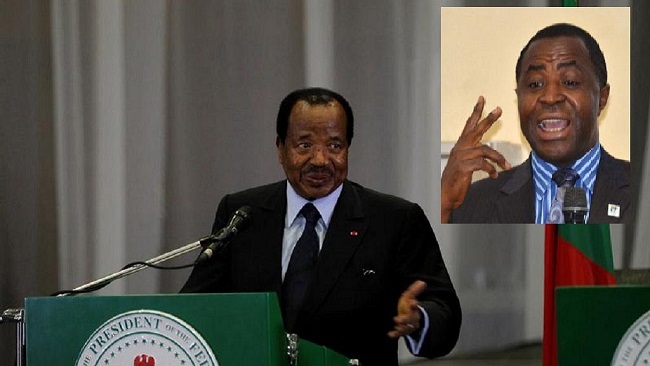
Cameroon will press ahead with its first election for 2018 ahead of the presidential vote later this year. A presidential decree issue last week slated senatorial polls for March 25, 2018.
The decree states that the electoral body ELECAM shall organize the polls in various divisional headquarters of the country.
Cameroon’s parliamentary system caters for 100 senators out of which 70 are to be elected by municipal councillors across the country. The remaining 30 slots are the prerogative of the president.
The elections will in effect mark the start of a busy electoral calender as it is set to be followed by council, legislative and presidential elections later this year. The respective dates are yet to be determined by the President.
Meanwhile, the state – run CRTV reports that nominations for the Senate ends today February 13, 2018. The National Salvation Front of Cameroon led by information minister Issa Tchiroma Bakary have confirmed their participation in the process.
Meeting in Bamenda, capital of the restive northwest region, the main opposition Social Democratic Front (SDF) led by Ni John Fru Ndi, the national chairman, said it will also participate in the process. The February 9, 2018 meeting also declared open nomination contest for the SDF’s presidential ticket for the upcoming polls.
President Paul Biya is expected to seek another term in office after over three decades in charge of the Central African nation. The country is currently riled by secessionist elements in the Anglophone regions – northwest and southwest regions.
The secessionists have entered an armed phase of a struggle for independence. About twenty five security forces have so far been killed in guerilla style attacks. Government received over 40 separatist members deported from Nigeria, they included leader Sisuku Julius Ayuk Tabe.
Source: Africa News


















13, February 2018
Ruler since 1982, Biya turns 85 as strife grips parts of Cameroon 0
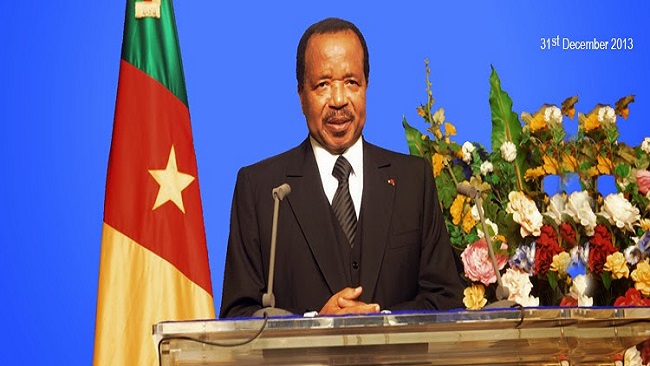
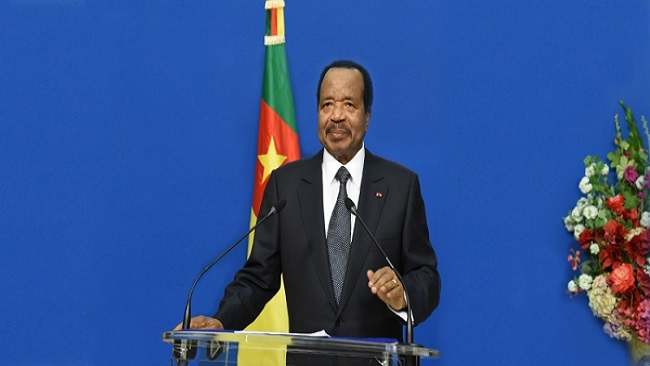
President Paul Biya of Cameroon celebrates his 85th birthday on Tuesday after 35 years at the helm of a country that today faces daunting problems, including a separatist revolt.
“The Cameroon of tomorrow, which is developing before our eyes, will have little connection with the Cameroon of yesterday… Let us seize the chance and take up the challenge,” Biya on Saturday said in a speech on the nation’s youth.
Three-quarters of Cameroon’s population, according to the most recent available statistics from 2014, are under 25. They were yet to be born when Biya in November 1982 settled into the presidential residence of Etoudi in the capital Yaounde, also called the Palace of Unity.
Biya urged young Cameroonians to vote in the next general elections due at the end of 2018, including a presidential poll.
But — true to his nickname of “the Sphinx” — he remained silent on whether he plans to run for a seventh term.
Several candidates have already declared their intentions, but the presidential camp has long since learned to keep a close watch over dissenting voices.
– ‘Divide and rule’ –
Biya has locked down all key posts and institutions, up to the creation early in February of a Constitutional Council of 11 members, the majority of whom come from the ruling Cameroon People’s Democratic Movement (RDPC). Their duties will notably include the validation of election results.
A former student in a Roman Catholic seminary and then of political science in Paris, Biya “has put the saying ‘divide and rule’ into practice,” said Stephane Akoa, a researcher at the Paul Ango Ela Foundation.
“This is how he is able to remain at the apex of the system — forces who might have contested his power can’t get organised, let alone form a coalition.”
The most obvious threats to this picture come from separatists in the anglophone west, where two provinces were united with French-speaking Cameroon after independence in 1960. English-speakers comprise a fifth of the population.
Resentment runs high over perceived neglect by the francophone-majority regime. Dozens of people have been killed on both sides since a bloody crackdown on protest by October, sparking an escalation of bloodshed that led to a week-long curfew on Saturday.
Northern Cameroon, meanwhile, is vulnerable to raids against civilians and troops from across the border by Nigeria’s jihadist group Boko Haram. Cameroon is part of a regional military coalition formed to crush the movement.
– Foreign trips –
Biya’s taste for alpaca suits and silk ties and repeated and often lengthy absences, especially to Switzerland, have been a source for criticism in a nation where more than a third of the population still survives on less than two euros ($2.40) a day.
The foreign trips in particular have raised questions about Biya’s health. Rumours that he was sick circulated again at the end of January, but they were confounded by his television appearance on Saturday. His public appearances are so rare that they are closely scrutinised.
Biya offered an upbeat assessment of the state of the nation. The threat from Boko Haram is “considerably reduced”, the anglophone regions have “calmed down” — though three gendarmes were killed on Sunday — and the national economy has been “embellished”, as he put it.
External commentators, though, say the threat of instability is casting a lengthening shadow.
“With the troubles in anglophone regions and the persistent threat from Boko Haram, the 2018 elections will be a greater challenge than previous votes,” said Hans De Marie Heungoup, a researcher with the International Crisis Group (ICG) thinktank.
Source: The Citizen