31, July 2026
AC Milan ‘in tears’ at death of Italian football legend Baresi 0
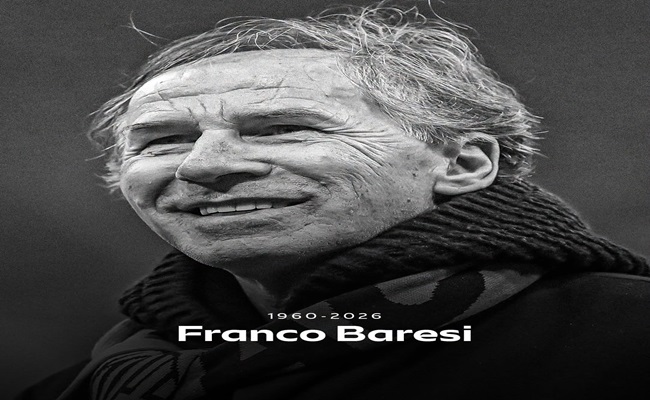
Italian defender Franco Baresi, the captain of AC Milan in the 1980s and 1990s when they won three European Cups and six Italian league titles, has died at the age of 66, the club announced on Friday.
“Milan is in tears following the passing of Franco Baresi. His example and integrity will be forever etched into the Club’s DNA, just as his iconic number 6 shirt is,” AC Milan, of which Baresi became honorary vice-president in 2020, wrote on X.
“We must be strong and gather every bit of energy, even at this saddest of times.
“We lost Franco only a few months after his last public appearance in a packed San Siro, at the Milan Winter Olympics opening ceremony, an event on the world stage he helped make unforgettable.
“In memory of Franco, we stand united, knowing he’ll guide and push us throughout our Rossoneri journey. Forever. Because Baresi is forever.”
A World Cup winner with Italy in 1982 and a finalist at the 1994 World Cup, Baresi is regarded as one of the greatest sweepers in football history.
AC Milan did not specify the cause of Baresi’s death.
He had undergone surgery in August 2025 to remove a lung nodule.
“It will take me a little time to get all my strength back,” he said shortly afterwards.
Born in Lombardy in May 1960, Baresi joined AC Milan’s youth teams in 1974, before moving up to the first team in 1978 ahead of his 18th birthday.
He then became a starter at 18 and captain at 22, noticed for his technique, anticipation and tackling skills, as well as his notable leadership qualities.
Baresi went on to form, alongside Paolo Maldini, Mauro Tassotti and Alessandro Costacurta, a defence feared by every striker in Europe.
He retired in 1997 after 719 matches with the Rossoneri, a record surpassed only by Maldini.
“Today I feel the same thing as to when for one reason or another you were unable to be on the pitch with us,” said Maldini.
“How are we going to cope without our captain?”
‘Greatest of defenders’
Gianluigi Buffon, Italy’s 2006 World Cup-winning goalkeeper, said his Serie A debut for Parma had stayed with him.
“November 19, 1995, I made my debut in Serie A against Milan,” he wrote.
“I was 17… to be on the pitch against such a champion was an unbelievable experience.”
In addition to his red and black club jersey, Baresi wore the blue of the Nazionale 81 times.
But after a World Cup title from the bench in 1982, he did not make the trip to Mexico in 1986 following a disagreement with the national coach.
Penalty shootouts, in the semi-final of the 1990 World Cup and then in the final in 1994, shattered his hopes of another triumph.
A Diego Maradona-led Argentina were their nemesis in the 1990 semi-final, but the late Argentinian superstar had paid him the greatest tribute when his club Napoli beat Milan 3-0 in a Serie A game the year before.
He asked for Baresi’s shirt and donned it in a post-match interview.
“He is the greatest of defenders. It is a memory I will keep for the rest of my life,” he said.
Baresi performed various roles for Milan in his retirement, the only time he spent away from them was a brief spell as technical director of English club Fulham.
“Ultimately, it was only a month: before the end of August, I was already back in Milan,” he told Gazzetta dello Sport in 2025.
“I realised it wasn’t the place for me, and in the end, I didn’t even start working. The umbilical cord with Milan was never broken.”
However, he was never a man to feature in the gossip pages preferring to spend time abroad for the Milan Foundation which he found educational and rewarding.
“With Fondazione Milan, I witnessed poverty in Kenya and Morocco,” he told Gazzetta.
“In Lebanon, I played football in the street with children. These are emotions that have completed me.”
Source: AFP









4, August 2026
Cameroon wins 5 Commonwealth Games medals as Eseme sets 100m record 0
Cameroon concluded the 2026 Commonwealth Games, which ended on Aug. 2 in Glasgow, with five medals: one gold, one silver and three bronze. The country’s delegation, which consisted of 21 athletes, improved on its performance at the 2022 Birmingham Games, where it won three medals.
Eseme Wins Gold in Record Time
Emmanuel Eseme secured Cameroon’s only gold medal by winning the men’s 100 meters. The 32-year-old sprinter crossed the finish line in 9.83 seconds despite rainy conditions, finishing ahead of Australia’s Lachlan Kennedy and Nigeria’s Kayinsola Ajayi.
Eseme’s performance established both a new Commonwealth Games record and a new Cameroon national record. Earlier in the semifinals, he had already lowered the national record to 9.89 seconds. Moreover, his winning time ranks as the third-fastest performance in African history and the third-fastest time in the world during the 2026 season as of the date of the race.
Judo Delivers Three Medals
Judo accounted for three of Cameroon’s five medals. Richelle Soppi Mbella claimed the silver medal in the women’s over-78 kg category after losing the final to New Zealand’s Sydnee Andrews. Meanwhile, Marie Céline Baba Matia won bronze in the under-52 kg division, while Franck Ulrick Tahman Zan also secured bronze in the under-100 kg category.
Cameroon’s fifth medal came from para-athlete Cédric Idriss Lekezo Azamdzi, who finished third in the F57 shot put with a throw of 12.57 meters. Consequently, Cameroon won medals in athletics, para-athletics and judo.
Medal Count Improves on Birmingham 2022
Cameroon increased its medal tally to five podium finishes, compared with three medals at the 2022 Birmingham Games, representing a 66.7% increase. However, the country maintained the same number of gold medals. At Birmingham 2022, weightlifter Junior Périclès Ngadja Nyabeyeu won Cameroon’s only gold medal in the 109 kg category.
Nevertheless, comparisons between the two editions require caution because the 2026 Glasgow Games featured 215 events across 10 sports, compared with 283 events across 19 sports at Birmingham 2022.
Cameroon Ranks Fifth Among African Nations
Cameroon finished 16th overall in the final medal standings and ranked fifth among African countries, behind Nigeria, South Africa, Kenya and Mauritius. Although Cameroon won one more medal than Mauritius, Mauritius ranked higher because it secured one additional silver medal. The Commonwealth Games ranking prioritizes gold medals, followed by silver and bronze medals.
Nigeria led the African medal table with 24 medals, including 10 gold medals, while South Africa collected 28 medals, including seven gold medals. Australia topped the overall medal standings with 171 medals, including 70 gold medals, ahead of England and Canada.
Source: Sbbc