7, June 2018
Nigerian Senate leader questioned over deadly gang robberies 0
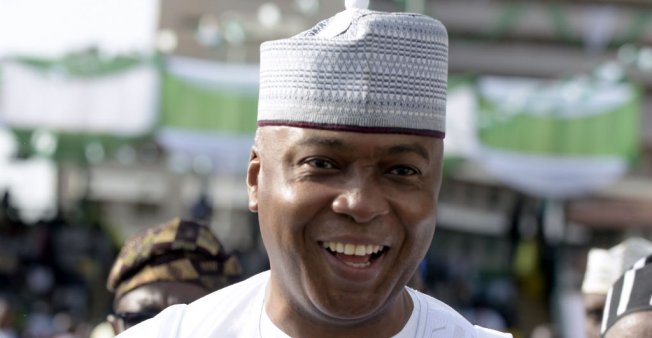
The use of political gangs has returned to the spotlight in Nigeria after suspects in a violent armed robbery claimed they had been recruited by the leader of the country’s Senate.
Twenty-two young men were arrested after heists on six banks killed 33 in the town of Offa, in the central state of Kwara, on April 5.
On Sunday, the police summoned Bukola Saraki, a former Kwara state governor and now head of the upper chamber of parliament, for questioning.
Five of those held “admitted and confessed” they were “political thugs… sponsored with firearms, money and operational vehicles” by Saraki and his successor as governor, Abdulfatah Ahmed, according to a police statement.
The gang allegedly operated for Saraki as political enforcers under the name Youth Liberation Movement or “Good Boys” but used the weapons and vehicles to carry out the heists, it said.
Saraki has rejected the allegation as “baseless” and claimed he was being set up.
Political enforcers – free-wheeling gangs providing security for their boss at public meetings or to intimidate opponents or more – have a long and sinister history in Nigeria.
But the latest incident has fuelled warnings the phenomenon could increase in the run-up to elections in February next year.
“Even in the 1960s during the First Republic, we had ‘Operation Wetie’ in western Nigeria, where politicians used thugs to burn houses and kill their opponents,” said Don Okereke, a security expert.
Since then, ethnic militia emerged such as the Oodua People’s Congress in the southwest, the Bakassi Boys in the southeast and the Niger Delta Vigilante Service in the south.
Northern equivalents sponsored to do the bidding of political godfathers include Sara-Suka, Yan Daba and Kauraye operating in Gombe, Kano and Katsina states.
Power struggle
Okereke blamed the practice on a loss of values in society and widespread economic hardship as well as desperation on the part of politicians to acquire and cling to power.
“Our youths have lost their moral values for good behaviour. It’s also a question of poverty and unemployment,” he told AFP.
“The youths have become willing tools in the hands of desperate politicians who capitalise on their poor condition to achieve their political ambition.”
Public affairs commentator Chris Ngwodo agreed: “Political thuggery is deeply entrenched in our politics because of the high stakes involved in the struggle for power.
“These thugs foment trouble, create tension and unleash violence on behalf of their patrons who are usually the big men, the senior government officials and politicians in society.”
Over time they can move from threats, intimidation and ballot stuffing into organised crime – or worse.
“That explains why there is a direct link between political thuggery, violence and organised crimes like armed robbery, kidnapping, cultism (gang membership) and assassinations,” said Ngwodo.
Former members of the ECOMOG gang recruited by the ex-Borno state governor Ali Modu Sheriff then dumped when he left office have allegedly gone on to join Boko Haram.
The hardline Islamists, who funded their activities in their early days through bank robberies and extortion, have killed at least 20,000 people in northeast Nigeria since 2009.
Boko Haram has been repeatedly accused of having political sponsors, although no link has ever been established.
‘Unwholesome practice’
Lagos police recently warned parents about their children being recruited as political touts, given the risks of them falling into other criminal activities, including kidnapping.
Buhari is hoping to secure a second, four-year term of office at elections in February next year against a backdrop of worsening security from ethnic and religious tensions.
Eradicating the practice may not be easy given Nigeria’s system of patronage politics and the lure of ready cash and status to legions of disaffected and jobless young men.
“The trend will continue as long as there are willing boys to do the bidding of politicians who have the resources to adequately reward them,” said Ngwodo.
“As we move towards the 2019 election, we are going to see more manifestation of this unwholesome practice.”
One way out is to make public office less attractive to reduce access to slush funds that could be deployed to hire thugs to serve selfish political interests, he argued.
(AFP)















7, June 2018
US Republicans challenge Trump on tariffs 0
Several Republican senators defied the White House Wednesday and pressed ahead with legislation that would require Congress to sign off on certain tariffs imposed by US President Donald Trump.
The Trump administration, citing national security concerns, last week unveiled punishing tariffs on imports of steel and aluminum from the European Union, Canada, Japan and Mexico, among others, antagonising free-trade supporters in the US Congress.
The bill, sponsored by six Republicans and four Democrats, would require the president to submit to Congress any proposal to place tariffs on imports in the interest of national security, under Section 232 of the Trade Expansion Act.
“Unfortunately, the administration is abusing the Section 232 authority delegated to the president by Congress,” said Senator Bob Corker, the bill’s chief proponent.
“If the president truly believes invoking Section 232 is necessary to protect the United States from a genuine threat, he should make the case to Congress and to the American people and do the hard work necessary to secure congressional approval,” Corker added.
Corker, who is retiring at the end of the year, said he received a “lengthy” phone call from the Republican president who told him “he’s not pleased with the effort” to rein in his trade authority.
The lawmakers aim to introduce the measure as an amendment to a national defence authorisation bill coming up for debate in the Senate.
The defence bill is must-pass legislation, but the fate of the tariff measure is uncertain.
Even if it passes the Senate, it might end up being scrapped from the final version of the defence bill negotiated with the House.
Senate Majority Leader Mitch McConnell signalled he was unwilling to spend much time on the “contentious” measure, saying he wanted to focus in the coming months on “getting bills passed that we have to do for the country.”
Several Republicans, including House Speaker Paul Ryan, have expressed frustration with Trump’s willingness to defy party orthodoxy and resort to punitive tariffs against allies, moves they warn could spark trade wars that would end up hurting American producers, workers and consumers.
But Ryan hinted Wednesday at the difficulty of Congress reining in Trump’s trade authority.
“You’d have to pass a law that he would want to sign into law,” Ryan told reporters. “You can do the math on that.”
Corker said the “vast majority” of Senate Republicans agreed with the policy to limit Trump’s imposition of tariffs.
But Republican leadership and rank-and-file conservatives have shown little appetite to defy Trump legislatively, especially in a mid-term election year.
(AFP)