
7, December 2022
Qatar 2022: The Big boys gear up for quarter-finals 0
Brazil, France and other World Cup heavyweights started the build-up to their quarter-final matches in earnest on Wednesday after Portugal made a huge statement of intent against Switzerland.
Five-time winners Brazil, defending champions France, Lionel Messi’s Argentina and England are all still in the mix as the tournament in Qatar paused for a first rest day.
But 2010 winners Spain were licking their wounds after crashing out to Morocco, ruminating on an identity crisis as they jetted home.
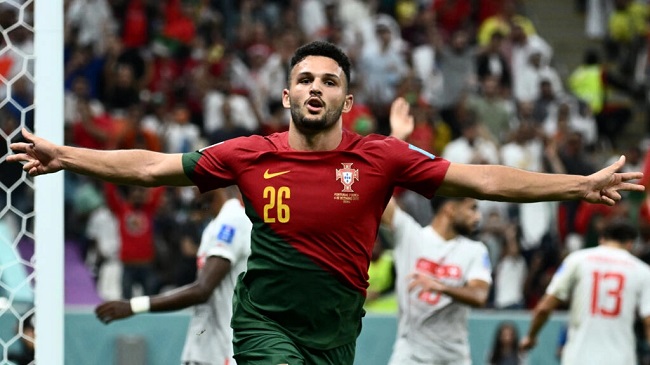
Portugal added their name to the list of favourites with a 6-1 hammering of Switzerland on Tuesday, with young gun Goncalo Ramos smashing in a hat-trick after replacing Cristiano Ronaldo.
Ramos was only two years old when Ronaldo made his debut for Portugal and has often spoken of his admiration for the 37-year-old, who came on as a late substitute to a raucous reception.
“Not even in my wildest dreams did I think of making my first start in a World Cup knockout game and scoring three goals,” said the 21-year-old.
“But we have to think game by game and prepare for the game (quarter-final with Morocco). This result doesn’t matter now. We’re going to go all out in the next game.”
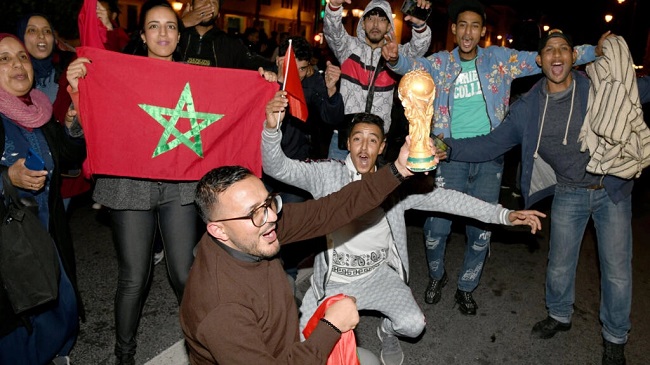
Spain were sent packing, knocked out by Morocco on penalties after a match they totally dominated — a familiar story for their long-suffering fans.
They attempted over 1,000 passes but ended up with nothing to show for it, forcing Yassine Bounou into only one save before an embarrassing penalty shootout, which they lost 3-0.
Spain’s exit means they have not lifted a major trophy since Euro 2012, while they have not won a single knockout game at the World Cup since triumphing in South Africa in 2010.
“We dominated the game but we lacked a goal,” lamented Luis Enrique.
“We could have been more effective in the final third, but I am more than satisfied with what my players did.
“They represented perfectly what my idea of football is.”
But there was joy for Morocco, who qualified for the World Cup quarter-finals for the first time in their history.
“We had agreed not to take possession — not out of fear,” Regragui said. “We are humble enough to say that we are not yet France, Germany or England, to compete with them in terms of possession.
“Nobody managed to steal the ball from them, so I accepted not having the ball. I’m not a magician.”
‘Best ever’
FIFA president Gianni Infantino on Wednesday hailed the World Cup group stage in Qatar as the “best ever”.
The opening phase featured some eye-catching shocks, with Saudi Arabia’s win over Argentina the first major upset.
Japan also beat Germany and Spain to finish top of their group, while Morocco saw off Belgium and drew with Croatia to finish top of their pool.
“I have seen all the matches, indeed, and put very simply and very clearly, this has been the best group stage of a FIFA World Cup ever. So, it’s very promising for the remainder of the FIFA World Cup,” said Infantino.
“The matches have been of great, great quality in beautiful stadiums — we knew that already. However, as well, the public who was there was incredible. Over 51,000 on average.”
Brazil, who face beaten 2018 finalists Croatia in the first of the quarter-finals on Friday, remain favourites to lift a sixth World Cup in Qatar after their 4-1 mauling of South Korea.
Argentina, who have hit their stride since their shock defeat against Saudi Arabia, will come up against an in-form Netherlands team, who remain unbeaten.
On Saturday, Morocco take on Portugal before focus shifts to the late kick-off between England and France.
England midfielder Declan Rice missed training on Wednesday due to an unspecified illness.
Source: AFP











7, December 2022
Southern Cameroons Crisis: Catholic University soliciting funds to assist affected students 0
The leadership of the Catholic University of Cameroon (CATUC) is soliciting funds to assist students affected by the protracted crisis in the English-speaking regions of the Central African nation.
In a statement issued Monday, December 5, the Vice Chancellor of CATUC says, “Two years ago, cases of students whose parents’ fortunes had changed drastically as a result of the Anglophone Crisis came to our notice.”
“Some parents had lost everything-businesses, farms, homes, cows, etc. – and were unable to pay tuition fees for the children who were already enrolled in the university,” Fr. Joseph Awoh Jum says.
Fr. Awoh notes that a “good number of students, including students of the Medical School, were going to drop out as a result.”
“Our immediate reaction was to appeal to people whom we knew – our friends, family, colleagues, alumni, former schoolmates, and students – for assistance,” the Vice Chancellor of the Catholic institution based in Cameroon’s Bamenda Archdiocese says.
He notes that a few of the donors “responded to our appeal and gave us donations which kept these students in school, for some time.”
In addition, Fr. Awoh says, “The Archbishop of Bamenda provided school fee loans to four of our medical students who were threatened with dropping out so that they could complete their training, work in Archdiocesan health institutions and eventually pay back these loans.”
“These students and their families are extremely grateful to all those who contributed to keep them in school and keep their dreams alive,” the Vice Chancellor says.
However, Fr. Awoh says, “Those of them in the middle of their medical training still have a long way to go and would appreciate whatever assistance they can get to take them to the finish line.”
“In these difficult times, the university and her proprietors can only offer so much assistance and are working towards the establishment of an endowment fund to cater for such cases in the future,” he adds.
The Cameroonian Catholic Priest goes on to appeal for aid, saying, “We would greatly appreciate whatever assistance anyone would like to offer to keep these unfortunate students’ dreams alive and to assist families rendered desperate by the Anglophone Crisis.”
“Please, give this appeal a thought and, if your heart tells you to contribute your widow’s mite to this noble cause, contact us at info@catuc.org for guidance on how you can do this,” he says.
He continues in his December 5 statement, “We thank you in anticipation of your kind help and pray for God’s abundant blessings on you and your people.”
Cameroon’s English-speaking regions plunged into conflict in 2016 after a protest by lawyers and teachers turned violent. An armed movement of separatists claiming independence for the so-called republic of Ambazonia emerged following the government’s crackdown on protesters.
School boycotts have become common in these areas, as have enforced moratoriums on public life known as “ghost towns”.
On August 21, members of the Bamenda Provincial Episcopal Conference (BAPEC) lamented the protracted conflict in the country’s Anglophone regions, that has been characterized by “the piteous and distressing cries of anguish”.
The Catholic Church leaders at the helm of Bamenda Archdiocese and the Dioceses of Kumbo, Kumba, Mamfe, and Buea Dioceses underscored the need to respect the dignity of the human person created in God’s image and likeness and the sacredness and inviolability of human life.
Source: aciAfrica