

1, June 2018
Uganda imposes tax on social media use 0
Uganda’s parliament has imposed a tax on the use of social media in a bid to raise revenue but opponents of the law say it aims to stifle criticism of President Yoweri Museveni, who has been in power since 1986.
Users will be charged 200 shillings ($0.0531) per day for services such as Facebook, Twitter and WhatsApp. That amounts to around $19 per year in a country where gross domestic product per capita was around $615 in 2016, according to World Bank figures.
The tax was passed on Wednesday as part of an overhaul of an excise duty law due to take effect next financial year which starts in July, parliament spokesman Chris Obore told Reuters.
A junior finance minister previously told journalists the tax would be levied daily by mobile phone operators on each SIM card used to access any of the targeted social media platforms.
There was no immediate comment from cell phone operators or social media companies, but rights advocates denounced the move.
“It (tax) is a new tool of stifling free expression and citizen organising that has been beyond the control of the state,” said Nicholas Opiyo, a Kampala-based lawyer who also heads a local rights organisation.
“It’s intended to curtail the ever increasing central role of social media in political organising,” he said.
A government spokesman did not return a call seeking comment but authorities have previously denied such accusations.
About 40 percent of Uganda’s 40 million people use the internet, according to data from the regulating body Uganda Communications Commission. Facebook and WhatsApp are widely used in Uganda and many other African countries.
Digital advocacy group the World Wide Web Foundation says data costs in Africa are among the world’s highest, a fact blamed for slow internet penetration and limited use even for those connected.
“Data right now is essential in nearly every worker’s day to day business, a responsible government should be lowering its price not the opposite,” said Diana Taremwa, a charity worker in the capital Kampala.
Critics of Museveni, 73, say his government employs a wide array of tactics to limit political debate, trample on civil rights and stifle the opposition.
Museveni has won a series of elections but his opponents say these have been rigged in his favour. His main rival, Kizza Besigye, has been jailed dozens of times since he first run against him in 2001.
Some opposition critics have in the past been charged for allegedly insulting him in posts on Facebook.
In the last presidential election in 2016, authorities also blocked access to Facebook, Twitter and WhatsApp saying the platforms would be used by the opposition to mobilise protests. ($1 = 3,770.0000 Ugandan shillings)
(Source: Reuters)











1, June 2018
The 2 years Southern Cameroons war may never end 0
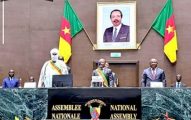
The United Nations and some renowned media houses in the West have started reporting on the deteriorating situation in Southern Cameroons barely two years into the conflict. Prof Patrice Nganang in a recent televised interview described the war in Southern Cameroons as an eroding stalemate in which the Ambazonian Interim Government and its Self-Defense Council Restoration Forces have not only been able to expand, but also consolidate, the territory they hold.
However, recent developments, including the barbaric attack by Cameroon government forces on a Hotel killing more than 30 unarmed Ambazonians in Menka-Pinyin are reminders of the need to assess the Southern Cameroons crisis in more than binary terms. Frankly speaking, the picture painted by French Cameroun’s US-based Prof Patrice Nganang as eroding stalemate is morphing into an uglier, more complicated conflict, that may soon resemble the Rwandan civil war or even the present, intractable war in Libya, due to the absence of a holistic strategy by the French backed Biya regime and military escalation by Francophone army commanders.
Ever since the crisis started, the Trump administration has been consistently inconsistent with its dealing with the malicious regime in Yaoundé. First, it supplied the Biya Francophone regime with war equipment including two fighter jets mindful of a CIA report to the White House stating that Cameroon government troops combating the Nigerian Islamic sect, Boko Haram have all been moved from the Far North region and redeployed to Southern Cameroons. Secondly, Ambassador Peter Barlerin attacked the Interim Government of the people of Southern Cameroons saying that they were “…a very tiny minority of Cameroonian-born individuals living in the United States” responsible for the crisis in Cameroon. And then recently the US ambassador made a dramatic u turn and accused the Biya regime of “targeted killings” in Southern Cameroons. Peter Barlerin during an audience with Mr. Biya advised the 85 year old tyrant to step aside.
Judging from this regular change of the United States position, it is evidently clear that the West does not have a solution to the Southern Cameroons crisis. The US and their European allies have notionally embraced the modest aims of the French government and the Biya regime: the elimination of transnational terrorism threats and weakening of Boko Haram that it feels compelled to ignore the numerous Biya excesses. Toward this, the Trump administration and the European Union have allowed Biya to expand Yaounde’s use of blunt military force against Southern Cameroonians, a targeted increase in troop’s presence in Southern Cameroons, and various forms of diplomatic pressure on Nigeria hosting more than 40,000 Southern Cameroons refugees.
The presence of US forces in the North of Cameroon and the numerous military donations from the US government to the Cameroon army may be view as less charitably. For some time now, the US has been seeking to know what the Russians and President Putin are doing in the Central African Republic, CAR. Russia is currently supplying the Bangui government with arms under UN approval and Russia has several military advisers stationed in the war torn country. CAR President Faustin-Archange Touadéra has been to Moscow twice recently and this is disturbing to the French and the US.
Let us, however, assume that US’s aims in Cameroon are indeed limited to destroying Boko Haram and the so-called Islamic State of West Africa. Even with these modest goals in mind, the grim reality may be that the Trump administration is giving Biya another chance as head of state in Cameroon that he actually doesn’t really have. And as a result of its military-first strategy, the United States will end up making things worse in both French and Southern Cameroons.
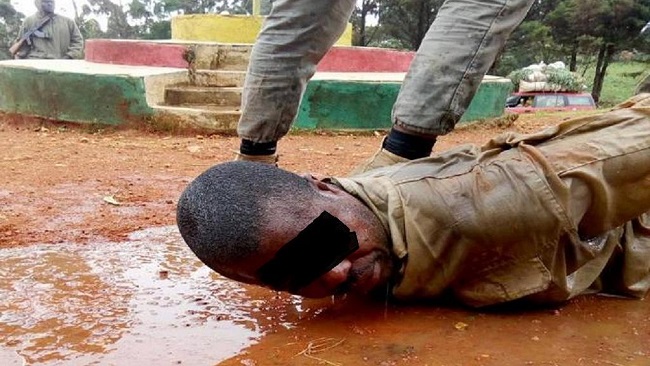
The US has erroneously joined the self-perpetuating ecosystem of violence in Cameroon. It rejects the 85 year old leader, Paul Biya but empowers his war machinery that is helping to breathe life into the CPDM crime syndicate. The Cameroon government army is a Francophone Fulani- Beti- Ewondo army and these warlords have abused the local populace in Southern Cameroons, kidnapped young boys and girls, making them into sex slaves and killed hundreds.
The supposed gains made by Cameroon government forces in Buea and Bamenda in recent months are easily reversible once the Interim Government starts attracting international partners. Correspondingly, the Cameroon government military would collapse if the Southern Cameroons crisis drags for another year.
By Soter Tarh Agbaw-Ebai