21, December 2022
Argentina’s World Cup heroes forced to abandon bus parade and tour in helicopter 0
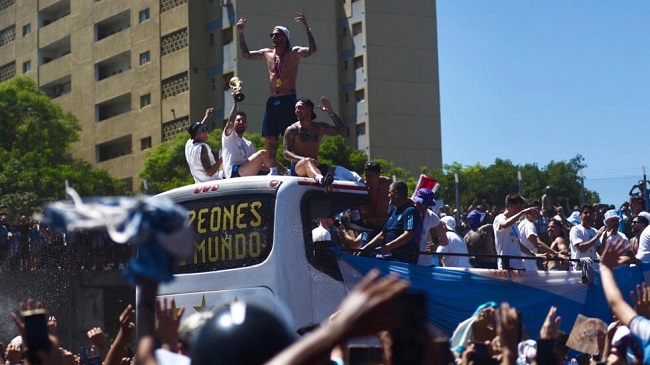
Argentina’s World Cup heroes had to abandon an open-top bus parade in Bueno Aires on Tuesday as millions of ecstatic fans flooded onto the streets and brought the city to a standstill, with Lionel Messi and his team mates whisked into helicopters to complete the celebrations.
The players who were triumphant in Sunday’s World Cup final in Qatar were unable to reach the central Obelisco monument as planned because the route was completely blocked by the heaving crowd, estimated by local media at four million people.
With social media footage showing some fans trying to jump onto the team’s bus when it passed under a bridge, the scheduled eight-hour journey was cut short due to security fears. The players were transferred from their parade bus and into helicopters.
“The world champions are flying over the entire route in helicopters because it became impossible to continue on land due to the explosion of joy,” presidential spokeswoman Gabriela Cerruti wrote on Twitter.
Television images showed people all over the city, including those waiting around the Obelisco and on surrounding highways trying to catch a glimpse of their returning champions.
“It’s crazy, it’s incredible, it’s the best thing that can happen to you in life,” said 25-year-old metalworker Matias Gomez.
“It is an enormous joy to see all these happy people, all together, one with the other, holding hands, giving each other hugs, kisses. We are all one today.”
The team had arrived in the early hours of Tuesday at Ezeiza airport. Despite it being around 3am local time (0600 GMT), thousands were waiting with banners, flags and flares and howling with joy after Messi and his team mates ended the country’s 36-year wait to win the World Cup.
By around midday millions had already congregated in downtown Buenos Aires, with major roads shut down for the parade. People held up banners of Messi and late icon Diego Maradona, played instruments or climbed lamp-posts or bus stops.
Roads started to clear after the players took to the sky in helicopters, with some people left disappointed not to see the team.
The Argentine capital has been in party mode since the dramatic victory over France in Sunday’s final in Qatar, which has helped mask economic woes in the South American nation battling one of the world’s highest inflation rates.
The penalty shootout victory made the country world champions for the first time since Maradona hoisted the trophy in 1986 and the third in total.
The government made Tuesday a national holiday to allow fans to celebrate the win.
‘I can’t cry and more’
As the open-top bus snaked through the city, players danced and cheered with fans who circled the bus. Police were having to hold people back to allow the vehicle to move forward on its slow journey towards the centre of town.
But eventually they could go no further.
“They don’t let us get to greet all the people who were at the Obelisco. The security agents that escorted us won’t allow us to move forward,” tweeted Chiqui Tapia, president of the Argentine Football Association (AFA).
“A thousand apologies on behalf of all the champion players.”
Messi, 35, has burnished his reputation as one of the world’s greatest ever with the win as Argentina beat France 4-2 on penalties after a scintillating 3-3 draw after extra time.
He has said it was his last match in the World Cup, though he plans to play a few more games for the national side.
At times it has felt that the whole country has been partying through the night from Sunday onwards in the southern hemisphere summer, the joy of victory infecting everyone with cars regularly blaring their horns in celebration.
“There are people lying on the floor who came straight from the last party to get up and keep partying,” said Elio Maisares, 25, as he celebrated in the city where everyone and everything was covered in the white-and-blue of the “Albiceleste”.
“Just look at all this, look at everything that is painted in light blue and white. Along the roads, the highways, all the people are rooting for Argentina,” he said.
“It’s really impressive, it’s unique, what a way to cry. I cried this morning, yesterday, the day before yesterday, I can’t cry anymore, it’s incredible!”
Source: REUTERS
















21, December 2022
Southern Cameroons Crisis: Pope Francis man in Yaoundé leaves behind a divided country 0
As the pope’s ambassador to Cameroon moves on, leaving behind a country still torn apart by ethnic and linguistic divides despite his best efforts at peace, his final plea to the country was to embrace a spirit of “dialogue without prejudice.”
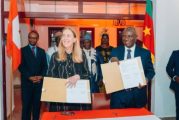
Archbishop Julio Murat, a Turkish prelate who’s served in Cameroon and Equatorial Guinea since 2018, was named the new Apostolic Nuncio, or ambassador, to Sweden and Iceland Nov. 9.
During a Mass to bid him farewell organized by the Cameroon Episcopal Conference on December 12, 2022, Murat asked God and the Christians to forgive him “for his sins of omission.”
“If I hurt anyone unknowingly, please, forgive me,” he said.
“There are things you can’t forget in life, even if you have so much to do,” the nuncio said, and acknowledged the “tremendous” support he received from the Cameroon Bishops’ Conference, the Christians and the country’s authorities.
He expressed gratitude to Pope Francis for trusting him with the position and called for dialogue whenever there are differences.
“The Church wasn’t meant to separate people, but to unite those who are separated. And if there are differences as a result of different sensibilities, we should always be open to listen, to dialogue, without prejudice.”
Murat didn’t mention the one issue that has divided Cameroon and threatens to bring down the country’s very foundations: A separatist war in the country’s English-speaking regions, which has been raging since 2016.
The President of the Bishops’ Conference, Archbishop Andrew Nkea lost no time in thanking the Apostolic Nuncio for his efforts at finding solutions to the crisis.
“You worked so hard to make sure that the poor and the vulnerable of our country are not forgotten,” Nkea said.
“Your love for peace, unity and reconciliation amongst Cameroonians characterized your stay in Cameroon. We will miss your spiritual diplomacy for the common good, especially for the people of the northwest and southwest regions.”
In those two territories, separatists have been fighting to create a new nation to be called “Ambazonia.” Fighting broke out in 2016 when the French-speaking central government took a hard stand against English-speaking teachers and lawyers who took to the streets to protest the over-bearing influence of French in Anglo-Saxon schools and Common Law Courts, which are signposts of the British colonial legacy to the two regions.
Nkea recalled that Murat was a key figure in the organization of a National Pilgrimage for Peace that took place at the Marian Shrine in Marienberg Edea from April 23-24, during which Cameroon was re-consecrated to the Immaculate Heart of Mary.
Noting that there was a time for everything, Nkea said that what’s important is “what happens between the time one is born and the moment one dies. It’s the same thing: when you arrive and when you leave is not important. What’s important is what happens between when you arrive and when you leave.”
Besides the search for peace in a divided nation, Nkea lauded the nuncio’s effort in creating a more harmonious atmosphere between the Church and the state.
“Your work in Cameroon filled a great void between the church and the state, and our church-state relations are now better understood,” he said.
In an apparent swipe at top government and religious officials present at the farewell mass, Nkea spoke at length about the notion of authority, and what it should mean in the exercise of their daily duties.
“A person in authority is not just anyone who wields coercive power over others,” the cleric said.
“The exercise of genuine authority is not to control, to keep in line, to command. On the contrary, it is to be an agent in releasing the potential that is in people: to be an empowering agent. Jesus didn’t wield coercive authority. He came not to be served but to serve. He came to lead people into the full development of what they could be, and what they were meant to be,” Nkea said.
The cleric explained that when Jesus went down on His knees to wash the feet of his disciples, it wasn’t a sign of weakness, “it was an act of authority, the authority of outreaching love.”
Noting that virtually everyone yielded some kind of authority, Nkea urged everyone to understand that all authority comes from God,” and we shall all one day answer to God how we used the authority that he gave us.”
“God gives us authority not to misuse, not to abuse, and not to impose our authority on others. All authority must be used in the fear of the Lord who is the source of all authority,” he explained.
With Christmas just days away, Nkea warned against “worldly, circular celebrations of Christmas,” and exhorted Christians to prepare to celebrate the coming Lord “with true joy and understanding…we cannot be distracted by all those excesses… and end up forgetting why we celebrate Christmas in the first place-our joy in the Lord’s coming and His salvation.”
Source: Crux