29, April 2021
France and the “Son Succeeding Father Policy in Africa” 0
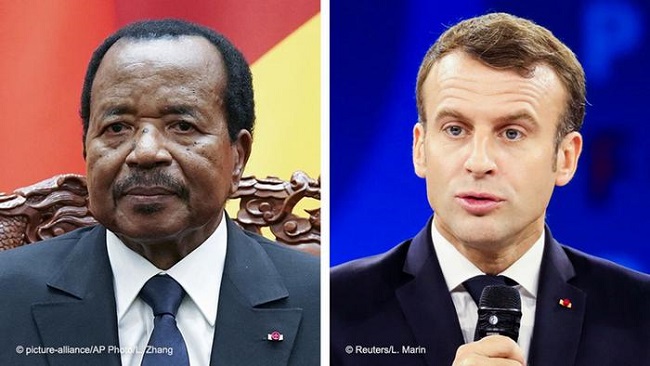
The political class in the Central African Economic and Monetary Community (CEMAC) watched last week with delight at how a French coup, installed37-year old Mahamat Idriss Deby as Chad’s new president. The coup unfolded without any significant internal or external objection. Besides a half-hearted statement issued by the African Union, asking for a return to civilian rule, the coup was treated by international actors as a simple matter in a region of many adventures. Thanks to neo-colonial France, the young and naïve Mahatma Deby has officially started his own 30-40 years reign of terror and misrule.
In neighbouring Cameroun, 88-year-old Paul Biya has misruled the country with an iron fist since November 6, 1982, after taking over from Ahmadou Ahidjo. Following numerous health scares over the last seven years, France has been working tirelessly in the background to find a suitable replacement that would keep its neo-colonial grip on the country and the CEMAC region going. Therefore, the coup in Chad offers hope to those in France and Cameroon who were concerned that Franck Biya succeeding his father, Paul Biya, would be tricky.
For 38 years, Paul Biya has divided and misruled his country to such an extent that France is concerned that a change of leadership to anyone out of the current crime syndicate would not serve France’s interest. France and Paul Biya have not groomed anyone within his ruling CPDM party for power and have had sleepless nights over the last seven years about the way forward. But the success of last week’s experience in Chad has calmed their nerves.
Cameroon Intelligence Report has been informed that Franck Biya is already receiving presidential protocol lessons and getting intelligence briefings from senior officials in the military, the gendarmerie, the secret service and the police. Many prominent media gurus and political scientists from France have been recruited to make the planned political succession as effortless as possible. Cameroon’s key institutions, such as the security services and military, including critical ministries and state agencies are all headed by President Biya’s trusted tribal cronies. Our source said Franck Biya has been holding private meetings with his father’s coterie of barons as they plan.
The thought of Franck Biya succeeding his father would be laughable in many countries where decency and high standards are part of the state political fabric. Franck Biya has never held a job and certainly is not a university graduate. He comes in with neither competence nor experience, but for France, this does not matter. What matters is his ability to do as Paris orders. The numerous conflicts in Cameroun have failed to draw in condemnation from major global powers. This intentional silence and inactivity have been due to France’s extensive work in the dark arts of international political lobbying.
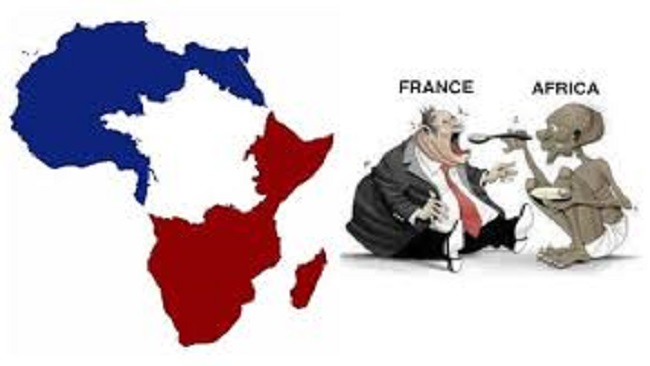
Hearing Macron talk to African countries about what is good for them is like having a lion lecture an antelope on protecting themselves. Since Europe realised that colonialism and theft had to end in the fifties, no other nation has been more aggrieved at ending neo-colonial theft and exploitation than France. The country’s entire economic system is built around the command, control and stealing of the natural resources of its former colonies. Portugal, Spain, Great Britain have all maintained a degree of political distance from their former preys, but France has doggedly refused to do the same.
Son-succeeding-father is a foreign policy objective of France in the CEMAC region designed to prolong their neo-colonial activities. At 77, Denis Sassou Nguesso of Congo Brazzaville, who has accumulated 36 years in office, has his son Denis Christel Sassou-Nguesso as he preferred successor. President Ali Bongo of Gabon, who has been incapacitated since suffering a stroke in 2018, has appointed his 29-year-old son, Noureddin Bongo Valentin, as the General Coordinator of Presidential Affairs. Current president Ali Bongo succeeded his father, Omar Bongo, who ruled Gabon for 42 years. Equatorial Guinea already has a President-in-waiting, the son of President Teodoro Obiang Nguema, who has led the country since staging a coup in 1979.
France has made a habit of throwing petrol bombs around Africa to serve its interest. It is grossly wrong to think that it will never face a day of reckoning for its meddling in African political affairs. In the brutal arena of International Relations, it is naïve to expect nation-states to be pleasant. But Africans are not asking for a friendly France; they ask for France to leave African politics to Africans.
Weak institutions in the CEMAC region are sturdy pillars of enriching the French Treasury. Nothing illustrates this better than the ongoing attempt to get a lineup of sons replacing their dads. Africa is paying the price for political passivity and France’s ruthlessness.
Integrity is an unknown noun in the French diplomatic community when it comes to dealing with Africa. France is a vacuum of integrity, and it is sowing the seeds of future turmoil in Africa with impunity. France has a lifelong contempt for the norms of decent behaviour in political leadership. What will not alter if Africans remain mute is the character of France. Apologists posit that sons succeeding their fathers offer continuation and political stability. The question is the continuation and strength of what and for whom?
France’s greatest weakness is in consistently underestimating the youths of Africa and the intelligence of Africans. Like the protests in Senegal, Mali and Chad, we need more of them and real political action in the continent to bring this evil to an end.
By Isong Asu with Intelligence Files
Cameroon Concord News Group
London Bureau Chief



















29, April 2021
US: Biden lays out ambitious plan, promises to turn ‘peril into possibility’ 0
President Joe Biden declared Wednesday night in his first address to a joint session of Congress that “America is rising anew,” and pointed optimistically to the nation’s emergence from the pandemic as a vital moment to rebuild the U.S. economy and fundamentally transform government roles in American life.
Biden marked his first 100 days in office as the nation pushes out of a menacing mix of crises, making his case before a pared-down gathering of mask-wearing legislators because of pandemic restrictions.
Speaking in highly personal terms while demanding massive structural changes, the president urged a $1.8 trillion investment in children, families and education to help rebuild an economy devastated by the virus and compete with rising global competitors.
His speech took place in a setting unlike any other presidential address in the familiar venue, with the U.S. Capitol still surrounded by fencing after the building was stormed in January by insurrectionists protesting his election.
The nationally televised ritual of a president standing before Congress for the first time was one of the most watched moments of Biden’s presidency so far, a chance to sell his plans to voters of both parties, even if Republican lawmakers prove resistant.
“America is ready for takeoff. We are working again. Dreaming again. Discovering again. Leading the world again. We have shown each other and the world: There is no quit in America,” Biden said.
“I can report to the nation: America is on the move again,” he said. “Turning peril into possibility. Crisis into opportunity. Setback into strength.”
This year’s scene at the front of the House chamber had a historic look: For the first time, a female vice president, Kamala Harris, was seated behind the chief executive. And she was next to another woman, House Speaker Nancy Pelosi, both clad in pastel.
The first ovation came as Biden greeted, “Madam Vice President.” He added “No president has ever said those words from this podium, and it’s about time.”
The scene was familiar yet strange, with members of Congress spread out, a sole Supreme Court justice in attendance and many Republicans citing “scheduling conflicts” to stay away.
There was no need for a “designated survivor,” with so many Cabinet members not there, and the chamber was so sparsely populated that individual claps could be heard echoing off the walls.
Biden was upbeat and forceful.
“I have never been more confident or more optimistic about America,” he said. “We have stared into an abyss of insurrection and autocracy — of pandemic and pain — and ‘We the People’ did not flinch.”
He repeatedly hammered home how his plans would put Americans back to work, restoring millions of jobs lost to the virus. He laid out a sweeping proposal for universal preschool, two years of free community college, $225 billion for child care and monthly payments of at least $250 to parents.
His ideas target frailties that were uncovered by the pandemic, and he argues that that economic growth will best come from taxing the rich to help the middle class and the poor.
For Biden, whose moment has been nearly a half century in the making, his speech also provided an update on combating the COVID-19 crisis he was elected to tame, showcasing hundreds of millions of vaccinations and relief checks delivered to help offset the devastation wrought by a virus that has killed more than 573,000 people in the United States.
He also championed his $2.3 trillion infrastructure plan, a staggering figure to be financed by higher taxes on corporations.
Unimpressed, Sen. Tim Scott of South Carolina said in the Republicans’ designated response that Biden was claiming too much credit in fighting the pandemic and reviving the economy.
“This administration inherited a tide that had already turned,” Scott said. “The coronavirus is on the run.”
Seizing an opportunity born of calamity, Biden has embraced major action over incremental change. But he will be forced to thread a needle between Republicans who cry government overreach and some Democrats who fear he won’t go big enough.
The Democratic president’s strategy is to sidestep polarization and appeal directly to voters. His prime-time speech underscored a trio of central campaign promises: to manage the deadly pandemic, to turn down the tension in Washington in the aftermath of the insurrection and to restore faith in government as an effective force for good.
Biden also was addressing an issue rarely confronted by an American president, namely that in order to compete with autocracies like China, the nation needs “to prove that democracy still works” after his predecessor’s baseless claims of election fraud and the ensuing attack on the U.S. Capitol.
No American politician has more familiarity with the presidential address to Congress than Biden.
He spent three decades in the audience as a senator and eight years as vice president seated behind President Barack Obama during the annual address.
Yet the desire for swift action is born from political necessity. Biden understands that the time for passing his agenda could be perilously short given that presidents’ parties historically lose congressional seats in the midterm elections, less than two years away. The Democrats’ margins are already razor-thin.
He spoke against a backdrop of the weakening but still lethal pandemic, staggering unemployment and a roiling debate about police violence against Blacks.
Biden also used his address to touch on the broader national reckoning over race in America, and to call on Congress to act on prescription drug pricing, gun control and modernizing the nation’s immigration system.
In his first three months in office, Biden has signed a $1.9 trillion COVID-19 relief bill — passed without a single GOP vote — and has shepherded direct payments of $1,400 per person to more than 160 million households.
Hundreds of billions of dollars in aid will soon arrive for state and local governments, enough money that overall U.S. growth this year could eclipse 6% — a level not seen since 1984.
Administration officials are betting that it will be enough to bring back all 8.4 million jobs lost to the pandemic by next year.
A significant amount proposed Wednesday would ensure that eligible families receive at least $250 monthly per child through 2025, extending the enhanced tax credit that was part of Biden’s COVID-19 aid.
There would be more than $400 billion for subsidised child care and free preschool for all 3- and 4-year-olds.
Another combined $425 billion would go to permanently reduce health insurance premiums for people who receive coverage through the Affordable Care Act, as well a national paid family and medical leave program.
Further spending would be directed toward Pell Grants, historically Black and tribal institutions and allow people to could attend community college tuition-free for two years.
Funding all of this would be a series of tax increases on the wealthy that would raise about $1.5 trillion over a decade.
Biden wants to raise the top tax rate on the most affluent families from 37% to 39.6%. People earning in excess of $1 million a year would see their rate on capital gains — the profits from a sale of a stock or home — nearly double from 20% to 39.6%, which would mean the wealthiest Americans could no longer pay at a lower rate than many families who identify as middle class.
He took aim at a hallmark achievement of the Trump presidency, saying the 2017 tax cuts failed to deliver on Republicans’ promise of strong growth. It was a recognition of how narrow the common ground is between the two parties.
“When you hear someone say that they don’t want to raise taxes on the wealthiest 1% and on corporate America – ask them: whose taxes are you going to raise instead, and whose are you going to cut?” Biden said.
Republican lawmakers in Congress so far have balked at the price tags of Biden’s plans, complicating the chances of passage in a deeply divided Washington.
Source: AP