2, November 2020
Africa needs a few Donald TRUMPs 0
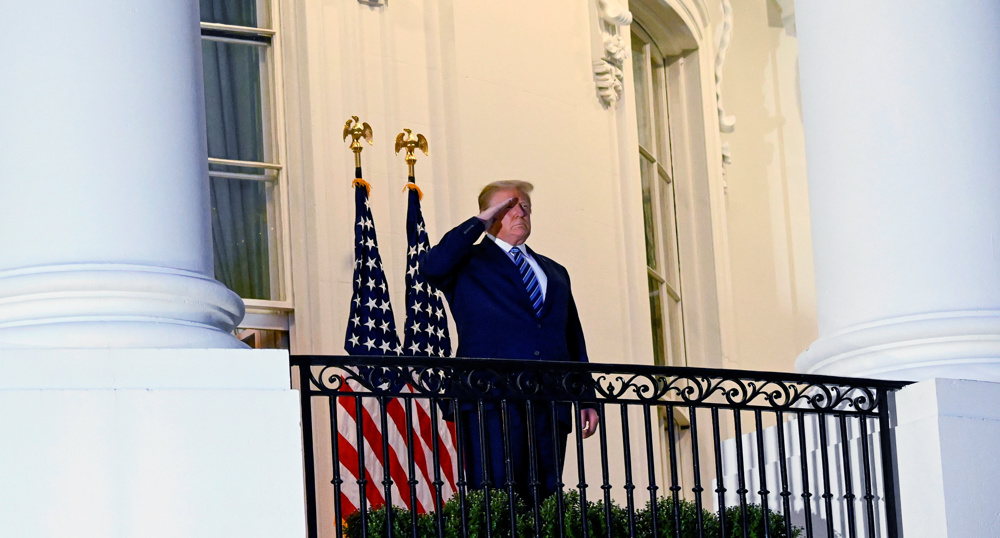
The USA presidential elections are less than 24 hours away. Unfortunately, I don’t have a vote. Otherwise, Trump could count on my vote 100%.
As an African, you might be wondering why I am pro-Trump. That is exactly the stereotype that drives me towards Trump. Yes, I am Black, but I would rather be voting for Trump.
I strongly believe that Africa would be a much better place today, if it had such leaders as Trump. Why is that?
1. Trump is not a career politician. I am more interested in results than political correctness. In any case, political ideologies and practices in Africa today are still essentially “copy and paste” from the colonial masters; and that is one of the major problems facing Africa today.
2. Trump is already a successful businessman. He does not need the presidency for daily subsistence. Most African leaders get into politics, not to serve, but primarily as a means to make a living. Consequently, they easily succumb to financial improprieties.
3. Trump puts America first. I really wished that the African leaders put Africa first. They appear to put their pockets and the interest of their colonial masters and mentors first.
4. Trump stands for small government. I am sick and tired of Africans looking up to the government for everything, and the leaders continuing to give the impression that citizens livelihoods are at their mercy. Most of the developed world was built by the private sector, with the governments only providing the enabling environment. For example, most of the UK’s vital public services (water, electricity, telecoms, railways) only became state corporations through a process of nationalization from private ownership after the 2nd world war. These companies have since been privatized, a sign that the government is not such a good manager.
5. Trump has strong self-belief and stays the course. The leaders closest to Trump that Africa has had, irrespective of ideology include Kwame Krumah of Ghana, Thomas Sankara of Burkina Faso, Patrice Lumumba of Congo DRC, Nelson Mandela of South Africa, and now Paul Kagame of Rwanda. Most of today’s leaders have no ideology, and are only interested in gaining and keeping power, at all cost.
6. Trump has a great family. Success is contagious. No unsuccessful leader can raise such very successful children. This competency inevitably translates into success for business, careers and country.
7. Trump embodies the “Power of One”, a phrase I borrowed from Cameroonian writer Patrice Nganang. History, innovation, and significant milestones are often initiated and led by ONE person, be it sports, entertainment, innovation etc. Trump is a true leader and we need such leaders in Africa.
8. Trump brings contradiction and innovation. Some may call it division, but I am tired of the African talk of unity as a pre-requisite for all human progress. No, No. Unity in Africa means that people should FOLLOW whoever is in a position of leadership without question. The physically strong quickly fight themselves into positions of power and preach unity as a tool to keep power. If anything, Africa needs more division (diversity) than unity (conformity) within a level playing field.
Win or lose on November 3rd, 2020, Trump is my hero. I wished we had a few TRUMPs in Africa today. But I have no doubt that the African Trumps will emerge.
I would appreciate your constructive comments. And if you think this article makes interesting reading, please share.
Gene Worifah
Nov 2, 2020













3, November 2020
The Anglophone crisis in Cameroon: Ambazonia is bleeding 0
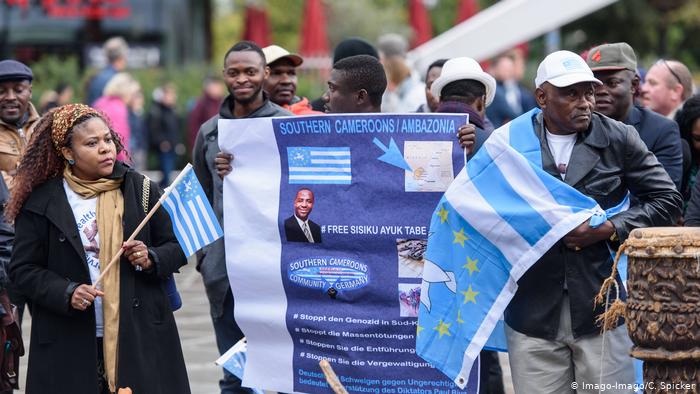
The Anglophone problem in Cameroon is often described as the evolution of the Anglophone’s awareness from the feeling of being marginalised, exploited and homogenised politically, economically and socially by the Francophone-dominated state and even the Francophone population.
The failure to promote the rule of law and democracy creates an environment for conflict, often exacerbated by marginalisation, discrimination, inequality and inequity.
The bitterness of citizens roused to violence is usually entrenched in lack of basic services and public infrastructure, corruption, lack of personal and economic security and lack of transparency and accountability of government to its citizens. Thus, the greatest problem of African countries is their failure to protect the economic, political, social and cultural concerns of their people. This year, 2020, has been marred by a series of human rights violations from Lagos to Kumba. Africa is bleeding.
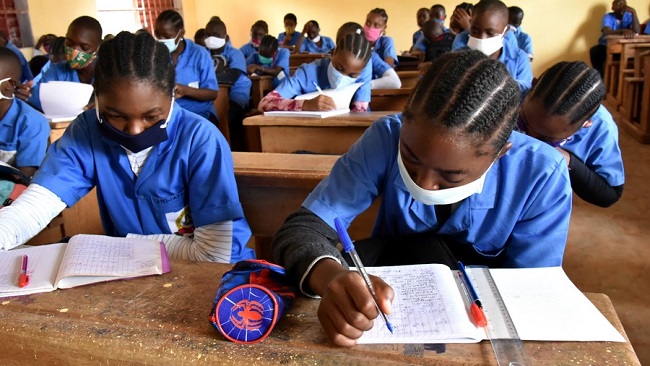
On 24 October 2020, at least eight children were killed and dozens wounded by a group of armed men at the Mother Francisca International Bilingual Academy Kumba, in the Southwest Region of Cameroon. There have been a lot of attacks in Cameroon since 2016. However, these attacks have intensified dramatically.
Since the Anglophone crisis in Cameroon began in 2016, hundreds of people have died, more than 70 villages have been destroyed, about 160,000 people are internally displaced while 35,000 people have sought refuge in Nigeria, Cameroon’s neighbouring country. This crisis has also led to months of general strikes, innumerable days of internet shutdown and the loss of academic years.
What began as a peaceful strike by teachers and lawyers in 2016 led to a conflict between the government and an armed separatist movement of the Anglophone region. This crisis is a serious threat to efforts to build national harmony and unification in Cameroon and has led to the re-establishment of strong contentions and conducts in support of secession and/or federalism by Anglophones. This is because at the centre of this conflict is the Anglophones’ wish to secede from Cameroon and form their own independent state called Ambazonia.
Many analysts contend that the conflict is a result of the unmanageable historical animosity between Cameroon’s Anglophones and Francophones in terms of varying language, culture and identity. Thus, if the differences in identity, language and culture are the primary drivers of the conflict as these analysts contend, it is quite surprising that Cameroon, one of the most ethnically diverse countries in Africa, has to a great extent avoided conflict until 2016.
This crisis goes way beyond language, culture or identity. It is a resurgence of an old problem known as the Anglophone problem. The Anglophone problem is often described as the evolution of the Anglophone’s awareness from the feeling of being marginalised, exploited and homogenised politically, economically and socially by the Francophone-dominated state and even the Francophone population in Cameroon.
The Anglophone problem is driven by the marginalisation and discrimination against the Anglophones in Cameroon in decision-making nationally; the dilapidation of the region’s infrastructure; the exploitation of the region’s rich economic resources by successive Francophone administrations without much beneficiation to the local communities; and marginalisation in human resource development and deployment by the inundation of Anglophone regions with Francophone employees and workers.
It is driven by the marginalisation of the Anglophones in the allocation of economic resources by the Francophones, especially by the mismanagement of the economic patrimony in the Northwest and Southwest regions of Cameroon; the common law system and the francophonisation of the English educational system; gradual erosion of Anglophone identity; the predominance of French and Francophones in official documents and public offices respectively; as well as the second-class citizenship of the Anglophones when compared with the Francophones.
The principle of territorial integrity and sovereignty may bar international actors from intervening. However, one can start from the low hanging fruit. For example, European media can call out President Biya for always spending his time and his country’s resources in Switzerland and other European countries without reasonable justification.
Atrocities and the killings of the innocents cannot continue and must stop. While President Paul Biya of Cameroon has made several commitments to end the conflict in Cameroon, there has to be a genuine commitment for the equal and equitable distribution of resources to the Anglophone regions as enshrined in the preamble of the Constitution of the Republic of Cameroon 1996, which stipulates that all citizens “have equal rights and obligations” and “the state shall provide all its citizens with the conditions necessary for their development” and that the state has a positive obligation to ensure that it protects the rights of the minorities. This must be upheld by the government of Cameroon.
Even if there is a commitment on the part of the Anglophones and the government of Cameroon to end the conflict and there are resources to do so, there may be an issue with the authorising environment. This is because President Biya began his rule in Cameroon in 1982 and is serving his seventh term, making him one of the longest-serving presidents in Africa and the world.
This means that for an average Cameroonian, s/he has only known one president since birth. Since the early 1990s, it has been speculated that President Biya is aloof to the needs of his people and has made very few public appearances. He is termed an absentee president who regularly spends extended periods in Switzerland with the excuse from his government that he goes to Switzerland to work without being disturbed. This deficit in governance, as well as the economic apartheid of the Anglophones, are some of the reasons for the demand for a change in the system of government from autocratic to democratic rule.
The bilateral partners of Cameroon such as France, the United Kingdom, the United States of America and other national, regional and international organisations should put pressure on the Cameroonian government to put in place a course of action to assuage the situation, partake in a genuine national dialogue and transform the governance archetype. The government of Cameroon should allow for negotiation and mediation during the national dialogue between parties, where necessary.
The principle of territorial integrity and sovereignty may bar international actors from intervening. However, one can start from the low hanging fruit. For example, European media can call out President Biya for always spending his time and his country’s resources in Switzerland and other European countries without reasonable justification.
Last, the African Union has a huge role to play in this crisis. Just like the Confederation of African Football (CAF) deprived Cameroon the right to host the Africa Cup of Nations in 2019, the African Union can strip Cameroon of the benefits that it enjoys from the continental body and may also place economic and political sanctions on Cameroon such as travel bans and restrictions on access to services in the international arena until it resolves the Anglophone crisis.
Thus, it is imperative to acknowledge that the Anglophone crisis may continue to simmer if the Anglophones still feel marginalised. Therefore, the government of Cameroon must make a conscious effort to address the concerns of the Anglophones, particularly in the allocation and management of economic resources and representation in state institutions.
Source: Daily Maverick