
23, March 2020
Coronavirus confines one billion to homes, death toll passes 13,000 globally 0
Cases of infection with the new coronavirus continue to surge throughout the world, and restrictions put in place by governments to contain the pandemic have confined one billion people to their homes in different countries.
The following are the latest on the coronavirus epidemic around the globe.
As many as 300,000 infections have been confirmed across the globe while the number of worldwide fatalities has exceeded 13,000.
Italy, the world’s hardest hit country, recorded a jump in its death tally from the viral infection on Saturday. Fatalities jumped by 793 to 4,825 in the largest one-day rise since the contagion emerged in Italy a month ago.
Confirmed cases of infection also rose to 53,578 from 47,021, the Civil Protection Agency said Sunday.
Cuban doctors, nurses rush to help fight virus in Italy
Italy requested Cuba to send a brigade of doctors and nurses to its worst-hit northern region of Lombardy, which, according to health officials, remains in a critical condition with 3,095 deaths and 25,515 cases.
Cuba sent a team of 36 doctors, 15 nurses, and a logistic expert to the country on Saturday night.
Cuba has already sent “armies of white robes” in recent days to combat the spread of the virus to several countries, including Venezuela, Nicaragua, Jamaica, Suriname, and Grenada.
But this was the first time Cuba was sending an emergency contingent to a European country.
Cuban doctors were in the front lines in the fight against cholera in Haiti and against the Ebola epidemic in West Africa in the 2010s.
The country has 8.2 doctors for every 1,000 people, one of the highest rates in world, according to the World Bank.
Russia sending military medics to Italy
The Russian army is also sending medical help to Italy on Sunday, after receiving an order from President Vladimir Putin, according to the Russian Defense Ministry.
The ministry said military transport planes would deliver eight mobile brigades of military medics, special disinfection vehicles, and other medical equipment to Italy.
Putin offered his support and help to Italian Prime Minister Giuseppe Conte during a phone call on Saturday, the Kremlin said.
Russia itself has reported one death and 306 infections, most of them in Moscow.
Spain: Worst yet to come
The coronavirus death toll in Spain, meanwhile, reached 1,326 on Saturday, from 1,002 the day before, and the number of infected people rose to 24,926, from 19,980.
The Spanish government, however, warned that “the worst is yet to come,” but promised to do whatever was needed to combat the epidemic.
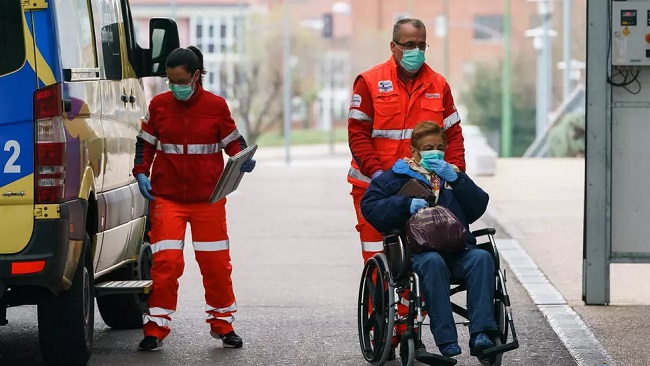
A total of 5,000 people have so far died of the infection across Europe, with Italy, Spain, and Germany reporting steep rises in both infections and deaths.
UK predicts jump in numbers
In the United Kingdom, a total of 5,018 have been infected with the virus, while 233 patients have succumbed to the disease.
Prime Minister Boris Johnson has warned that Britain’s National Health Service could be “overwhelmed” by the virus like Italy’s health system in just two weeks.
“The numbers are very stark, and they are accelerating. We are only a matter of weeks – two or three – behind Italy,” he said.
Increase in US cases as widespread shutdowns enforced
In America, 26,900 people have tested positive and 348 people have died of the novel coronavirus.
Almost 1 in 4 Americans were obliged to close up shop and stay at home on Saturday.
Meanwhile, Republican and Democratic leaders are still working on reaching a deal to pump over $1 trillion into the economy on top of the hundreds of billions of dollars in fiscal and monetary stimulus that have already been used to support the world’s largest economy.
China sees rise in imported cases
China, where the virus first emerged in December last year, said the imported cases of the disease continued to rise.
The National Health Commission reported 46 new cases of coronavirus on Sunday.
China has drastically reduced the number of locally transmitted cases. After four consecutive days of zero such cases, health officials reported the first local transmission on Saturday.
The latest figures bring mainland China’s total cases to 81,054, with 3,261 deaths, including six on Saturday.
The central province of Hubei, where the outbreak first emerged, reported its fourth straight day of no new cases.
North Korea says Trump offered help
North Korea said on Saturday that the US had offered cooperation in the country’s fight against the pandemic.
US President Trump “expressed his intent to render cooperation in the anti-epidemic work, saying that he was impressed by the efforts made by the Chairman to defend his people from the serious threat of the epidemic,” the North’s official news agency, KCNA, said, referring to North Korean leader Kim Jong-un.
It did not say when the letter had been received.
A senior US administration official confirmed Trump had sent a letter to Kim and offered help. The official said Trump looked forward to continuing communications with the North Korean leader.
Pyongyang, which has not reported any cases of the infection, welcomed the offer, saying it was a sign of “the special and very firm personal relations” between Kim and Trump, according to KCNA.
Trump has attempted to build a relationship with Kim but has refused to lift any sanctions on North Korea. Negotiations between the two countries on demilitarization have snagged.
Two dead in Sri Lanka jail clash over coronavirus restrictions
Two prisoners in Sri Lanka’s Anuradhapura prison were killed and six others injured after fighting broke out over restrictions to prevent the spread of the new coronavirus to the facility on Saturday.
Clashes erupted between prison guards and prisoners when the inmates began to complain about a ban on visitors. Some inmates attempted to escape amid the clashes.
Police said on Sunday that the guards had opened fire to prevent the prisoners from fleeing.
Sri Lanka imposed a three-day countrywide curfew on Friday. The number of infections in the country stands at 77. Sri Lanka’s prisons are overcrowded, sometimes reportedly housing 5,000 inmates in a facility capable of holding only 800.
India launches 24-hour curfew
The fast-spreading coronavirus prompted India to launch a 14-hour curfew on Sunday, in a crucial test of its abilities to fight the pandemic.
India has reported 315 infections so far.
Malaysia traces worshipers, deploys army to enforce ban on movements
Malaysia says authorities are tracing thousands of worshipers who attended a four-day mass religious event at a mosque near the capital, Kuala Lumpur, at the end of last month.
The government said the religious event was connected to 60 percent of all the 1,183 cases in the country.
Officials said on Thursday that they had yet to trace 4,000 of the 14,500 Malaysian residents who attended the mosque.
The government has also enforced a two-week ban on travel and movements, starting on Wednesday. It said army force would be deployed to help police enforce the ban.
Malaysia has the highest number of infections in Southeast Asia, which has a total of more than 3,000 cases.
Indonesia reports more deaths
The Indonesian Health Ministry on Sunday updated the new number of coronavirus infections and deaths in the country to 64 and 10 respectively, bringing the total number of confirmed cases to 514 and the fatality count to 48.
Death toll exceeds 1,680 in Iran
Iranian Health Ministry spokesman Kianoush Jahanpour said on Sunday that 1,028 new coronavirus cases had been diagnosed within the past 24 hours, bringing the total number of infected individuals to 21,638.
“With 129 new deaths in the past 24 hours, the death toll from the virus has reached 1,685,” he said.
Jahanpour further put the number of patients who have recovered from the viral disease at 7,913.
Jordan deploys troops, armored vehicles amid curfew
In the Middle East, Jordan started a nationwide curfew “until further notice” on Saturday, warning its 10 million citizens to stay indoors.
“Anyone going outside will be subjecting themselves to punishment,” Justice Minister Bassam Talhouni told Jordan’s al-Mamlaka news channel.
Thousands of soldiers and armored vehicles have been deployed inside cities and on main highways across the country, according to witnesses.
Jordan has closed land and sea border crossings with Syria, Iraq, and Egypt, and suspended all incoming and outgoing flights since Tuesday.
Coronavirus cases in Jordan have risen to 99, including 15 new cases identified on Saturday.
Kuwait orders partial curfew
Meanwhile, Kuwait has ordered a partial curfew starting Sunday evening till early Monday morning.
The decision was made due to “some manifestations of non-compliance with precautionary measures,” Deputy Prime Minister Anas al-Saleh said.
Those who violate the curfew could face up to three years in jail or fines of up to 32,157 dollars.
The Kuwait National Guard will aid police in imposing the curfew.
The Persian Gulf country has reported 176 cases of infection.
Kuwait has taken some of the most drastic steps in the region, including the closure of schools and universities until August.
Coronavirus spreading in Africa
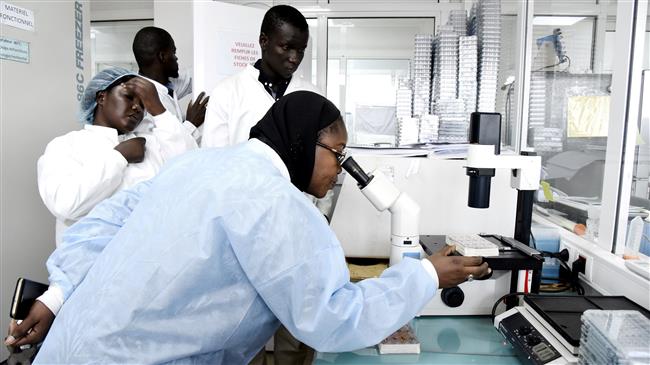
The coronavirus continues to spread across Africa, with more than 1,000 confirmed cases across the continent so far, according to the World Health Organization (WHO).
Eritrea and Uganda reported their first cases on Sunday, while Mauritius confirmed its first death, with 14 cases of infection so far.
South Africa, which has the most cases in sub-Saharan Africa, reported a total of 240 infections on Saturday.
Health experts have been concerned that Africa will not be able to handle a surge in cases due to the lack of medical facilities.
Source: Presstv











23, March 2020
The Southern Cameroons Crisis Demands A Real Dialogue 0
The Anglophone Crisis has ravaged an area of Cameroon that is home to more than 3.5 million people – approximately a seventh of the country’s population – and yet it remains one of the world’s forgotten conflicts. General strikes and protests beginning in 2016 gave way to a formal declaration of independence the following year, pitting English-speaking separatists against President Paul Biya’s Francophone government in Yaoundé. The situation has deteriorated since, with last month’s parliamentary elections leading to further unrest.
At the start of the year, Mr. Biya promised that the deployment of additional troops to the area would ensure that the vote proceeded as planned. Polls across the Northwest and Southwest regions were indefinitely postponed anyway, even as the military presence remained.
In the English-speaking Northwest and Southwest regions of Cameroon, teenagers are kidnapped and mutilated by separatist militants who want to discourage them from attending schools. Villages like Ngarbuh are the site of brutal massacres, shows of force orchestrated by government soldiers seeking to dissuade civilians from harbouring dissidents. Candidates for political office risk kidnapping and assaults and more than 80% of schools, and 40% of health centres are closed. Over 3,000 people are dead and more than 700,000 displaced, including 50,000 refugees who have fled across the border to Nigeria. The Cameroonian army’s inability to curb separatist influence and its complicity in atrocities like the attack on Ngarbuh, suggests that higher numbers of boots on the ground will do little to stem the bloodshed.
Cameroon’s linguistic divide and the grievances that it has fostered is rooted in the country’s very foundation. A 1961 referendum led to what is currently Northwest and Southwest Cameroon joining a newly-independent French Cameroon, instead of English-speaking Nigeria to the north despite a history of English rule. The absence of leadership from the British and French governments, whose forerunners laid the groundwork for this powder keg, is a particularly striking failure.
UK Prime Minister Boris Johnson has been silent on the matter since a 2018 tweet, back when he was Foreign Minister, which noted an “urgent need to pursue dialogue, decentralisation and respect #humanrights in Anglophone Regions as [Paul Biya] has previously committed.”
French President Emmanuel Macron vowed to exert “maximum pressure” on Mr. Biya to address the Ngarbuh massacre. He quickly adopted a more conciliatory tone. A phone call at the beginning of March succeeded in defusing the resulting tensions between France and Cameroon, but did little to advance prospects of a peaceful resolution to the crisis. Biya’s commitment to an investigation of the massacre following the call was a hollow victory for Macron. Cameroon’s government had already announced it was opening an inquiry and the problems the country faces extend far beyond one act of violence.
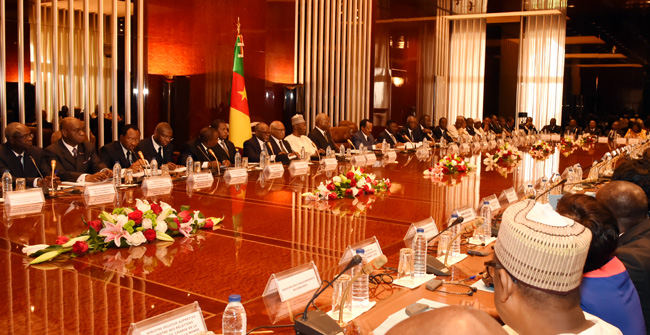
Efforts within Cameroon to find a resolution have been more concerted but just as ineffective. The Major National Dialogue, a summit called by Mr. Biya in September and October last year, made for good political theatre. It excluded several major separatist leaders, some of whom were still in government detention. These meetings produced vague commitments for greater Anglophone autonomy. A period of intensified violence immediately followed them in western Cameroon.
Though devolution is a step in the right direction, Mr. Biya’s subsequent efforts to placate the separatists were doomed to fail, due to their limited scope and the lack of consultation. Legislation passed by parliament in December promised “special status” for the Northwest and Southwest regions, granting them their own legislative assemblies and executive government. The bill was pursued by the Biya government unilaterally with little concern for the input of the people it was meant to appease. Moreover, the provisions granted under “special status” are insufficient. Critics describe it as “too little, too late,” noting that many of these autonomous institutions would still depend on Yaoundé to approve their decisions. Amid a crisis where lack of trust in the central government fuels Anglophone resistance, only genuine consultation and good-faith negotiations can remedy the situation.
For that kind of dialogue to happen, French and British absenteeism must end. Mr. Macron, whose country is Cameroon’s closest partner, should follow the lead of President Donald Trump, whose administration last year reduced military assistance and trade concessions to Cameroon in response to its human rights violations. Military and economic influence can be used to corral Mr. Biya into commencing negotiations and the involvement of foreign leaders in the peace process will help ease the doubts of separatist leaders. Several Anglophone groups boycotted the Major National Dialogue due to scepticism about the Cameroonian president’s intentions and lack of international oversight. Meaningful involvement from Messrs Trump, Macron and Johnson would go some way in kick-starting the peace process.
Mr. Biya will need to engage with the broad array of separatist groups claiming to represent English-speaking Cameroonians. There is no point for a peace agreement that excludes some groups, as they will simply continue fighting. Releasing political prisoners and mollifying the concerns of separatist leaders who boycotted last year’s summit is imperative. The separatists, for their part, cannot continue to violently enforce bans on education and political activities if they want to reduce military presence in the west. The government will not entertain reducing its troop deployment – a necessary precursor to fruitful negotiations – if militants continue to deprive the people in the region of education and healthcare access.
If Mr. Biya and the relevant opposition leaders are able to begin discussions, a successful outcome will depend on significant concessions from both sides. The extreme position of many separatists, an independent Anglophone state called Ambazonia, is untenable and would not be accepted by Mr. Biya or the international community. On the other hand, the response to December’s devolution bill proves that fundamental change is necessary to appease Cameroon’s English-speakers. Returning the country to a federal system (it was shortsightedly transformed into a unitary state in 1972) would preserve ultimate authority in Yaoundé, while still providing those in the Northwest and Southwest with genuine autonomy under a powerful regional government.
Separatists who have styled themselves as leaders of a newly independent state would be disappointed by the devolution of authority. By the same token, it remains questionable whether Mr. Biya would be willing to relinquish control after forty years of accumulating centralised power. The three years of violence and disorder have been bad for Cameroon and its Anglophone regions. Each escalation, troop deployment and human rights violation has merely exacerbated the conflict. This crisis will only end when the relevant parties are willing to make concessions through real dialogue instead of political performance.
Culled from The Organization For World Peace