21, March 2022
At least twelve soldiers killed in Burkina Faso attack 0
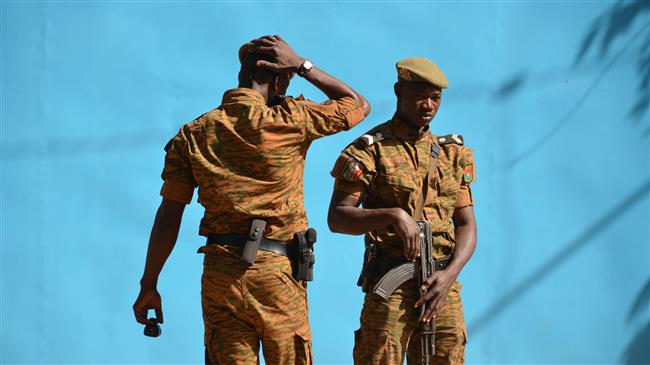
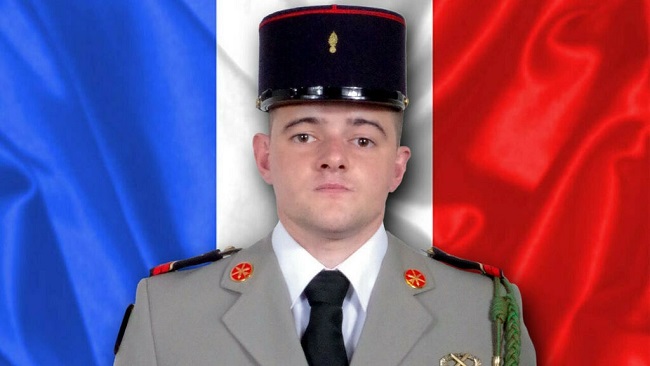
At least twelve soldiers were killed Sunday in eastern Burkina Faso by suspected jihadists, security sources told AFP, the sixth attack of its kind in the country in ten days.
“On Sunday, armed elements attacked a (military) unit around Natiaboani. The provisional toll is twelve fallen soldiers,” a security source told AFP.
“This was a patrol and security team that were attacked by presumed jihadists,” another security source told AFP, adding that around ten soldiers had been killed.
“Multiple elements on the enemy side were also neutralised,” they said, without giving further details.
Natiaboani is a rural community about sixty kilometres south of Fada N’Gourma, the largest town in the Eastern Region administrative area that since 2018 has been regularly targeted by armed groups.
Around 15 youths were kidnapped by armed individuals during an attack on Friday in nearby Nagre, according to the country’s information agency.
Burkina Faso has seen an uptick in violence after a period of relative calm following a military junta taking power in January.
Disgruntled officers toppled elected president Roch Marc Christian Kabore, who had been facing protests over his handling of the bloody jihadist insurgency.
In total, 23 civilians and 25 policemen or soldiers have been killed over the last ten days.
Burkina Faso has been struggling with jihadist attacks since 2015, when militants linked to Al-Qaeda and the Islamic State group began mounting cross-border raids from Mali.
The violence has killed more than 2,000 people and displaced at least 1.7 million, according to an AFP tally.
In January alone, 160,000 fled their homes, a group of international charities said last Thursday.
Source: AFP










6, April 2022
Burkina Faso’s ex-president Compaoré gets life sentence over murder of Thomas Sankara 0
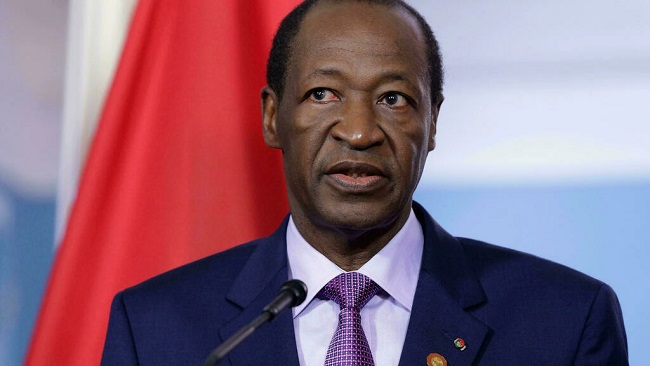
Burkina Faso’s former president Blaise Compaoré was sentenced in absentia to life imprisonment over his role in the 1987 murder of his predecessor Thomas Sankara, a military court ruled on Wednesday, wrapping up a six-month trial that was disrupted by a coup.
An iconic figure sometimes dubbed the “African Che Guevara”, Sankara was just 33 when he came to power in a coup in 1983, setting in motion a revolution that pledged to “decolonise African minds” and continues to inspire followers across the continent.
The short-lived experiment came to a brutal end on October 15, 1987, when he and 12 colleagues were gunned down by a hit squad during a meeting at the presidential palace in Ouagadougou. The massacre coincided with a coup that took Sankara’s erstwhile comrade Compaoré to power.
On Wednesday, the special court in Ouagadougou ruled that Compaoré was guilty of complicity in Sankara’s murder, sentencing him and his former head of security, Hyacinthe Kafando, to life in jail.
Prosecutors had demanded a 30-year jail term for Compaoré, who was deposed in a 2014 popular uprising and now lives in exile in neighbouring Ivory Coast since his ouster. The former president, who denounced a “political trial”, was tried in absentia on counts of attacking state security, concealing a corpse and complicity in a murder.
Throughout his 27-year reign, Compaoré clamped a tight lid on the circumstances of Sankara’s demise, fuelling speculation that he was the mastermind. It was only after his ouster in a popular uprising in 2014 that Sankara’s remains were exhumed, paving the way for the long-waited trial.
International ‘conspiracy’
One of the world’s poorest countries, Burkina Faso has a long history of political turmoil and is battling a jihadist insurgency that has claimed some 2,000 lives and displaced up to 1.8 million people.
Reflecting the turmoil, the trial was briefly suspended after a coup on January 24 that deposed the elected president, Roch Marc Christian Kaboré. It resumed after a new military strongman, Paul-Henri Sandaogo Damiba, restored the constitution and swore an oath.
Tensions between Sankara and his erstwhile ally Compaoré were described in detail during the six-month proceedings, with several witnesses pointing to an “international conspiracy” to remove a troublesome leader who was not afraid to challenge the world order and rebuke France, the former colonial power.
“The tragedy of October 15, 1987 was a result of pressure exerted by a number of heads of state, including Félix Houphouët Boigny,” said Abdoul Salam Kaboré, a sports minister under Sankara, referring to Ivory Coast’s former ruler and a key French ally.
Speaking via video-link from France, Sankara’s former close aide Moussa Diallo said there was no doubt the assassination “was premeditated” and that Houphouët Boigny “was at the heart of the plot”.
The longtime Ivorian leader once told Sankara, “[y]ou have to change, and if you don’t, we will change you,” Serge Théophile Balima, a former head of Burkina Faso’ state TV, testified in court.
In its closing statement, the prosecution recounted in grim detail the day Sankara was murdered by a hit squad that burst into a meeting of his National Revolutionary Council meeting, killing his guards.
“The squad then ordered president Sankara and his colleagues to leave the room,” the prosecution said. “They would then be killed one by one.”
Ballistics experts told the trial Sankara had been shot in the chest at least seven times by assassins using tracer rounds. At least one bullet was fired in his back.
The defendants had claimed the victims died in a botched attempt to arrest Sankara after he and Compaore fell out over the direction the country’s revolution was taking.
During the trial, “none of the accused confessed or repented – not a single one!” said Prosper Farama, a lawyer representing the Sankara family, adding that the family wanted “justice, not revenge”.
‘Pride of Africa’
While Sankara’s death put an end to his revolution, the premature and brutal manner of his demise would help cement the legend of a progressive leader who sought to empower the people in a continent blighted by colonial plunder and mismanagement.
Sankara followed in the footsteps of previous pan-African icons, including the likes of Ghana’s Kwame Nkrumah and Patrice Lumumba of the Democratic Republic of Congo, historian Amzat Boukari-Yabara told FRANCE 24 at the start of the trial.
“His originality was to defend the principle of people’s emancipation, rather than the emancipation of states. He called on the people of Africa to join forces around regional struggles, such as fighting desertification, and around continental challenges, like ending debt bondage,” Boukari-Yabara explained.
“On matters of governance, women’s rights, fighting forced marriage and female gential mutilation, climate and culture, he was a pioneer,” he added. “His assassination clearly marked the end of revolutionary pan-Africanism.”
The man who renamed the former French colony of Haute-Volta as Burkina Faso – meaning the “Land of the Honest”, or “Upright” – was ahead of his time in recognising climate change and desertification as the single biggest threat to the wellbeing of its people.
“The desert is at our gates, it’s already upon us, ready to engulf us,” he warned as he launched a massive tree-planting drive to “regreen” the country, halt soil erosion and foster sustainable agriculture. More than three decades after his death, his vision of a “wall of trees” holding back the encroaching desert has taken root in a pan-African project of breathtaking scale, a cross-continental barrier stretching from the Atlantic Ocean to the Red Sea.
None of this was possible without the liberation of women, Sankara would stress in his fiery speeches up and down the country, pointing out that women “carry the other half of the sky” – on top of the wood that fuels stoves and cookers and the water that feeds their families, their crops and their livestock.
“May my eyes never see and my feet never take me to a society where half the people are held in silence,” he once said. “I hear the roar of women’s silence. I sense the rumble of their storm and feel the fury of their revolt.”
That spirit has outlived Burkina Faso’s revolutionary captain, said Serge Ouédraogo, a high-school teacher in the capital, Ouagadougou – outshining the darker aspects of Sankara’s legacy, including his efforts to silence dissenters.
“Sankara is a whole philosophy, a way of thinking and living. He’s the pride of Africa,” Ouédraogo told AFP. “Today we can say that Sankara is a compass for the people of Burkina Faso. He’s a guide, the one who charts a path of hope for the people.”
Source: France 24