5, June 2022
Eposi Njoh Monyengi is first Cameroonian woman to install and maintain solar panels in her community 0
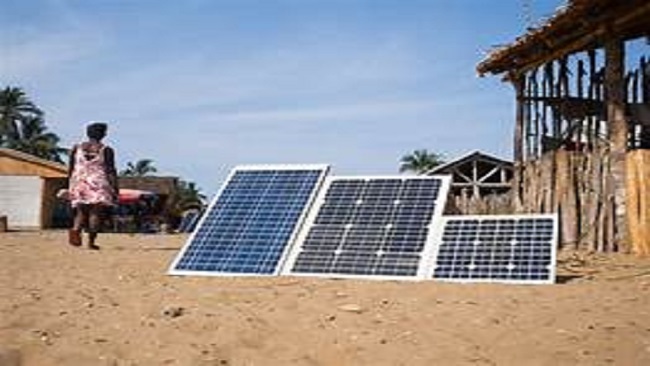
The sun shone from a cloudless sky in a quiet, bushy neighbourhood in Tiko, in Cameroon’s Southwest region. Eposi Njoh Monyengi was busy at work.
In less than an hour, she successfully installed a solar panel on a roof.
Supplying renewable energy to remote communities across Cameroon has become a passion for Monyengi, 44.
“My main aim is to light the community,” said the mother of three, the first woman to install and maintain solar panels in her community.
In Tiko, she has won respect for her work and fondly referred to as “solar mama.”
In 2019, with the help of a local non-governmental organization (NGO), Rural Women Development Project, Monyengi travelled to India, where she studied installation and maintenance of solar panels for six months.
Since her return to Cameroon, she has installed solar panels in over 200 households, impacting more than 600 people.
Monyengi’s work has provided inspiration and ignited hope among her neighbours, friends and family alike in Ombe, her native village also known as Bamukong, on the outskirts of Tiko.
SUNNY HOPE
For over 50 years, the village with about 400 inhabitants had no electricity.
In May last year, Monyengi took a motorcycle to the banks of the Ombe River and then crossed the river on a canoe to reach the remote village.
In three months, she installed solar panels in 54 households.
When reporters visited the village, the village was full of life and energy, and music boomed from bars in the agrarian community.
“We are very happy,” said Ignatius Tamala, whom Monyengi appointed as chairman of the solar committee of the village.
“The kids are studying well, until 10, 11 at night,” said the 47-year-old father of five. “They study very comfortably because there is electricity.”
As the sun set and darkness began falling over the village, 49-year-old Gladys Fienyam switched on her solar bulb and started grilling fish. She has been grilling and selling fish for eight years.
Not long ago, nightfall would have forced her to stop working, but now Fienyam can grill fish for as long as she wants.
“I am extremely happy. I don’t use torch again. I have more customers now and mostly because of light,” she said.
Across Tiko municipality, villagers said their standards of living have since improved remarkably thanks to access to solar energy.
Monyengi’s success story is a booster to the fight against climate change that has taken its toll on the livelihoods of people especially in Africa where droughts, erratic rainfall, floods have become more frequent.
Since 2015, Cameroon has made renewable energy a priority, especially for rural electrification.
WOMEN EMPOWERMENT
But the project is not just about going green.
Monyengi has made it a point of duty to train more “solar mamas.”
“When you empower women, you have empowered a whole nation,” she said. “When people see me, they are so excited to see a woman because not every woman can do it. Just their happiness encourages me to do more for them.”
After losing her job as a plantation worker, Cecilia Otto, 55, was low-spirited and began struggling to eke out a living as a farmer.
“‘Solar mama’ convinced me that I should learn how to install solar panels,” said the mother of five. “I was reluctant (at first) but I finally accepted. Today I am pleased that I did.”
Otto is among over 50 women trained by Monyengi to install and maintain solar panels in rural communities. She now accompanies Monyengi regularly to install the panels.
They were also joined by 61-year-old Joan Nkweti, a retired civil servant and widow with four children.
“When I heard about solar installation, I was so interested because it makes me exercise what I really wished to do as a youth,” she said.
“I am so happy I achieved something at this age,” Nkweti said.
“I can go and install solar panels without anybody’s help, because the training teaches you what to do and what not to do,” she said.
“You feel so satisfied. You feel so happy for achieving something,” Nkweti said.
As the world observes World Environment Day, Monyengi hopes that the government and international NGOs will help her expand the project to other communities.
Source: Xinhuanet

















6, June 2022
Climate talks start in Bonn as Ukraine war overshadows threat of global warming 0
Negotiators from almost 200 countries will meet in Bonn Monday for climate talks tasked with reigniting momentum on tackling global warming, as Russia’s invasion of Ukraine overshadows the threat from rising emissions.
The conference will set the stage for a fresh round of major United Nations talks later this year in Egypt.
It will also be a chance to test the resolve of nations facing a catalogue of crises, including escalating climate impacts, geopolitical tensions, bloodshed in Ukraine and the threat of a devastating global food crisis.
“Climate change is not an agenda we can afford to push back on our global schedule,” said outgoing UN climate change chief Patricia Espinosa ahead of the meeting.
She said it is imperative that nations arrive at the UN COP27 meeting in Sharm el-Sheikh in November prepared to show they are taking “bold, concrete steps — backed by specific plans — to deliver the urgent and transformational climate ambition we simply must see before it’s too late”.
Governments have already accepted that climate change is a grave threat to humanity and the planet, and have advocated immediate action to cut fossil fuel emissions and prepare for the accelerating impacts of warming.
The summary to this year’s landmark climate report from the Intergovernmental Panel on Climate Change concluded that any further delay in action “will miss a brief and rapidly closing window of opportunity to secure a liveable and sustainable future for all”.
But as things are going, the world is unlikely to be able to meet the Paris climate deal’s commitment to limit warming “well below” 2 degrees Celsius above pre-industrial levels.
“There is this disconnect between the scientific evidence of global crisis in the making, of potentially rushing towards unmanageable climate impact, versus the lack of action,” Johan Rockstrom, director of the Potsdam Institute for Climate Impact Research, told AFP.
“This is a deep worry.”
The world has warmed nearly 1.2C so far — enough to usher in a crescendo of deadly heatwaves, floods and storm surges made worse by rising seas.
Funding focus
While the June 6 to 16 conference in Bonn is a largely technical meeting aimed at preparing for Egypt, there are a number of key issues up for debate.
A particular focus will be funding from rich polluters to help vulnerable developing nations least responsible for global heating to cope with its increasingly ferocious consequences.
A promise of $100 billion a year from 2020 to help them adapt to a warming world has still not been met.
Meanwhile, there are growing calls for “loss and damage” funding for countries already struck by devastating climate impacts, with a specific dialogue on the subject slated for this week.
The Alliance of Small Island States has warned that the Bonn conference must not be “just another talk shop”, calling for a “clear view” on when and how this financing will be put in place.
‘Fragile’ world
UN Secretary General Antonio Guterres last week warned that Russia’s invasion of Ukraine risked slowing action to combat the climate crisis.
“But I think this war has demonstrated one thing: how fragile the world is in its dependence to fossil fuels,” he added.
The invasion has prompted countries, particularly in Europe, to scramble to shore up energy supplies. It has also caused wheat and fertiliser prices to soar.
Fears of a food crisis have intensified in recent weeks, with India moving to ban wheat exports after the hottest March and April on record — blamed largely on climate change — hit harvests.
One opportunity for exhibiting political will comes on Wednesday when the European Parliament votes several hotly debated planks of the bloc’s sprawling “Fit for 55” climate plan.
EU member states have set themselves the target of reducing their greenhouse gas emissions by 55 percent by 2030 compared to 1990, and achieving carbon neutrality for the continent by 2050.
In May, an analysis from non-profit groups found that countries in the G20 group of major economies have yet to strengthen greenhouse gas reduction goals, despite agreeing to revisit their plans.
Last year in Glasgow, countries made new pledges to slash methane emissions, stop deforestation and other measures that — in addition to existing national carbon cutting pledges — could theoretically cap warming under 2C, said Rockstrom.
But that means the focus at this year’s meetings needs to be on “accountability”, he added.
“We are now in the delivery phase”.
Source: AFP