26, October 2021
Anti-coup protests in Sudan continue with 7 killed, 140 injured 0
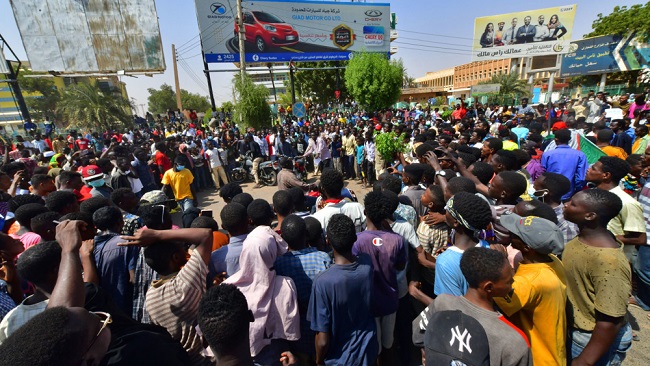
Protesters in Sudan remained in the streets on Tuesday, despite the violence, a day after the country’s military seized power from a transitional government in an apparent coup d’état.
At least seven protesters have been killed and 140 others injured in the countrywide protests that broke out on Monday.
Military forces in the African Union country on Monday detained Prime Minister Abdallah Hamdok after besieging his house. He was taken to an unknown location “after refusing to support coup”.
Hamdok had shared power with the country’s military leadership following the ouster of former president Omar al-Bashir more than two years ago.
Hours after the apparent military coup on Monday, Sudan’s main opposition coalition called for civil disobedience and protests across the country.
The Sudanese Information Ministry said the Forces of Freedom and Change alliance had demanded that the transitional military council step down and transfer power back to the civilian government.
The alliance also called for the release of all detained members of the Sudanese cabinet and the Sovereign Council, the ministry said on its Facebook account.
On Tuesday, more than 24 hours later, protests were gathering momentum across the country, according to reports.
Sudanese security forces keep watch as they protect a military hospital and government offices during protests on October 25, 2021 in the capital’s twin city of Omdurman. (Photo by AFP)
Protesters were chanting slogans like “returning to the past is not an option,” and “civilian rule is the people’s choice,” while some were using tyres to create burning barricades.
The employees of the country’s central bank have also announced a strike to reject the coup, according to the Information Ministry.
The protests have, however been marred by violence. The country’s Health Ministry on Tuesday announced that at least seven people had been killed by gunfire and 140 others were injured.
Authorities said tens of thousands of people opposed to the takeover had taken to the streets and had faced gunfire near the military headquarters in the capital Khartoum.
The Information Ministry said on its Facebook page that the transitional constitution gives only the prime minister the right to declare a state of emergency, calling Hamdok a “legitimate transitional authority”.
The state of emergency was on Monday declared by the coup leader, General Abdel Fattah al-Burhan, who dissolved the cabinet, as well as the ruling sovereign council of military and civilian figures.
The international community has condemned the military takeover, with the UN Security Council expected to hold a closed-door meet on Tuesday to discuss the unfolding crisis.
The United Nations has demanded the prime minister’s “immediate release,” with Secretary-General Antonio Guterres describing their detention as “unlawful.”
UN High Commissioner for Human Rights Michelle Bachelet warned that Sudan risked the return to oppression.
“It would be disastrous if Sudan goes backwards after finally bringing an end to decades of repressive dictatorship,” she said.
Meanwhile, the US government has decided to halt the $700 million in economic support for the African country, according to the US Department of State.
African Union Commission head Moussa Faki Mahamat has also expressed “deep dismay” about the emerging political situation in Sudan.
General Burhan, however, defended the military actions, saying, “What the country is going through now is a real threat and danger to the dreams of the youth and the hopes of the nation.”
He is slated to hold a news conference later in the day, officials from his office said.
Source: Presstv










7, November 2021
Sudan anti-coup protesters block streets 0
Sudanese anti-coup demonstrators built street barricades in and around the capital overnight Saturday following calls for civil disobedience to protest last month’s military coup.
Activists were seen working in darkness to pile up bricks and large slabs to block streets in Khartoum and neighbouring cities, according to witnesses and AFP correspondents.
Their preparation followed calls for civil disobedience made by the Sudanese Professionals Association (SPA), an umbrella of unions which were instrumental in the 2018-2019 protests which ousted the longtime autocratic president Omar al-Bashir.
The SPA circulated its appeals via text messages to bypass internet outages since October 25, the day of the putsch.
“The Sudanese people have rejected the military coup,” the SPA said on Twitter, vowing “no negotiation, no partnership, no legitimacy”.
“We will start by barricading the main streets to prepare for the mass civil disobedience on Sunday and Monday,” it said, urging protesters to avoid confrontation with the security forces.
Nationwide protests — including by tens of thousands on October 30 — have been met by a deadly crackdown. At least 14 demonstrators have been killed and about 300 wounded, according to the independent Central Committee of Sudan’s Doctors.
By Sunday morning, some shops were still open but others were shuttered in Khartoum and its twin cities of Omdurman and Khartoum-North, according to witnesses.
“Movement on the streets is less than usual but there is not full blockage of streets or closure of shops” after the civil disobedience call, said a witness from Omdurman who declined to give his name fearing reprisals.
Almost two weeks ago Sudan’s top general Abdel Fattah al-Burhan dissolved the government as well as the ruling joint military-civilian Sovereign Council that was supposed to lead the country toward full civilian rule.
He also declared a state of emergency and detained Sudan’s civilian leadership, including Prime Minister Abdalla Hamdok and members of his government.
Hamdok was later placed under effective house arrest and the military has since Thursday released four civilian members of his government.
The military takeover sparked international condemnation, including punitive aid cuts and demands for a swift return to civilian rule.
Burhan insists it “was not a coup” but a move to “rectify the course of the transition.”
Source: AFP