22, February 2019
US: Trump says ‘witch hunt’ must end as Mueller prepares to file report 0
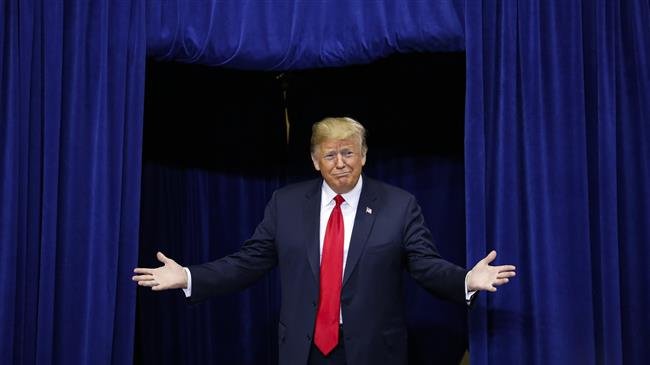
US President Donald Trump has condemned an investigation by special counsel Robert Mueller into possible collusion between his 2016 election campaign and Russia as a “witch hunt” in a new tweet, calling for it to end amid reports that it is coming to a close.
“Highly respected Senator Richard Burr, head of Senate Intelligence, said, after interviewing over 200 witnesses and studying over 2 million pages of documents, ‘WE HAVE FOUND NO COLLUSION BETWEEN THE TRUMP CAMPAIGN AND RUSSIA.’ The Witch Hunt, so bad for our Country, must end!” Trump tweeted on Friday.
Senator Richard Burr (R-N.C.), the chairman of the Senate Intelligence Committee, said recently that the panel has not found evidence of collusion between the Trump campaign and Russia during the 2016 presidential.
According to reports, Mueller could file his report on his investigation with the Department of Justice next week. Trump announced in November that his personal legal team would compile a “major Counter Report” to Mueller’s findings.
Robert Mueller has disputed a report that President Trump’s former lawyer Michael Cohen said Trump directed him to lie to Congress. Trump has repeatedly denied any collusion and has long called for end to the probe. Moscow has also denied any interference in US elections.
“After two years and millions of pages of documents (and a cost of over $30 million) no collusion!” Trump tweeted in December.
In another previous tweet Trump had called the probe the “greatest witch hunt” in the US history. “This is the single greatest witch hunt of a politician in American history.”
Presstv













23, February 2019
Security under the spotlight as Nigerians vote in presidential election 0
An attack in northeastern Nigeria by suspected Islamist militants just hours before polls were set to open in Nigeria’s presidential election Saturday underscored the challenges confronting Africa’s most populous nation.
Nigerians began voting for a new president Saturday after a week-long delay that has raised political tempers, sparked conspiracy claims and stoked fears of violence, including terrorist attacks and post-electoral unrest.
Just hours before polls were set to open, suspected Islamist attacked a northeastern Nigerian town, forcing residents to flee.
“We have fled, along with our wives and children and hundreds of others,” Ibrahim Gobi, who lives in the town of Geidam in Yobe state, told Reuters by telephone. “We are right now running and hiding in the bushes.”
Around the same time a Reuters witness said blasts were heard in Maiduguri, the capital of the neighbouring state of Borno.
Northeast Nigeria has been hit by the decade-long Boko Haram insurgency with attacks in recent months carried out by offshoot Islamic State in West Africa Province.
Crowded presidential race
Some 120,000 polling stations were due to open across the country, from megacity Lagos and the oil hub Port Harcourt in the south, to ancient Kano in the north and the country’s rural heartlands.
The 2019 presidential campaign has been a crowded one, with 70 challengers running against incumbent President Muhammadu Buhari, including the main opposition party candidate, Atiku Abubakar.
The election, due to be held a week ago, was postponed around five hours before polling stations were set to open and there are concerns that the delay may hurt turnout. The electoral commission blamed logistical factors for the delay and denied political pressure was behind the decision.
Presidential elections in 2011 and 2015 were also delayed over logistics and security concerns but Buhari on Friday urged Nigerians “to go out and vote”, promising that there would be adequate security for the ballot.
Economy tops campaign agenda
The biggest challenge facing Nigeria’s next leader is revamping an economy struggling to recover from its first recession in 25 years, which it slipped into in 2016 as crude prices crashed and militants attacked energy facilities in the Niger Delta. Crude sales make up 90 percent of foreign exchange earnings.
“Instability is a rising concern but a weak economy is being felt in all sectors and country-wide so we believe it will be the preeminent voter concern,” Benedict Craven, analyst at The Economist Intelligence Unit, told AFP.
Buhari’s critics say his much-touted focus on rooting out corruption may be offset by his handling of the economy. Despite the president’s campaign against graft, there have not been any significant convictions in his first term.
Nearly a quarter of the workforce is unemployed, much higher than when Buhari, a former military ruler who was later elected president, took over in 2015. The cost of living has also risen rapidly, with inflation of 11.37 percent in January – just short of a seven-month high reached the previous month.
Buhari is the flagbearer of the ruling All Progressives Congress (APC) while Atiku spearheads the main opposition People’s Democratic Party (PDP). Both candidates have promised to address Nigeria’s economic problems. The pair are both Muslims from the north of the country.
The south has favoured the PDP in the past, while the north is Buhari’s stronghold. The number of eligible voters stands at 72.8 million people. To be declared winner, the candidate with the most votes must have at least one quarter of the vote in two thirds of Nigeria’s 36 states and the capital. Otherwise there is a runoff.
(FRANCE 24 with AFP and Reuters)