9, January 2022
Armed gangs kill 200 people in Nigeria after military strikes 0
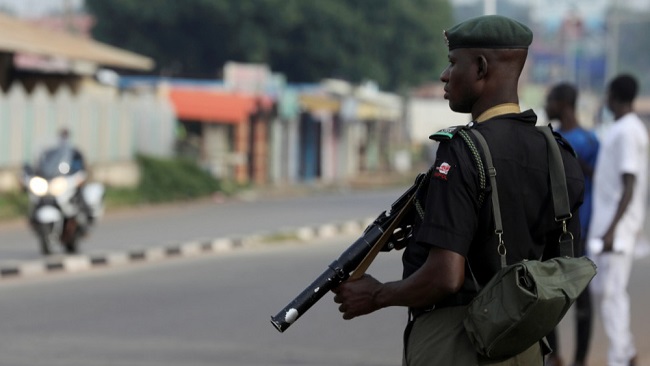
Armed criminal gangs have killed at least 200 people in attacks on villages in northwest Nigeria this week as clashes between the gunmen and the African country’s military forces continue in the restive area, according to residents.
Media reports cited the residents as saying on Saturday that an estimated 200 people or more have been killed by armed “bandits” in villages in the northwestern Nigerian state of Zamfara this week following military air strikes on their hideouts.
Ummaru Makeri, a resident who lost his wife and three children during the attack, said around 154 people had been buried so far, including several vigilantes who were killed.
Residents said the total death toll was at least 200 while the state government put the number of fatalities at 58.
According to a report published by Reuters, at least 30 people were killed in the Anka local government area in Zamfara on Tuesday when more than 300 armed bandits on motorbikes stormed eight villages and started shooting sporadically.
The Nigerian military said it had conducted air strikes in the early hours of Monday on targets in the Gusami forest and west Tsamre village in Zamfara state, killing more than 100 bandits including two of their leaders.
“The latest attacks on innocent people by the bandits is an act of desperation by mass murderers, now under relentless pressure from our military forces,” Nigeria’s President Muhammadu Buhari said in a statement on Saturday, adding that the government would not relent in its military operations to get rid of the bandits.
Buhari also said the Nigerian military had acquired further equipment to track down and eliminate criminal gangs unleashing a reign of terror on locals, including through the illegal imposition of taxes on communities under siege.
Separately, 30 students abducted from their college in the northwestern Nigerian state of Kebbi were freed on Saturday, a spokesman for the Kebbi governor said, without providing details.
Northwest Nigeria has seen a sharp rise in mass abductions as well as other violent crimes since late 2020 as the government struggles to maintain law and order.
Criminal gangs have terrorized northwestern and central Nigeria for years, but they have become more brazen in recent months. The armed gangs across the violence-wracked region repetitively terrorize inhabitants by looting villages, stealing cattle, and taking people hostage. More than 800 students and school children have been abducted in Nigeria for ransom by armed groups since December 2020 alone.
More than 30,000 people have been killed in over a decade of terrorism in Nigeria instigated by the Boko Haram Takfiri group. The reign of terror has spilled over into neighboring Chad, Niger, and Cameroon and has forced more than two million people to flee their homes.
Nigerian troops are fighting a 12-year militancy by Boko Haram in the northeast, herder-farmer tensions and banditry in the northwest, and separatist agitations in the southeast.
Source: Reuters


















9, January 2022
Russia rules out any concession over Ukraine in talks with US 0
Russia ruled out Sunday any concession at talks with the United States on soaring tensions over Ukraine as Moscow seeks a wide-ranging new security arrangement with the West but faces strong pressure to pull back troops.
Russia’s deputy foreign minister Sergei Ryabkov told Russian news agencies ahead of his talks in Geneva the Kremlin was also “disappointed” with signals coming from both Washington and Brussels, where NATO and the European Union are based.
The high-level discussions start a week of diplomacy in which Russia will meet with NATO and the Organization for Security and Cooperation in Europe (OSCE), with the US trying to assure European allies they will not be sidelined.
Russia since late last year has amassed tens of thousands of troops at the Ukrainian border and demanded guarantees that NATO will not expand further eastward.
The Kremlin is insisting NATO must never grant membership to ex-Soviet Ukraine, which is pushing to join.
The United States, to be represented by Deputy Secretary of State Wendy Sherman, agreed to talks even though it made plain that many of Moscow’s proposals are non-starters.
Originally scheduled to start on Monday, Sherman is now due to have a working dinner with Russian Deputy Foreign Minister Sergei Ryabkov on Sunday evening, said a State Department spokesperson.
Secretary of State Antony Blinken, dismissing Moscow’s demands as “gaslighting”, has insisted that talks will yield no progress so long as Russia has a “gun to Ukraine’s head”.
“We’re prepared to respond forcefully to further Russian aggression. But a diplomatic solution is still possible and preferable if Russia chooses it,” Blinken said Friday.
Russian President Vladimir Putin met his US counterpart Joe Biden in Geneva in June and agreed on regular “stability” talks between Sherman and Ryabkov, who will again lead the Russian delegation.
‘Massive’ retaliation
In two phone calls to Putin, Biden has warned of severe consequences if Russia invades Ukraine.
Measures under consideration include sanctions on Putin’s inner circle, cancelling Russia’s controversial Nord Stream 2 pipeline to Germany or, in the most drastic scenario, severing Russia’s links to the world’s banking system.
A US official, speaking on condition of anonymity, warned that Washington would also send more troops to eastern NATO members such as Poland and the Baltics if Russia invaded.
Europeans have showed solidarity, with EU foreign policy chief Josep Borrell visiting the frontline in Ukraine, although some nations are expected to hesitate at the strongest measures.
“Whatever the solution, Europe has to be involved,” EU Commission chief Ursula von der Leyen said.
Russia insists it was deceived after the Cold War and understood that NATO would not expand.
Instead, the US-led alliance accepted most of the former Warsaw Pact nations and the three Baltic nations that were under Soviet rule.
Russia has inflicted intense pressure on neighbouring Ukraine since 2014 after a revolution overthrew a government that had sided with the Kremlin against moving closer to Europe.
Russia seized the Crimean peninsula and backs an insurgency in eastern Ukraine in which more than 13,000 people have died.
At a time that Russia is also intervening to shore up allies facing popular uprisings in Belarus and Kazakhstan, Moscow has insisted it wants concrete progress in talks with Washington.
Putin’s foreign policy adviser Yury Ushakov warned after the call with Biden that the United States would make a “colossal mistake” if it went ahead with sanctions.
‘Gigantic bluff’?
NATO chief Jens Stoltenberg, meeting foreign ministers of the alliance on Friday, said there remained real risks of a Russian invasion.
But John Herbst, a former US ambassador to Ukraine, described the Russian troop build-up as a “gigantic bluff” by Putin to seek a negotiated agreement.
“They are trying to see if the Biden administration or Europe will blink,” said Herbst, now at the Atlantic Council think tank.
“As long as the Biden administration remains at least as strong as it is now,” he said, “it probably is enough to keep Putin from striking large into Ukraine, but I don’t rule out something smaller.”
Matthew Rojansky, director of the Kennan Institute at the Woodrow Wilson International Center for Scholars in Washington, said the Geneva talks were more about preventing the Ukraine crisis from accelerating than reaching a major deal.
“I think this is about pulling the pendulum back, if we can, towards thicker interaction and more effective diplomacy and communication — not permanent and forever resolution of all problems.”
While also downplaying the possibility of a full-scale invasion, Rojansky said the risks of the Russian build-up were real.
“There is the principle of Chekhov — you put a loaded gun on the stage in Act One and it has to be fired by Act Three.”
Source: AFP