27, April 2026
Cameroon courts Brazilian investors with 10-Year incentives 0
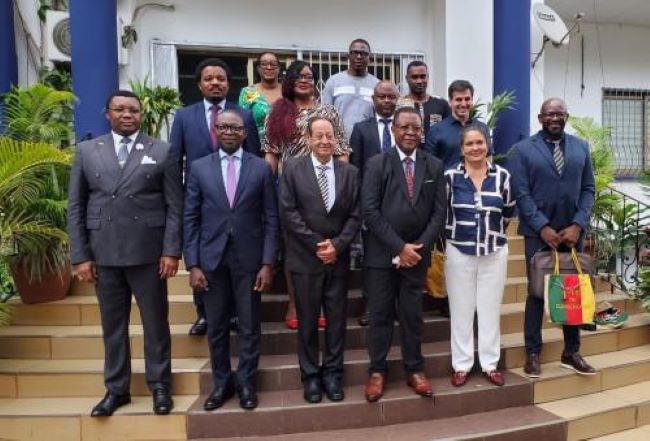
Commerce Minister Luc Magloire Mbarga Atangana met a delegation of Brazilian business leaders in Yaounde on Friday, April 24, to discuss plans to establish operations in Cameroon and position the country as a production base for Central Africa.
The delegation, which included representatives of Brazilian groups Trilhas and Adilson, is exploring market entry as Cameroon seeks to attract industrial investment, reduce imports and expand exports. The meeting was attended by Cameroon’s Minister Counsellor at the Embassy in Brazil, Paulin Martial Tchenzette.
The visit comes as Cameroon intensifies South-South economic cooperation and seeks new industrial partnerships capable of reducing imports, increasing domestic production and expanding exports.
Speaking during the audience, Mbarga Atangana said Cameroon wanted partnerships that go beyond trade in finished goods and instead support domestic manufacturing capacity.
“Cameroon does not want to limit itself to the simple exchange of goods or services. Cameroon wants to develop its local capacity to increase production. We want to be able to produce massively in Cameroon rather than import what Brazil produces,” he said.
The minister said Cameroon offered institutional stability, freedom of enterprise and an investment incentives framework designed to support new businesses. He also highlighted the country’s youthful population, natural resources and varied geography as assets for industrial development.
He added that Cameroon accounts for nearly half of Central Africa’s gross domestic product, making it a key commercial gateway for companies targeting the sub-region.
“When you invest in Cameroon, it means you have invested in the whole of Central Africa. And if you produce in Cameroon, you will be able to sell across Africa,” he said.
Access to African and European Markets
Officials also used the meeting to underline the commercial reach available to investors manufacturing in Cameroon. The minister cited the African Continental Free Trade Area, a market of 1.3 billion consumers, as well as Economic Partnership Agreements with the European Union and the United Kingdom. He said those arrangements provide duty-free access for qualifying Cameroonian products into markets representing roughly 500 million additional consumers.
That positioning strengthens Cameroon’s pitch as a production hub where investors can manufacture locally while serving multiple export destinations.
IPA offers 10-year incentives to agri-investors
Earlier the same day, the delegation met officials of the Investment Promotion Agency, IPA, at its Yaounde headquarters to discuss opportunities in livestock, grain and aquaculture. Interim General Manager Boma Donatus said the IPA remained the mandatory first point of contact for foreign direct investment entering Cameroon and could guide investors through establishment procedures.
He outlined a convention signed with the agency granting incentives for up to ten years during both construction and operating phases.
“During this time, your tax rates will be reduced and what you are bringing in will be free from customs duties during the establishment phase,” Boma said.
He confirmed that livestock and grain are classified as strategic sectors under Cameroon’s investment code, giving investors access to targeted support measures.
Boma said Cameroon has 9.6 million hectares of arable land, with only 1.6 million hectares currently in use, pointing to significant room for agricultural expansion. He added that rice, maize and fish remain heavily imported products that could be produced domestically.
“Agriculture is one of the backbones of our economy, not only in growing crops but in transforming coffee, cocoa and all these products which you have in abundance in Cameroon,” he said.
For aquaculture investors, he also identified floating fish cage opportunities on the Wouri River.
More Brazilian firms may follow
The Brazilian delegation was led by Santa Maria General Director Daniella Prudente Vitorino, who said repeated visits to Cameroon had strengthened investor confidence and accelerated project plans.
“Since my first visit, I have received strong support from the agency, from airport reception to helping with formal procedures. That accompaniment gives us confidence and reassures us that we are welcome here,” Vitorino said.
“Each time I return, the projects become more concrete and more solid. After I go back to Brazil, many companies are waiting for my report, and it will be positive,” she added.
Vitorino said she first visited Cameroon in 2023 and has since carried out market and business studies with support from the IPA.
“Today I am here to open my company, my Brazilian branch in Ngaoundere. The official opening will take place on April 30,” she said.
She added that several additional Brazilian companies were already considering visits to Cameroon in November, with interest spanning technology, internet services and other sectors.
With Brazil recognized globally for agribusiness expertise, the partnership could also support Cameroon’s broader strategy of modernizing agriculture while strengthening its role as a supply hub for Central Africa.
Source: Business in Cameroon

















27, April 2026
Yaoundé: Biya to get a deputy for first time in 43-year rule 0
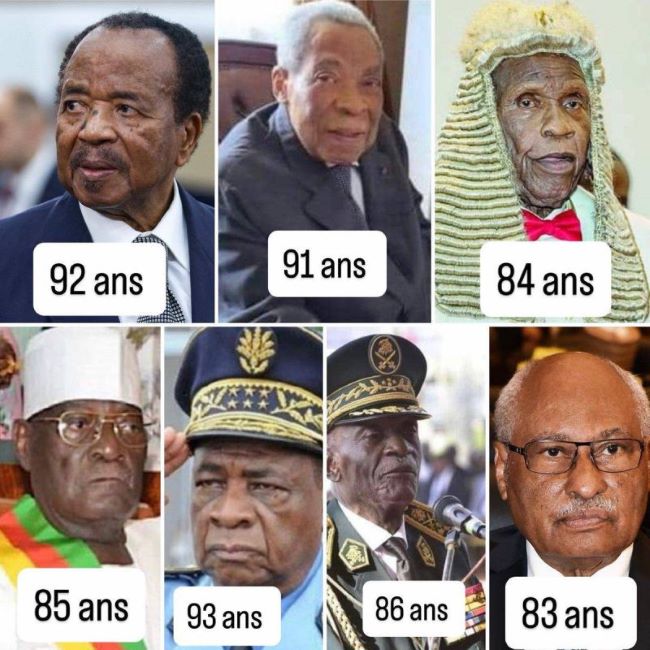
President Paul Biya, the world’s oldest leader, is set to get a vice-president for the first time in his four-decade rule following controversial constitutional changes backed by parliament.
Should anything now happen to Biya, 93, the vice-president will automatically step in and complete the term before a new election is held.
The position was scrapped in 1972. In recent years the leader of the senate was expected to act as president but only until a fresh election was arranged.
The opposition said the amendments were hastily drafted and aimed at consolidating power. Even one senator from Biya’s party described the process as “suspicious”.
There has been frequent private speculation about the state of Biya’s health, but openly discussing it is taboo and he has always defied rumours of his death by appearing in public after long absences.
A joint sitting of both houses of parliament on Saturday passed the bill changing the constitution, which now requires the president’s signature, with 200 lawmakers voting in favour, 18 against and four abstaining.
Supporters said the bill would enhance government efficiency as it would elevate the level of representation whenever an official is required to stand in for the president. It would also lift the burden of succession from the Senate to enable it to focus on its legislative functions.
Prior to the amendment, the constitution designated the leader of the Senate to briefly take over in case the sitting president dies or is incapacitated. An election would then be held.
The approved bill now stipulates that the vice-president – appointed by the president rather than elected – will become the head of state to serve out the rest of the seven-year term.
The opposition said it was submitted without broad consultation.
The Social Democratic Front (SDF) party, which has six representatives in parliament, boycotted the vote. It had pushed for a revision in favour of the vice-president being jointly elected with the president, rather than appointed.
The party also sought a constitutional provision that reflects the linguistic split between English and French-speaking regions. The SDF wanted the nation’s top two posts to be shared between Cameroon’s two communities, which was the position before 1972.
“This constitutional reform could have been a moment of political courage, but it is nothing less than a missed historic opportunity,” SDF chairman Joshua Osih said.
Meanwhile, another leading opposition voice, Maurice Kamto of the Cameroon Renaissance Movement said the amendment amounted to a “constitutional and institutional coup” by the ruling party.
In a statement, he argued that the incumbent was seeking a “republican monarchy,” and announced his intention to launch an online campaign to denounce the move.
From 1961 to 1972, Cameroon operated under a federal system which respected the autonomy of the francophone and anglophone parts of the country.
During this period, the role of vice-president was in place. However, following a 1972 referendum which moved the country to a unitary state, the office was scrapped.
Biya’s long time in power, which began in November 1982, has sparked a debate about his succession. Despite the move to reinstate the vice-president position, the future of Cameroon beyond Biya remains uncertain.
The president won an eighth term in power last October with 53.7% of the vote in an election that the opposition said was rigged.
With the constitutional changes passed, national discussions are now dominated by speculation over the identity of the new vice-president.
Culled from BBC