20, March 2026
Yaoundé: Catholics invited to throng Pope Leo XIV’s procession 0
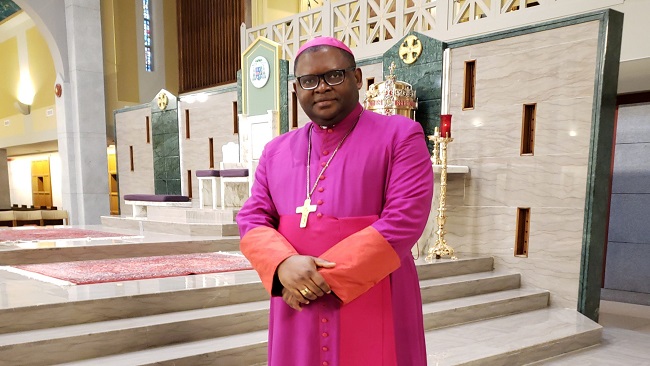
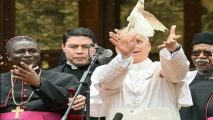
The Archbishop of Cameroon’s Archdiocese of Yaoundé has encouraged animated participation in the planned Apostolic Visit of Pope Leo XIV to the central African country, calling on Catholics in the country to turn out in large numbers along the routes of the papal procession.
In a pastoral letter on Monday, March 16, Archbishop Jean Mbarga said that to ensure a fitting welcome of the Holy Father, attention should be paid to three key areas of preparation: mobilisation, unity, and prayer.
Archbishop Mbarga described the papal visit scheduled for April 15–18 as “an event of grace,” emphasizing its spiritual significance for the local Church.
“This visit is, for all of us, an event of grace. The Pope comes, as Vicar of Christ and Successor of the Apostle Saint Peter, to strengthen us in the faith. But he also comes as a Father in the midst of his family,” Archbishop Mbarga said.
“I invite the faithful to gather along the various routes that the papal procession will take. May our streets vibrate to the rhythm of our songs and our joy!” he said.
The Catholic Church leader added, “At each movement of the Holy Father, we will form honor guards to show him our affection and our unity, following the routes that will be indicated.”
Archbishop Mbarga also underscored the importance of visible unity among Church groups during the visit.
“I strongly encourage all members of movements, associations, and choirs to wear their group attire or the various uniforms available. May this visual harmony reflect the unity of our hearts,” he said.
Archbishop Mbarga further called on groups responsible for liturgical animation to prepare vibrant performances.
“I would like all groups in charge of song and dance performances to prepare the most beautiful hymns, tune their musical instruments, and offer choreographies of great rejoicing,” he said.
He implored, “May the city of Yaoundé, the convergence point of our three Ecclesiastical Provinces, be in celebration, thus bearing witness to a living, joyful, and fraternal Church!”
A special prayer has been prepared for the Apostolic Journey, and members of the National Episcopal Conference of Cameroon (NECC) have requested that it be recited daily at the end of every Eucharistic celebration in all parishes and religious communities.
Archbishop Mbarga emphasized that this be respected in all parishes and religious communities of his Metropolitan See.
He urged the faithful to participate actively in the liturgical highlight of the visit.
“In this spirit, let us all pray for this Apostolic Journey of the Supreme Pontiff in our country. Let us especially be numerous in attending the Pontifical Mass that the Holy Father will celebrate on April 18, 2026, at exactly 9:30 a.m. at Yaoundé Air Base 101, where our Communion around the Altar, supported by free and open public participation, will be even stronger,” the Catholic Archbishop said.
He invited the people of God to remain united in anticipation and prayer, saying, “In the Joy and Prayer of this anticipation, may God watch over us!”
On March 16, the Vatican released the official itinerary for the first Apostolic Journey of Pope Leo XIV to Africa, scheduled for April 13–23.
The visit is expected to take the Holy Father to four countries – Algeria, Cameroon, Angola, and Equatorial Guinea – marking his first pastoral journey to the continent since his election to the Papacy in May 2025.
The 11-day visit combines pastoral encounters with Catholic communities, meetings with political leaders and civil society, and symbolic gestures of interreligious dialogue and reconciliation.
Source: aciafrica


20, March 2026
Smarter Water Use Could Feed 10 Billion and Create Nearly 250 Million Jobs 0
Rebalancing water use across the global food system is key to meeting future food demand sustainably and could generate 245 million long-term jobs, largely in Sub-Saharan Africa, according to a new World Bank Group report launched today.
The report – Nourish and Flourish: Water Solutions to Feed 10 Billion People on a Livable Planet – notes that current agricultural water management practices, marked by overuse in some countries and underuse in others, can only sustainably support food production for less than half the global population. By 2050, 10 billion people will need to be fed. Addressing both the overuse that depletes water in stressed regions and the underuse that leaves available water and productive capacity untapped in water-abundant regions will be essential to meet that demand sustainably.
It introduces a new framework for agricultural water management that links water availability with food production and trade. By categorizing countries based on water stress and their food import or export status, the framework helps identify where expanding rainfed agriculture can increase food production, where irrigation investments can unlock jobs and growth, where water use must be rebalanced to protect ecosystems and future productivity, and where trade offers a more sustainable path than local production.
“The way we manage water for food will have profound implications for jobs, livelihoods, and economic growth. By making smarter choices about where crops are grown, how water is allocated, and how trade supports food security, we can strengthen resilience, expand opportunity, and safeguard the resources which we all rely on,” said Paschal Donohoe, Managing Director and Chief Knowledge Officer of the World Bank Group.
Realizing these outcomes will require stronger private sector participation and financing alongside public investment, supported by effective policies, institutions, and regulations to boost food production, create jobs, and support sustainable growth. Public funding alone cannot deliver the sustained services, innovation, and scale needed to expand irrigation, improve performance, and maintain results. Farmers, who are the primary users of irrigation and its main investors, are already willing to co-invest when access to finance, quality equipment, markets, and digital tools reduces the risks and transaction costs they face.
“When investments in infrastructure and natural resources, business-enabling policies, and private capital mobilization come together, the impact can be greater than the sum of its parts,” said Guangzhe Chen, Vice President for Planet at the World Bank Group. “By linking global evidence with country realities, this framework can help policymakers navigate trade-offs and adapt food production to today’s water and climate realities—delivering food, jobs, and resilience together.”
Expanding irrigation where water is available, alongside modernizing existing systems, is estimated to require an additional $24–70 billion per year through 2050. Governments already spend roughly $490 billion annually on agricultural support, most of it on subsidies. Redirecting a portion of current spending—combined with regulatory reform, use of blended finance, and public-private partnerships—will crowd in private capital, including co-investment by farmers themselves, and support financially sustainable water and food security.
The World Bank Group works alongside countries, companies, partners and people to translate these insights into action by combining policy reform, public investment, and private capital to strengthen food systems, create jobs, and protect natural resources. It has committed to doubling annual agribusiness financing to $9 billion by 2030 and mobilizing an additional $5 billion per year under the AgriConnect initiative to help smallholders move from subsistence to surplus. Through the Water for Food and Water for the Planet pillars of its Water Strategy Implementation Plan, the World Bank Group addresses the twin challenge of water and food security by strengthening food production systems and improving farmer livelihoods.
Reported by the World Bank Group