30, March 2025
Cameroon still faces power cuts despite full output from Nachtigal Dam 0
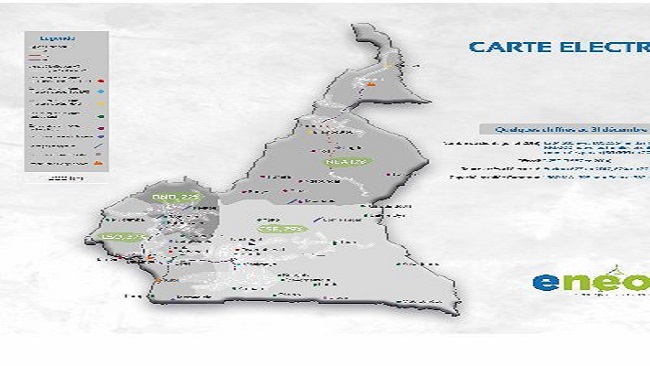
Nearly a month after blackouts began to worsen across Cameroon’s Southern Interconnected Grid, electricity outages continue to affect seven of the country’s ten regions. In Yaoundé, the planned power cuts announced to last four to six hours often extend for several days. Many neighborhoods are without power, and other towns and villages across the country are also affected. Homes and businesses are struggling to cope.
Power utility Eneo has been sending alerts to customers, citing repeated issues on the transmission network managed by Sonatrel, the national electricity transmission company. The alerts mention ongoing maintenance work, fallen poles, broken cables caused by trees falling during heavy rains, and fires at overloaded transformers. In recent days, Eneo has reported almost daily incidents at the Nyom substation, located on the outskirts of Yaoundé. This substation is newly built and plays an important role in transmitting power from the Nachtigal dam.
The Nachtigal hydropower dam has been connected to the national grid since the first half of 2024. The first of its seven turbines, each with a capacity of 60 MW, began generating electricity last year. On March 18, 2025, the dam reached full capacity, with all seven turbines injecting a total of 420 MW into the grid, according to NHPC, the company in charge of the project. The official inauguration of the dam is scheduled for April 3.
Despite the increase in electricity production, the distribution network remains unreliable. Many parts of the country are still experiencing power cuts. Sources close to the project say that some of the new power lines needed to deliver electricity from the Nachtigal project are not yet completed. As a result, it is difficult to use all the power produced by the dam. Industrial demand has also grown, with an estimated additional need of more than 300 MW, according to industry sources.
Under the agreement between the State of Cameroon and NHPC, the government is required to pay CFA10 billion each month as soon as the dam becomes fully operational. This payment is due whether the energy is consumed or not. Since March 18, when the dam began supplying its full 420 MW to the grid, this condition has been in effect.
Although the dam has increased Cameroon’s electricity production capacity by 30%, many consumers are still experiencing daily outages.
Source: Business in Cameroon


















30, March 2025
CPDM Covid Scandal: Prosecutor seeks 10-Year ban for 4 officials 0
The Advocate General of the Chamber of Accounts of the Supreme Court requested on Thursday that financial penalties and disqualifications be imposed on four officials from the Ministry of Public Health implicated in mismanagement related to a public contract for the COVID-19 response in 2020, during today’s hearing.
Public prosecutor Félix Owona Etoundi, representing the state, called for a fine of 2 million CFA francs each against Élysée Amour II Eyenga Ndjomo, Technical Advisor No. 1 at the Ministry of Public Health; Ousmane Diaby, Head of the Studies and Projects Division within the same ministry; Rémy Bekolo Edou, Logistics Accountant at the minister’s office; and Abiba Ntue Ngapout, Paymaster at the specialized Treasury office attached to the Ministry of Public Health.
The Advocate General also requested “a five-year ban for the individuals from holding any role involving authorizing or managing funds in a public or semi-public body, or in a state-owned enterprise,” as well as “a ban from holding any position of responsibility in the public administration.” If the judges follow the prosecution’s recommendations, the accused would effectively lose their civil servant status for a decade.
To justify these sanctions, the prosecution cited no fewer than five acts of mismanagement. The first was the lack of qualification of the members of the commission tasked with receiving the 278 million CFA franc contract for the construction of an isolation center at Ngaoundéré Regional Hospital in 2020. This commission included the late former Secretary of State Alim Hayatou, Élysée Amour II Eyenga Ndjomo, Ousmane Diaby, Rémy Bekolo Edou, and the CEO of Grand Lux, the contractor. As the Advocate General reminded the court, some of the accused admitted they lacked the necessary qualifications to serve on the commission.
During the hearing, Élysée Amour II Eyenga Ndjomo stated that “strictly speaking, they should not have sat on this commission,” while Ousmane Diaby declared that “aside from myself and the delegated project owner, the late Alim Hayatou, the other members of the commission were not competent to sign a work acceptance report.” Rémy Bekolo Edou concurred, stating that “the commission should have changed the format of this report, because it was not, in principle, authorized to accept construction work.”
The second act of mismanagement, according to the prosecution, concerns the commission validating the reception of construction work instead of “goods, items, and materials,” as specified in the acceptance report.
The third alleged mismanagement involves an advance payment on the work set at 40%, whereas the public procurement code limits this type of advance to 20%.
The fourth act of mismanagement relates to the failure to pay the full guarantee deposit before issuing a start-up advance. Instead, the contractor Grand Lux paid the guarantee only eight months later.
Finally, the fifth act involves accountant Abiba Ntue Ngapout, accused of fully paying a purchase order of 111 million CFA francs before any services had been rendered.
For all these charges, the Advocate General called for “exemplary sanctions” because the judges’ decision is “highly anticipated.”
Following the defense pleadings presented by the two lawyers representing the accused—who rejected all charges brought by the prosecution—the panel of judges adjourned its decision until April 17.
Source: Sbbc