

2, February 2021
Southern Cameroons Crisis: Don’t target Ambazonians, Ground Zero commander told! 0
Southern Cameroons Vice President Dabney Yerima says the Ambazonia Interim Government supports any Vatican initiative which represents people from all Southern Cameroons restoration groups in the Federal Republic of Ambazonia.
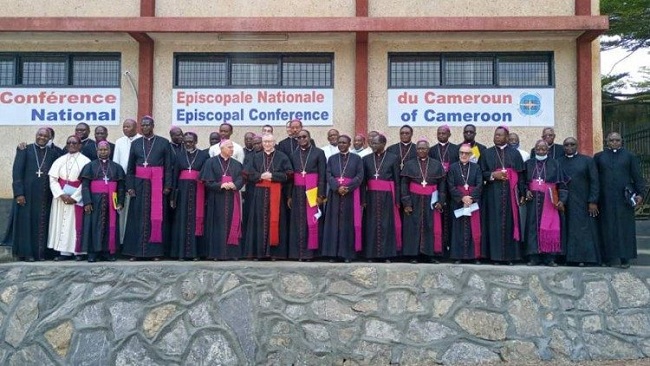
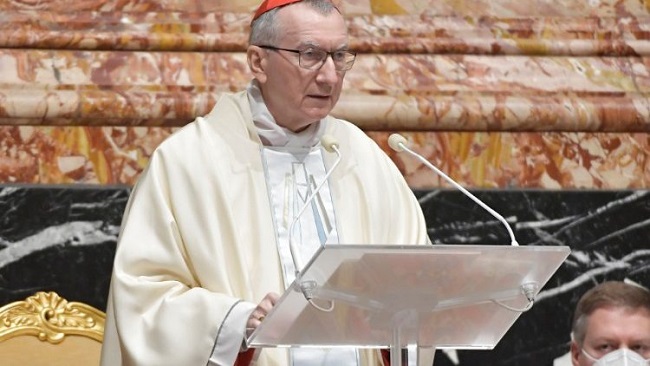
During a telephone conversation with a senior Amba commander in the Mezam County on Monday morning, Yerima praised Roman Catholic Christians for granting the visiting Cardinal Secretary of State, His Eminence Cardinal Pietro Parolin a befitting welcome in Southern Cameroons.
“Through the Christian faith, the Southern Cameroons Interim Government supports an inclusive peace mission with the government of La Republique du Cameroun and considers it a necessity for the United Nations to take a leading role in Southern Cameroons” Yerima said.
“Southern Cameroonians are your people and should not be targeted in any Ambazonia Self Defense operations,” the Vice President added.
The Ambzonian Vice President then pointed to the action by the Holy See, stating that the Vatican remains a provider of good mediators and peace brokers.
For his part, the Ambazonia Ground Zero commander briefed Yerima on the continued militarization of Southern Cameroons towns and cities by the French Cameroun government in Yaoundé and pointed to the broken promises of the Interim Government towards Restoration Fighters.
By Fon Lawrence in Bamenda



















3, February 2021
Portugal: Funeral workers nearing ‘breaking point’ over Covid deaths 0
Yet another phone call comes in for Artur Palma, who is straining to cope with all the bodies piling up at his suburban Lisbon funeral parlour.
The call is from a nearby retirement home, prompting Palma to send his employee Jose Santos to collect the latest Covid-19 victim and drive her body back to the Velhinho funeral parlour he runs in Amadora.
Santos suits up in line with Portugal’s latest health guidelines: head-to-toe white suit, gloves and surgical mask. Then, he sets off in his hearse.
Faced with an explosion in Covid deaths during a virulent third wave in the last few weeks, Palma says that the demands on the business and staff are taking their toll.
“It’s real chaos. There are so many dead people we don’t have enough room for them all,” Palma says.
“It’s an enormous weight at all levels, physically and psychologically. We sleep little and we are reaching our limit. We are reaching the breaking point,” he adds.
Velhinho employees now make three or four trips a week to retirement homes to collect the dead, Santos, 62, tells AFP, at the wheel of his hearse.
That is about three times the number of deaths the funeral parlour handled in January 2020.
According to data compiled by AFP, over the last two weeks Portugal has recorded the largest number of infections and deaths relative to its population of any country in the world.
Over the year since the pandemic began, Portugal ranks seventh in the world for infections per capita but is lower down the list for deaths per capita.
The disease has claimed just over 13,000 lives in the country of 10 million people, including more than 5,500 in January alone.
A second general lockdown was introduced on January 15 in a bid to slow infections.
– ‘We feel it at home’ –
At the retirement home, Santos and a colleague place the body in a mortuary bag and wheel it on a stretcher to the hearse.
“It really has to happen like this from now on,” Santos says, stressing the importance of respecting health measures at each stage of preparing the body for burial.
Back at the funeral parlour, amid stacks of new ornate wooden coffins, Santos and Palma complete their protective gear by pulling on medical shoe covers, goggles, overalls and gas masks.
“We absolutely must stick to using this protective equipment. I myself put on three pairs of gloves. They are made for high-risk situations,” Palma says.
Covid-19 victims are wrapped in a shroud before being placed in the coffin.
Their bodies are not embalmed because of the contagion risk but disinfectant is sprayed everywhere.
When the coffin is sealed, Velhinho staff cover the joints with an adhesive tape, which, in turn, is sealed with several layers of cellophane.
The deceased is then put back in a refrigerated room, full of Covid victims.
Palma himself has lost family members to the disease.
“With Covid-19, I have already lost my aunt, my cousin, my father and my grandfather,” he says.
At the Velhinho funeral parlour, there are a total of just four people to cope with the recent surge in bodies and the work is having a high personal cost.
“It’s very difficult and we feel it at home with our families. Fortunately, they are there to support us,” Santos says, smoking a cigarette.
Source: AFP