
11, October 2020
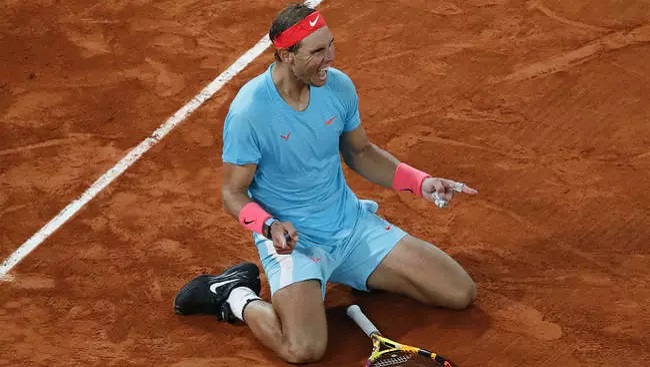
Nadal beats Djokovic to win his 13th French Open, ties Federer with 20th Grand Slam title 0
Rafael Nadal demolished Novak Djokovic 6-0, 6-2, 7-5 to win his 13th French Open and equal Roger Federer’s all-time record of 20 Grand Slam titles on Sunday.
For world number one Djokovic, the defeat ended his hopes of an 18th Slam and of becoming the first man since Rod Laver in 1969 to win all four majors twice.
Nadal, 34, claimed his 100th match win at Roland Garros against just two defeats since his 2005 debut.
The Spaniard, the oldest champion in Paris since Andres Gimeno in 1972, claimed the title without dropping a set.
He finished the one-sided affair with just 14 unforced errors to his opponent’s 52.
“Congrats to Novak for another great tournament. Sorry for today. We’ve played plenty of times together – one day one wins, another the other,” said Nadal.
“After all the things I have been through in my career with injuries, I could not have done it without my family.”
Nadal said he wasn’t even thinking about matching Federer’s record.
“It’s been a very tough year. Winning here means everything to me so it’s not about equalling Roger on 20, for me today it’s just a Roland Garros victory,” said Nadal who had skipped the US Open due to the global health crisis and was playing just his second tournament since February.
“Roland Garros means everything to me. I spent most of the most important moments of my tennis career here.
“Just playing here is a true inspiration. The love story I have with this court and city is unbelievable.”
Federer, who sat out the tournament to recover from knee surgery, hailed Nadal’s 13th French Open victory as “one of sport’s greatest achievements”.
“I have always had the utmost respect for my friend Rafa as a person and a champion,” Federer tweeted on Sunday.
“As my greatest rival over many years, I believe we have pushed each other to become better players. Therefore it is a true honour for me to congratulate him on his 20th Grand Slam victory,” Federer wrote.
“It is especially amazing that he has won Roland Garros an incredible 13 times which is one of the greatest achievements in sport. I hope the 20 is just another step on the continuing journey for both of us,” the Swiss player added.
‘King of clay’
For Djokovic, it was just his second loss of 2020 following his default at the US Open.
“Today, Rafa showed why you are the king of clay. I was out-played by a better player.”
Nadal also used his victory speech to thank organisers for staging the tournament, pushed back from its traditional May-June slot due to the coronavirus pandemic.
“I want to send a message to everyone around the world. We are facing one of the worst moments that we remember in this world, fighting against this virus. Keep going, stay positive.
“We will get through this and we will beat the virus soon.”
The 56th meeting between the world’s top two started under the roof of Court Philippe Chatrier, intensifying the echo of a crowd limited to 1,000 due to the pandemic.
Conventional wisdom suggested that would favour Djokovic but nobody told Nadal who broke three times in the 45-minute opening set.
The Spaniard hit 10 winners and just two unforced errors.
Djokovic’s error count was 13 with the out-of-sorts Serb even squandering three break points of his own in the fourth game.
More worrying for the world number one—Nadal improved to 111-0 when winning the first set of best-of-five matches on clay in his career.
It was the first opening set ‘bagel’ in a Roland Garros final since 2004 when Gaston Gaudio recovered to defeat Argentine compatriot Guillermo Coria in five sets.
Djokovic finally got on the board with a service hold in the first game of the second set but Nadal maintained his relentless push, going to a double break for 4-1 as even the Serb’s usual deft touches on the drop shot deserted him.
Nadal wrapped up a two-set lead with his unforced error count at just six to Djokovic’s 30.
Nadal broke for the sixth time for a 3-2 lead in the third before Djokovic suddenly restored his reputation as the sport’s best returner by carving out his first break of the afternoon for 3-3.
However, there was to be no miracle recovery as a double fault handed Nadal a 6-5 lead and he took the title with an ace.
(FRANCE 24 with AFP)


















11, October 2020
Ghanaian President Nana Akufo-Addo on an ECOWAS Mission in Mali 0
The President of Ghana, Nana Akufo-Addo, who is also the current President of Economic Community of West African States (ECOWAS) is on a mission of the 15 nation-bloc in Bamako.
He was received by the transitional president Bah Ndaw on Sunday to take stock of the political transition and discuss the next steps to ensure that the deadline of the eventual election is met.
All activity is towards regional solidarity with the now embargo-free Mali still regrouping post-coup d’état August.
The Ghanaian president is the first head of state to visit the West African nations since the ECOWAS-imposed sanctions were lifted.
Source: Africa News