15, June 2021
Southern Cameroons Crisis: The IEDs are hurting! 0
Nobody ever thought that the peaceful demonstrations organized by lawyers and teachers in 2016 in Cameroon’s English-speaking regions could morph into something more dangerous, especially as they were not planned and Cameroonians, at least, these generations, are not used to fighting for their rights.
If anybody had pretended about seeing the future regarding this dispute, it would have been the Yaoundé government which held that it would roll the “trouble- and attention-seeking” lawyers and teachers back to their courts and classrooms using the “government’s” conventional method of governance – military violence.
To the government, the people of Cameroon are like slaves and those in government must dictate everything to them. Arrogance has a way of blurring the human mind and when it gets mixed with egoism, the blindness could be total. That is the unfortunate tale of governance in Cameroon.
The people of Southern Cameroons had been pushed to a very tight corner for more than fifty years by a government they thought was theirs, but the government, for its part, really thought every Cameroonians was having a blast in the country.
There had been lots of red flags that could have alerted a people-centered government, but since the Yaoundé government and the country are about one person – the country’s president – nobody really paid attention to the challenges and frustrations that were stifling lives in Southern Cameroons.
The country’s educational policy in the past had created only a single university where French was the language of communication, causing most Southern Cameroonians to seek university education out of the country, with many ending up in the West or other English-speaking countries where the seeds of a dangerous rebellion were being slowly but surely sown.
The country’s heavily centralized system was also suffocating many Southern Cameroonians, with little or no appointment of Southern Cameroonian to strategic leadership positions. Southern Cameroonians by their nature are used to highly decentralized systems that make the people the masters of their destiny, but the hastily and forcefully stitched “dictatorship” ramped down their throats in 1972 has, for decades, remained a bitter pill to swallow.
The Yaoundé government was simply oblivious of the danger that was brewing in the two English-speaking regions. Unemployment, lack of social service, crumbling infrastructure and marginalization had compelled many Southern Cameroonians to look for greener pastures elsewhere.
America, Canada, the United Kingdom, Nigeria, South Africa and others offered a good environment for the fleeing Southern Cameroonians who needed a sound education that could proffer them huge opportunities on the global stage.
More than five decades following the wave of migration to these freedom-loving countries, many Southern Cameroonians have seen their dreams come through. Thousands have acquired knowledge and wealth and they honestly hold that their country of birth could be better if the rules of governance could be altered a bit.
This school of thought has been common among the Southern Cameroonian Diaspora which holds that it too can have a say in the management of the country’s affairs. But their concept of governance cannot be applied in Cameroon as the Yaoundé government thinks differently and its policies are designed to keep one person in power forever.
Changing the core principle of governance in Cameroon will imply that the president’s rights would be curtailed, and his authority would not be felt in every nook and cranny of the country.
But the Southern Cameroonian Diaspora which is replete with some of the finest professionals in all walks of life has been lying in wait for the government to make its mistake. And the mistake came when lawyers and teachers called for a federal system that would enable Southern Cameroonians to be masters of their destiny and the government responded by arresting the leaders of the demonstration and sending out its “dogs of war” to mow down any dissidents who stood in its way.
A peaceful demonstration was therefore transformed into a military conflict that is in its fourth year and has sent thousands of young Cameroonians to an early grave.
While the government threw its entire military into the war, Southern Cameroonians used whatever means that were available to them. Catapults, machetes, and hunting rifles were employed by hastily formed Southern Cameroonian fighters to protect themselves and their people against the Yaoundé genocidal regime whose intention was to kill anything in its paths.
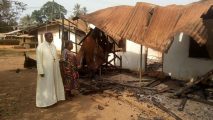
The country’s military burned down homes, businesses and even the helpless elderly people were roasted alive to send home a message to any young men and women who had opted to fight against the country’s military. But its message was the wrong message. It completely fell on deaf ears.
The dynamics had changed. The world had become a global village, significantly reduced by the invention of “technologies of freedom” which enabled ordinary citizens to capture the government’s horrific acts in Southern Cameroons and share them with the Diaspora which has also been seeking to jump into the fight.
These shocking videos triggered waves of resource mobilization campaigns across the globe. In less than no time, the catapults, machetes, and hunting rifles were replaced with more sophisticated killing machine which caused the military to rethink its strategy.
The mass murdering of ordinary people by the military would no longer go unpunished. Revenge was driving the fighters and anybody suspected of collaborating with the regime became a target. Southern Cameroonian fighters attacked soldiers all over the two English-speaking regions, killing thousands and sending many to hospitals around the country.
The power dynamics were no longer in favor of government forces. In the Southwest and Northwest regions, the massive jungles and wide savannas provided coverage for the determined fighters and they made the most of this natural advantage. Those who doubted the determination and courage of these fighters had to think twice before expressing their views, especially as the number of body bags heading to East Cameroon increased by the day. The tell-tale signs of a political and military miscalculation had begun appearing on the government’s dashboard.
The “two cubes of sugar” which were supposed to have melted are not going anywhere, anytime soon. The fighters are determined, and the weapons are pouring into Southern Cameroons to bring about a quick fix to the mistakes made in Foumban. The much-dreaded Brigade d’intervention rapide (BIR) has been demystified in Southern Cameroons, with many of its officers either captured, injured, or killed in a very graphic manner that has even shocked government officials who, at the beginning of the fighting, thought the country’s military would sweep through the English-speaking regions like a Tsunami, swallowing up all the free radicals challenging their authority.
Instead of seeking sustainable solutions to the problem, the Yaoundé government has been performing a mincing dance around the truth, using all tricks that it thinks could douse the fire. But the problem will not go away anytime soon without genuine, frank and fruitful negotiations held in a neutral place and facilitated by a neutral body or groups of neutral persons and countries.
As the government drags its feet, so too does the situation evolve. Southern Cameroonian fighters have been honing their skills and strategies. Over the years, they have found innovative ways to diminish the enemy’s presence in their territory.
While the fighting was started with hunting rifles, AK-47s were thrown in the mix as things progressed and their presence has been a long nightmare to the Cameroon military. These dangerous Russian-made war machines have cut short the lives of many soldiers, sending their families into long periods of mourning. Many are already questioning the rationale behind the fighting.
But the fighters are not yet done. They still have unfinished business. Southern Cameroons is not yet independent. They still have more tricks up their sleeves. In their view, the enemy must be humiliated. Either he comes to the negotiating table or he will be pushed out of the mineral-rich region.
The lethality of the weapons in the hands of the determined armed fighters has morphed into something more sinister. The AK-47s are gradually yielding the floor to IEDs which have struck fear into the minds of French Cameroon soldiers.
These IEDs have been going off every day and they are decimating the military population in Southern Cameroons while robbing the government of the expensive military trucks the French and Chinese have been supplying at a very high cost.
The Northwest region, in particular, has become a graveyard for many young soldiers who get blown up by these IEDs. The Yaoundé government is in the grip of confusion. It has thrown all it has at the Southern Cameroonian fighters but none of its military devices has dampened the determination of the “boyses in the bushes” who are determined to bring about an independent Southern Cameroons.
The IEDs are hurting. Yaoundé is looking for a way out. It needs help. It has put itself in a tight corner. It has finally understood that not all battles get won militarily. Diplomacy sometimes trumps over violence.
The pain is too much. Many bereaved families blame the government for the deaths of their loved ones. They hold that real dialogue could help reduce the number of IEDs.
The IEDs are really hurting to the extent where even regime stalwarts such as Prof. Jacques Fame Ndongo, a strong believer in military violence, are now telling the world that the Yaoundé government is ready for talks on federalism. Can he be truly considered as a bearer of a special message from the Unity Palace? What has happened to the melting of the “two cubes of sugar?”
Is the government suddenly realizing that its military might may not put an end to its nightmare? Even if Prof. Fame Ndongo’s message were to be taken seriously, can anybody really trust a government that is wont to speaking from both sides of its mouth?
If the government really wants to end the mess it has created in Southern Cameroon, it must start implementing some confidence building measures which will reassure the fighters and the Diaspora. A general amnesty to all those who have been remotely or directly involved in the conflict will be a welcome measure.
The release of Sisiku Julius Ayuk Tabe, the poster boy of the revolution, and all those who have been arrested over the last five years due to this conflict will be considered a sign of seriousness on the government’s path. The government could also set up a commission comprising trusted national and international personalities to run the period leading up to the discussions and the implementation of any resolutions and recommendations that will be made during the negotiations.
Without such confidence-building measures, Southern Cameroonians will continue to be wary of a political system that is full of snares and hypocrisy. The ball is in the government’s court and it is up to it to take the right decisions and measures. The more it delays, the more the IEDs will continue wreak havoc on the country’s military.
By Soter Tarh Agbaw-Ebai

Chairman/Editor-In-Chief
Cameroon Concord News/Cameroon Intelligence Report


18, June 2021
CPDM Crime Syndicate: Lack of Transparency, Corruption Allegations Mar Covid-19 Spending 0
The International Monetary Fund’s (IMF) Executive Board should ensure that a three-year loan sought by Cameroon is used to meet its human rights obligations and not lost to corruption, Human Rights Watch said today. It should require the government to make its spending fully transparent, conduct a comprehensive independent audit of its Covid-19 spending to date, and hold anyone responsible for corruption accountable.
“The IMF Board is voting on its third loan to Cameroon since the start of the pandemic in the midst of a Covid-19-related corruption scandal and violent crisis roiling the country’s English-speaking regions with a devastating impact on people’s right to health,” said Sarah Saadoun, senior business and human rights researcher at Human Rights Watch. “When badly-needed aid is being squandered or stolen, it would be irresponsible for the IMF to approve another loan without safeguards to ensure that the money goes where it is intended.”
On May 27, 2021, the IMF announced that it had reached a staff agreement for the loan “to mitigate the consequences of the pandemic,” among other objectives. The IMF did not specify the amount or detail any concrete measures to address corruption other than saying that “effective enforcement of the anti-corruption legal framework will also be critical.”
The IMF previously disbursed two emergency loans totaling US$382 million to Cameroon in response to the pandemic. Although the government made specific commitments to the IMF to use these funds transparently and accountably, its Covid-19 spending has been marred by secrecy and credible allegations of widespread mismanagement and corruption.
On May 19, Cameroonian media published a summary of an audit by a Supreme Court investigative body, the Chambres des Comptes. The audit detailed findings of large-scale corruption and mismanagement involving 180 billion CFA ($333 million) spent in response to Covid-19 up to December 31, 2020. It recommended “initiating 10 judicial cases regarding findings that likely violate criminal law.”
Citing the findings, as well as major corruption scandals, including one linked to the African Cup of Nations (AFCON) project that took place during a past IMF loan program and for which no one was held accountable, 20 prominent Cameroonian women urged the IMF Board not to approve any additional funding until the government accounted for prior IMF loans and held those complicit in corruption accountable.
The audit found “numerous abuses” in the use of funds. For example, it found that a single company, Mediline Medical Cameroon, was awarded a “quasi-monopoly” on government contracts for personal protective equipment (PPE), Covid-19 tests, and other medical material, despite not being active in the country before the pandemic.
Local media reports referred to it as a subsidiary of South Korea-based Mediline Medical Korea, but that company told Human Rights Watch it “has no subsidiary company or investment companies in/outside of the country.” A June 1 news release from Mediline Medical Cameroon in response to the audit report was signed by Sangki Yi, as the board chairman. Human Rights Watch was unable to find any contact information for him or his company. A Cameroon government document identified Sunguk Yoon as the company’s sole beneficial – or actual – owner. Human Rights Watch wrote him on LinkedIn, the only contact information we were able to find, but received no response.
The audit found that Mediline Medical Cameroon overcharged for its products, delivered defective or the wrong material, and that its orders lacked documentation to enable tracking and delivery confirmation. The authorities were unable to account for products they had apparently received, including 610,000 Covid-19 tests. The audit also found that the government had bought 16 ambulances from Mediline Medical Cameroon and another company for 880 million CFA ($1.6 million), yet none had been delivered by December 31.
Human Rights Watch spoke with medical and administrative staff in hospitals across the country, including in the two English-speaking regions where violence has severely disrupted access to health care, who said they received little or no additional funds or equipment during the period covered by the audit to help them respond to the virus.
One doctor said his hospital initially only received 12 masks, 20 boxes of gloves, and four full body gowns for almost 50 employees and that a nurse from a nearby hospital died from Covid-19 in June 2020. It was not until early August that the 10 health facilities in his district received a combined 10 million FCA (around $17,000), which enabled his hospital to buy some PPE. However, when Human Rights Watch spoke with him in September, he said the hospital still lacked sufficient protective gear for most staff and had no ambulance.
Mediline Medical Cameroon’s June 1 statement dismissed these allegations as part of a “disinformation campaign.” It said that as of January, the company had delivered 1.9 million out of the 3 million tests the government bought, for which it has been paid 24.5 billion CFA ($45 million) and is still owed 8.5 billion CFA ($15 million).
It said that the prices “conform to regulations,” although the amounts it cited effectively confirm the audit findings that the government paid 17,500 CFA ($32) per test, significantly more than alternative options. It also said it was still processing what it said was the purchase of 17 ambulances for 8.5 billion CFA (around $15 million), citing challenges posed by the pandemic.
The audit found that the government requisitioned 32 hotels for 1,028 people who needed to be quarantined but has not repaid about 200 million CFA ($370,000) in expenses incurred by the hotels, deepening their financial distress from the pandemic.
Human Rights Watch spoke with several people who worked at these hotels between November and December who said their pay had been reduced in part because the government hadn’t fully paid these bills. An events manager at a hotel in Douala said she had to ask her brother if her two children could stay with him because her salary had been cut and she could no longer afford to provide for them. Human Rights Watch contacted the Health Ministry about the issue in February but received no reply.
These irregularities may have been identified and addressed had the government kept its commitment to the IMF regarding timely publication of how it spent funds. Nonetheless, the IMF still approved a second emergency loan in October, and now appears poised to approve a third, larger program, without addressing this fundamental lack of transparency despite serious allegations of mismanagement and corruption.
The IMF required the government to publish some information about the contracts it awarded, including the names of all of the companies’ actual owners prior to awarding the second loan. However, that disclosure is not accessible from any government website, it has not been updated since the approval of that loan, and the quality of information is poor. For example, that document lists Sunguk Yoon as the beneficial owner of Mediline Medical Cameroon, even though media reports refer to him as a project coordinator.
Cameroonian authorities have also not yet commissioned or published an independent audit of Covid-19 spending, despite promising the IMF to do so by the December 31 end of the fiscal year. In February, media reported that the Financial Ministry had called for tenders for an independent audit and in March the IMF told Human Rights Watch that the government had shared with its staff the terms of reference for an independent audit, but it is unclear whether a firm has been hired.
The Chambre des Comptes audit is important, though it only examines spending by two of the 10 ministries that received Covid-19 funds and the government did not disclose its findings, which journalists published on social media. It is no substitute for a full independent audit.
Between March 29 and April 8, the secretary general of the presidency, Ferdinand Ngoh Ngoh, sent a series of letters on behalf of President Paul Biya to various ministries regarding investigating and restructuring Covid-19 spending. This was apparently due to pressure stemming from the government’s loan negotiations with the IMF. One letter directed the Justice Ministry to initiate proceedings against those identified in the Chambre des Comptes’ audit. A separate May 28 statement referred to the audit and said that judicial inquiries are ongoing before a special criminal tribunal.
Though investigations are useful, recent events hint at the serious difficulties with holding corrupt Cameroonian officials accountable. Between June 7 and 9, multiple government offices, including for the Tax Administration and the National Business Association, were burglarized, despite being housed in heavily guarded buildings. Media reports, citing a confidential source, said “tons of documents” were stolen, possibly complicating the justice ministry’s investigations. On June 15, police announced the arrest of someone in connection with the Tax Office break-in and released a video of the suspect, who claimed to have acted alone.
“The IMF’s attention to corruption has spurred Cameroonian officials to take small steps on transparency and accountability,” Saadoun said. “But faced with evidence of widespread mismanagement and corruption, those efforts are insufficient, and the IMF should insist on much more.”
Source: Human Rights Watch