21, September 2018
Vietnamese President Quang dead at 61 0
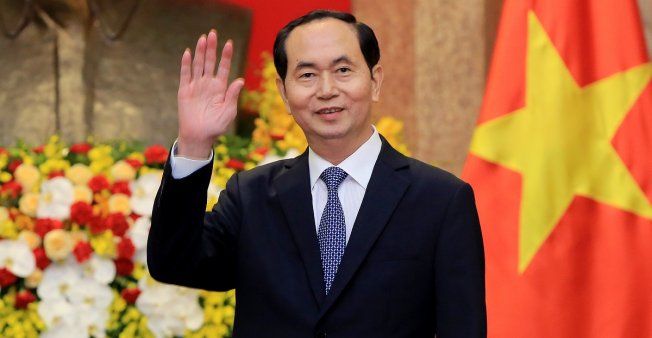
Vietnam’s President Tran Dai Quang died Friday at age 61 after a prolonged and serious illness, state media reported. He passed away from a “serious illness despite devoted treatment by professors and doctors” both in Vietnam and abroad, the official Vietnam News Agency said.
In office as president since April 2016 after more than four decades at the powerful Ministry of Public Security, Quang had a reputation as a tough leader with little tolerance for dissent.
Though he held one of the country’s top four positions and was officially the head of state, his role as president was seen as largely ceremonial, greeting visiting leaders and hosting diplomatic events in a bid to boost Vietnam’s profile on the world stage.
Quang had appeared thin and pale in public, and was unstable on his feet last week when he hosted a welcoming ceremony for Indonesian President Joko Widodo in Hanoi last week.
His last public appearance was just two days ago, at a meeting with visiting Chinese politicians and foreign dignitaries in Hanoi.
Quang, a member of the Politburo, had a reputation as tough and influential in the inner circles of the communist party, though often appeared uncomfortable in the public eye and lacked the charisma of some of his peers in the upper echelons of the party.
In an interview with AFP in 2016 ahead of a visit by the former French leader Francois Hollande, Quang read from a prepared statement and was quickly escorted from the room by staff when a question went off-script. State media made a somber announcement of his death Friday and celebrated his long commitment to public service.
His time in office was dominated by a simmering conflict with Beijing over the South China Sea, a long-running dispute between the communist neighbours that escalated on several occasions. Vietnam cancelled at least one oil drilling project in the resource-rich region during Quang’s tenure in an apparent bid to quell tensions.
He was the administration’s most public face at a series of high-profile events, most notably at an APEC meeting in Danang in November last year where he hosted a bevy of world leaders including US President Donald Trump and China’s Xi Jinping.
As president, he oversaw a crackdown on dissidents that rights groups have decried as a chokehold on free expression. More than 40 people were jailed this year and some 100 have been behind bars as of April 2018, according to Amnesty International.
(AFP)











21, September 2018
Southern Cameroons Crisis: Military brutality makes school resumption impossible 0
For more than two years, schools in Cameroon’s English-speaking regions have been closed following a peaceful demonstration by lawyers and teachers in 2016 against injustice and widespread marginalization.
The demonstrations were followed by the violent military action and this has pushed the country into a military conflict with government troops killing more than 3,000 civilians. The schools are bound to remain closed as government troops are killing students and teachers.
Last week a teacher of the Cameroon Protestant College (CPC) Bali, Mr. Ndeh Blaise, was gunned down by a trigger happy soldiers for no reason. The teacher, who was going to town to run some errands, was stopped by soldiers on patrol. He was asked to present his national identity card, which he promptly did. He was asked by one of the soldiers to undress. He reluctantly did that given that there were some passengers around some of whom were women.
He was later ordered by the soldier to face a wall which he did without question. He was shortly after shot to the leg by the soldier and while lying on the ground, the other passengers rushed to help him, but the said soldier ordered them to stay away or they would be killed. The other passengers were ordered to leave and a moment after, they heard gunshots. It was Mr. Ndeh who had taken a bullet to the chest, a bullet that killed him instantly.
With situations like this, it is hard for schools to resume. Parents are scared of sending their children to school and teachers are reluctant to go to school as both the country’s military and Southern Cameroonian fighters have made them their target.
Many teachers and students in the English-speaking regions have simply migrated from the region for fear of being killed. The conflict in the region has taken unacceptable proportions and the population is moving out.
Last week, things took a turn for the worse. Huge crowds could be seen traveling from the English regions to East Cameroon where they hoped they would find a safe place. The situation was overwhelming and even the South West governor, Okala Bilai, who once called the people of his region “dogs”, had to plead with the residents to cancel their trips. But his pleas fell on deaf ears.
The fear was prompted by threats by Southern Cameroonian fighters to implement a strict movement of goods and persons within the region from September 20, 2018 to October 7, 2018. It should be indicated that Cameroon will be having presidential elections on October 7, 2018 and this has ignited a new wave of fighting and killing in the region as the government seeks to mop up the environment.
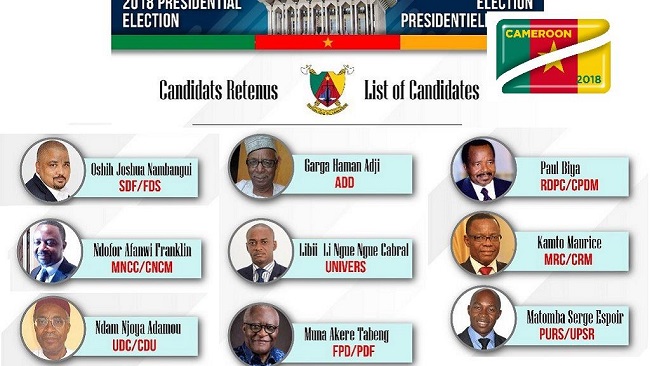
Campaigns for presidential elections scheduled for October 7, are currently underway and it is generally held that Mr. Biya, considered by the ruling crime syndicate as its natural candidate, will emerge as the winner in an election that has already been rigged.
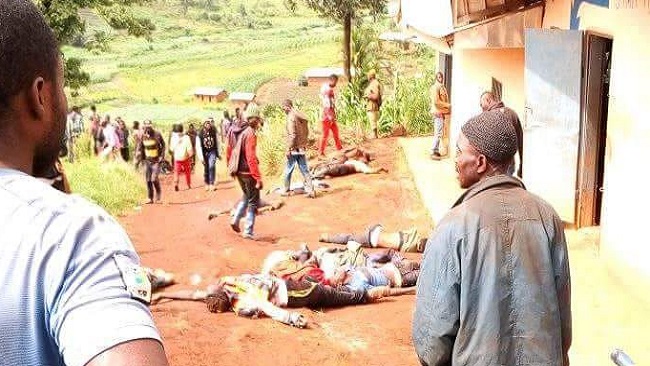
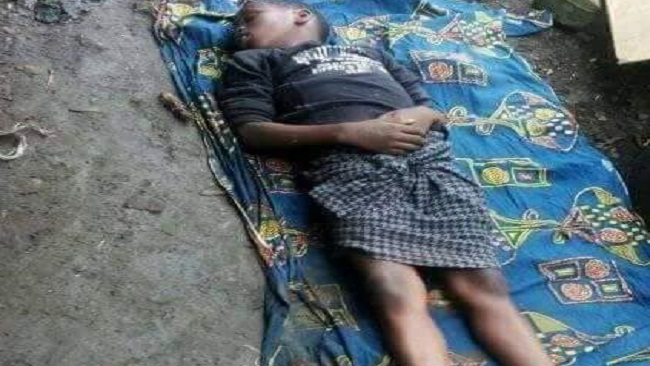
The movement of the population has prompted new tensions in the cities vacated by the population. As the crowd moves out of Southern Cameroons, the country’s military has transformed the place into a slaughterhouse. Pictures from Njikwa and Bafut speak to the type of carnage that is taking place in towns deserted by the population.
While the majority of the population is out, those who do not have relatives out of their main towns have opted to stay and this is costing them their lives. Government militias dressed in the country’s military fatigue are on a rampage. The government has trained a group of Beti killers and unleashed them on the Southern Cameroonian population. A massacre of a global scale is unfolding in many villages and towns in the English-speaking regions.
Pictures emerging from the region are too graphic to be shown. The story is hard to tell. Young men hiding in their homes have been reduced to a mass of flesh as army soldiers move from house to house to carry out a mission they have been handed by Defense Minister, Joseph Beti Assomo, and Territorial Administration Minister, Paul Atanga Nji.
A source close to the government has hinted that the ministers of defense and territorial administration have hatched a plan to end the fighting through brute force. They believe that once many people are killed; there will be no need for an inclusive dialogue. They want to keep the system as it is, even when Cameroonians are complaining and feel that reforms are necessary.
“They have trained killers to kill young able-bodied Southern Cameroonians in the region. This is not the right time for any young man to be in the Southwest and northwest regions. The government has decided to cleanse the region and its militia and military are working hand in glove to implement a plan put in place by the defense minister and his collaborators,” the source said.
“The days ahead will be the bloodiest. The government has no respect for human life. I am really ashamed to be called a Cameroonian. I wish I could express myself in public, but the position I hold makes it hard for me to speak. I am dying in silence. Our country is going through the toughest moments in its history. How can a complaint by a peace-loving people be allowed to degenerate into a civil war,” he added.
The source, which elected anonymity, asked why the international community was not taking this issue seriously. “Why has the international community abandoned Southern Cameroonians? When will they come in to end this carnage? There is a massacre unfolding in many parts of the English-speaking region. The world has to act before the militia and military kill everybody,” he said.
While the killings are going on, the Yaoundé government has decided to seal its leaps. The massacre speaks to a well-orchestrated genocide. The government of Cameroon has decided to wipe out all adult males from certain communities as a move to end any opposition it might face in the region.
With presidential elections on the horizon and October 1 which is considered by many Southern Cameroonians as their independence day, the government is hard at work to ensure that it faces no challenges in the two English-speaking regions of the country.
Ever since the slaughtering of Southern Cameroonians started in October 2017, the country’s president, Paul Biya, who is also known as the monarch, has not expressed any regret about what is happening in his country.
Even with the influx of Southern Cameroonians into East Cameroon, the Yaoundé government has not made any public statements regarding the welfare of those fleeing the conflict in the region.
On the contrary, the defense minister has only issued a press statement indicating that among those who have fled the carnage in the Southwest and Northwest regions to Yaoundé, are some terrorists who have to be neutralized.
The press statement therefore implies that government security forces will be carrying out attacks and searches in neighborhoods inhabited by Southern Cameroonians. The government seems to be rolling out its genocide plan and it is clear that Southern Cameroonians are not safe even in the nation’s capital.
The Southern Cameroons crisis which started as a demonstration by teachers and lawyers in Cameroon’s English-speaking regions has finally migrated to East Cameroon, as thousands flee Southern Cameroons following threats from Southern Cameroonian fighters to stage sporadic attacks on soldiers and punish civilians who have been cooperating with the Yaoundé government.
All major cities in Southern Cameroons have become ghost town as helpless civilians struggle to find a safe place before the expiry of the deadline given by the fighters. Buea, Mamfe, Limbe, Bamenda and Kumba have all witnessed huge crowds struggling to leave, following warnings from Southern Cameroonian fighters that from September 20, 2018, all roads will be blocked and there will be no movement in the region.
The crisis in Cameroon will not be coming to an end anytime soon. The devil is at work in that part of the world. Government troops and the fighters are all committing atrocities that could not have been associated with Cameroon a few years back. The world has to step in if the carnage must stop. Mr. Biya has finally achieved his goal – leave Cameroon with a civil war once he leaves the stage. The country has finally inherited the dictator’s legacy that has affected many countries on the continent.
By Kingsley Betek in Bamenda