26, September 2024
Yaoundé: Glencore affair could cause political earthquake 0
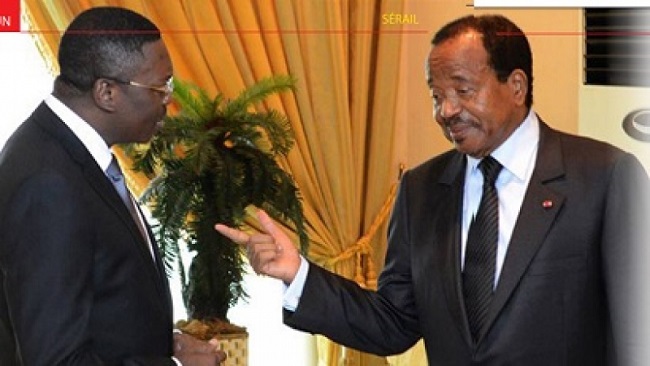
As UK courts investigate accusations of corruption against Glencore and the oil trader’s activities in Africa, speculation is rife in Cameroon that the affair could have repercussions for President Paul Biya.
On 8 October, Southwark Crown Court in London will open a new hearing in the Glencore case, and Cameroon will again be holding its breath. The case could erupt into an international corruption scandal.
At this and subsequent hearings, it will be a question of putting names to the nebulous figures who are alleged to have received bribes from the oil company – to the tune of some CFA10bn ($16.9bn) in connection with contracts awarded to Cameroon by the Société Nationale des Hydrocarbures (National Society of Hydrocarbon, SNH).
Expectations dropped on 10 September at Westminster Magistrates’ Court in London, where the case was called for a preliminary hearing. Despite popular pressure, none of the names of those suspected were mentioned. Yaoundé is waiting for British defendants Martin Wakefield, Alexander Beard and Andrew Gibson, former senior executives of the Anglo-Swiss oil company, to reveal the names of the Cameroonians to whom they are alleged to have paid bribes for the award of oil contracts – and preparing for the impact.
Biya implicated?
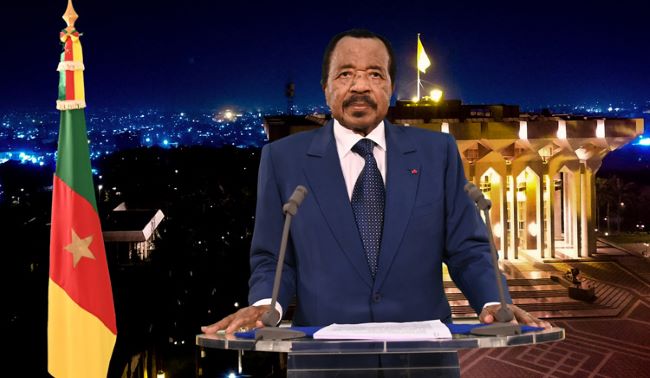
As Cameroon’s President Paul Biya looks set to run for re-election in a year, he is grappling with the possible consequences of the Glencore case, which could call into question his commitment to fighting corruption. Two years have passed since former executives of the company confessed to bribing Cameroonian officials, yet no criminal investigation has been launched. This is despite a complaint by SNH to the Special Criminal Court (SCT) asking it to “identify the Cameroonian accomplices in these acts of corruption”.
According to the British defendants, the events took place between 2007 and 2014. Most of those working for SNH or Société Nationale de Refininage (National Society of Refining, Sonara) at the time are still in their positions. However, none have been heard from in an investigation. Is this because the chain of responsibility could go all the way back to the president of Cameroon himself? According to many observers, it is unthinkable that SNH could have awarded contracts at extremely advantageous rates without the presidency being informed.
The minister of state and secretary-general of the presidency, Ferdinand Ngoh Ngoh, also chairs SNH’s board of directors. Yet the government has communicated little about this affair, reinforcing the impression of a lack of transparency that surrounds the management of oil affairs, despite international commitments to financial openness. The only positive development is that the ministry of finance has referred the matter to Swiss and British authorities to defend Cameroon’s interests. Glencore’s Douala-based subsidiary will be subject to a tax reassessment commensurate with the damage suffered by Cameroon’s public finances.
At the very least, the affair reveals major security flaws, since it has been established that aircraft carrying cash could land at Cameroon airports without alerting the attention of the relevant authorities. How did these shipments escape the attention of the customs service and therefore the ministry of finance? This is one of the questions that Wakefield, Beard and Gibson, the British defendants at Southwark Crown Court, will have to answer.
Moudiki on borrowed time?
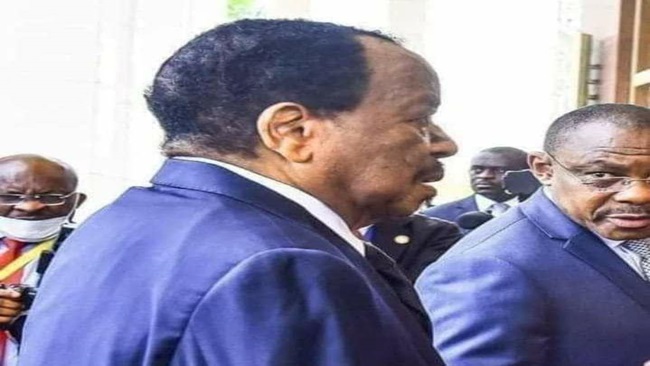
Who might be the Cameroonians implicated in the Glencore affair ? On 26 July, Biya authorised Ngoh Ngoh to hold an extraordinary meeting of the board of directors of SNH, with a view to replacing Adolphe Moudiki, the long-serving managing director and a long-time ally of the head of state. But the president then changed his mind and in the end prevented the dismissal of his old ally, without explanation. Moudiki is still at the head of SNH, but now appears to be a man on borrowed time.
The matter is all the more delicate for him because his wife, Nathalie Moudiki, is charged with the company’s contractual interests through her position as director of legal affairs at SNH. At 85 years of age, Moudiki will not indulge in any talk of retirement, even though his colleagues say his insight and vigilance have been undermined by illness. He initially denied any involvement in the company that he has run with an iron fist for 31 years, before changing tack.
On 6 November, 2023, he filed a complaint with the TCS to “identify the Cameroonian accomplices in these acts of corruption”. He added that SNH is “confident that the outcome of the proceedings in London will enable the TCS to speed up its investigations”. In Yaoundé, there is no doubt Moudiki is hoping to get the TCS to look into the oil networks of the man who tried to sack him – Ngoh Ngoh, secretary-general of the presidency.
As chairman of SNH’s board of directors since 2011, he is the number two in Cameroon’s executive and the link between President Biya and the oil company, which contributes around 60% of the national budget. Given he is supposed to be the eyes and ears of the president, how could he have allowed the Glencore scandal to emerge, his critics ask. “Technically, you can’t sell at knock-down prices without it showing up in the records presented to the directors, and SNH’s and Sonara’s auditors are turning a blind eye,” said one source.
Reluctance to comment
Against a backdrop of clan warfare around the presidency, Ngoh Ngoh’s enemies are waiting to see him fall. Given the complexity of the Glencore affair and the number of people involved in the alleged acts of corruption, between London, Geneva and Cameroon, is still unknown, could it all come to nothing?
Among the “second tier” figures exposed are Charles Metouck and Ibrahim Talba Malla, the two successive heads of Sonara between 2007 and 2014, when the incidences of corruption are alleged to have taken place. Neither has, as yet, offered a reaction. The former, appointed managing director in 2007, was dismissed and arrested in 2013 before being sentenced to 15 years’ imprisonment for embezzling CFA514m ($872,000). But the latter, his successor, who held the post from 2013 to 2019, is the current minister delegate in charge of public procurement.
Little known to the public, he is nonetheless a political heavyweight of northern Cameroon, comprising the three regions of Adamaoua, the north and the far north and representing reservoirs of votes on which Biya will be relying in part in the forthcoming elections. No doubt aware of the explosive nature of the situation, Talba Malla’s successors, Jean-Paul Simo Djonou and Harouna Bako, have not so far commented on the Glencore affair, nor on the actions Sonara intends to take to protect its interests and safeguard its image.
Source: The Africa Report














26, September 2024
UN Conference on diversity holds in Nairobi 0
A UN conference on climate diversity and desertification, held on the theme “Greening the African Horizon” took place in Nairobi, Kenya, on 17 September 2024 with Africa taking center stage in efforts to restore degraded landscapes, protect biodiversity and build sustainable livelihoods for its citizens.
Dubbed as the GLF Africa 2024 hybrid conference greening the African Horizon, the event brought together thousands of participants from local communities, indigenous peoples, youth leaders and policy makers, as well as innovators to showcase Africa’s immerse potentials.
Speaking at the event, the CEO of the Center for International Forestry Research and World Agroforestry (CIFOR-ICRAF), Eliane Ubalijoro, said that the event was designed to showcase Africa’s immense potential to construct a resilient equitable future through its landscape.
“Together, we have the power to green Africa and beyond- for food securing livelihoods, food security, climate resilience and biodiversity conservation. Land and community are the common denominators for achieving these goals. Though the climate crisis presents immense challenges, Africa holds immense potentials of rich and local indigenous knowledge, innovative solutions, youth leaders, brilliant minds and emerging technologies,” she said.
Also speaking at the event, Elijah Mboko, National Technical Specialist at FAO Kenya said that “As we bring in new tools and approaches, we should look at how to best integrate them into the existing functional systems so that we don’t start from zero to distort what is ongoing on the land. We don’t want to work in isolation; we want to strengthen that system.”
By integrating local knowledge with cutting-edge technology and the latest science, the GLF is creating an AI hub to promote community-driven AI solutions that challenge the status quo. It will connect landscape actors and create interdisciplinary alliances to foster collaboration, innovation and inclusive knowledge.
Catherine Nakalembe, Associate Research Professor at the University of Maryland and Africa Program Director at NASA Harvest, who also attended the event pointed out that Africa needed to design systems that fitted the African context.
“We need to design systems that are appropriate for the context of Africa. We need data from the places that we’re trying to understand to build better models. Let’s say, foe Western Kenya, we need a context-aware model that can interpret intercropping in small-scale practices,” she said.
A key aspect of restoring forest is planting trees, which in turn requires effective tree seed and seedling delivery systems. During a session hosted by CIFOR-ICRAF, panelists and participants emphasized the need to develop a market for demand-driven native tree species to engage communities through participatory approaches and to share knowledge and resources broadly through stakeholder networks such as the nascent Transformative Partnership Platform (TPP).
Also present at the event, the Senior Manager for the Youth Leadership Program at the African Wildlife Foundation, Simangele Msweli, underscored that youths made a critical mass of the population. “70% of the African population is under the age of 35. Youths make up a very critical mass of the population. The biodiversity and climate crisis requires a whole-of-society approach-everyone must take action,” he said.
“There is a need to decolonize how we do climate justice and land restoration. Whatever has happened on other continents, whatever the donors and the granters are saying might not be the solution for Africa. There is a need for Africa to come up with African solutions. There is a need for women to be involved in coming up with solutions to land issues that are upon them,” said Deborah Oyugi, English Countries Manager and Safeguarding Lead at Youth Initiative for Land in Africa (Yilaa).
By Cecilia M. Manjang