
14, August 2022
Cameroon looks to bright future in film productions 0
“Stand by!” shouts the director as actors take their marks. The lighting blinks on. The film crew snaps into action after the order to hurry up.
It’s a sunny day in Tiko, a locality in southwestern Cameroon and a local film crew is gathered to shoot for an action series.
The series which spotlights the ills of drugs and human trafficking is called “Boss Daughters” and it’s expected to be premiered in November.
“We have been filming for like four days now and truly this one is a wonderful experience because I love the story line,” said 32-year-old Jackson Stephanor, director of the show.
Stephanor hopes that “Boss Daughters” will provide new impetus to Collywood, the affectionate nickname for Cameroon’s film industry.
Cameroon’s cultural diversity, tree-lined suburbs and sweeping landscapes, deserts and lakes have increasingly dotted the silver screen in recent years, serving as the backdrop for several popular movies in the country.
“For the last four years, the Cameroon film industry has really evolved. We have moved from the sales of DVDs and CDs to online,” said 31-year-old Montana Peters who has produced and acted in several movies.
The Central African nation has seen considerable growth in its film productions with over 300 movies produced since 2008, said Coach Obi who joined the industry as an actor in 2006.
In recent months, a number of Cameroonian productions have been attracting attention from streaming company Netflix, which has so far purchased four Cameroonian movies.
“We are making some strides,” Obi told Xinhua while shooting an advert in a studio in Buea, chief town of Southwest region which has become the center of film productions in the country.
The growth and popularity of the industry has won the admiration and attention of young Cameroonians like Josiane Shengang, 21, Angel Ntube, 21 and Elyon-Bright Ayuk, 22 who raised funds to produce “Boss Daughters”.
“We are just students who are working so hard to bring themselves up there. I will like to take my career as far as above the sky, as far as I can go,” said Ntube.
“We are trying to hit the limelight. We are all young ladies and we have the talents,” added Ayuk.
There are no official statistics on how much the industry has contributed to the Cameroonian economy, but it has undoubtedly created jobs in a country with an economy that relies mainly on oil and agriculture, said Obi.
“Some persons are cashing out. It might not be that much but really producers are making that effort,” Obi said.
Still, Peters said the industry has a long way to go before its actors and directors have a chance to make millions of dollars.
“We don’t actually have platforms where we can sell our movies. That is where the big problem is. That is where Nigeria is ahead of us,” Peters said, adding that a team was working on a platform that will soon air Cameroonian movies online for Cameroonians to stream.
Fueled by low budgets, whirlwind production schedules and little professional collaboration, the industry is still young but has great potentials, said film editor and producer, Musi Gakehmi.
“As it’s growing, as people are trusting production, more money is going to come in and we are going to have better equipment. Our equipment is not the Hollywood kind of equipment as of now, so whatever we have we make sure that we maximize its use,” Gakehmi said.
“In the next ten years, I see Cameroon film industry like one of the biggest film industries in Africa. It is going to be really big because they are working and achieving a lot,” said Shengang. ■
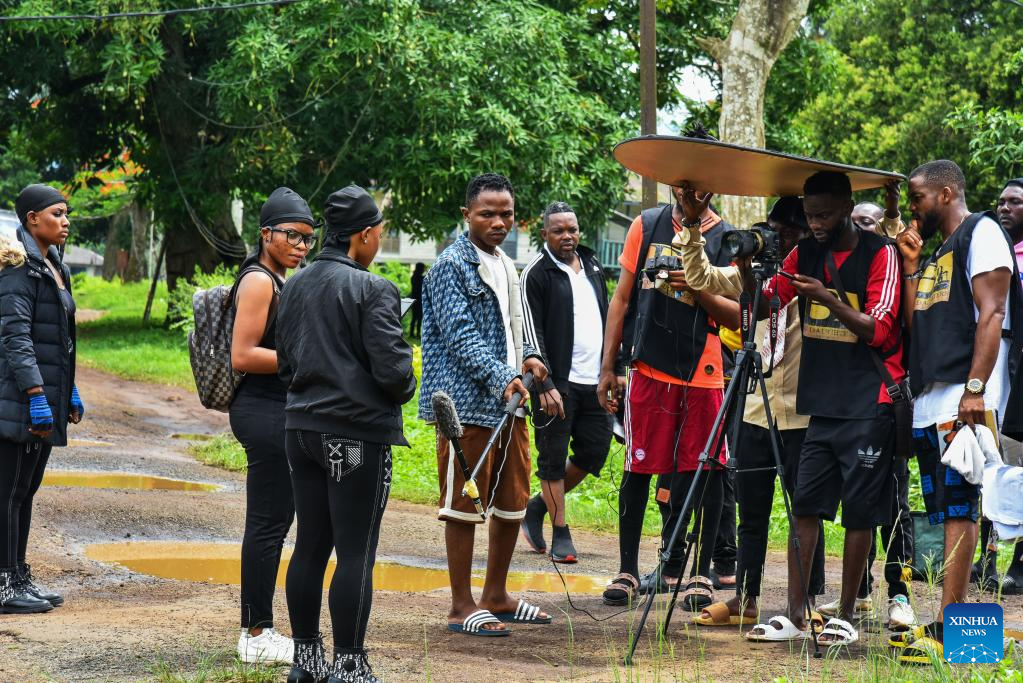
File photo taken on May 26, 2022 shows the scene of film shooting of Boss Daughters in the Southwest region, Cameroon. (Xinhua/Kepseu)
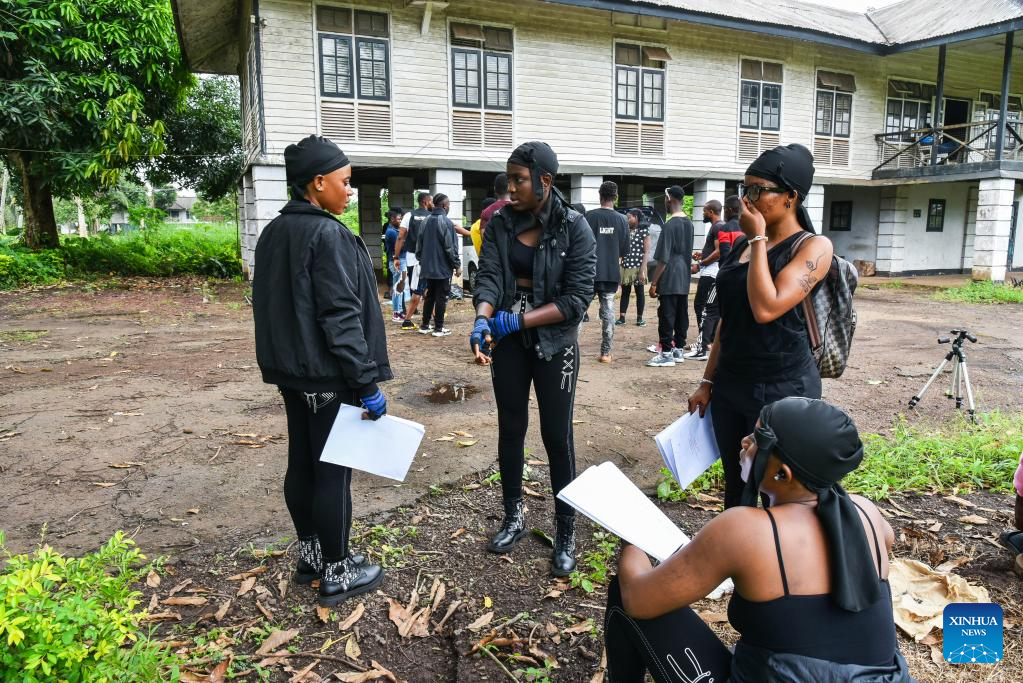
File photo taken on May 26, 2022 shows the scene of film shooting of Boss Daughters in the Southwest region, Cameroon. (Xinhua/Kepseu)

File photo taken on May 25, 2022 shows Jackson Stephanor (1st L), director of Boss Daughters, giving instructions to actresses while shooting the film in the Southwest region, Cameroon. (Xinhua/Kepseu)
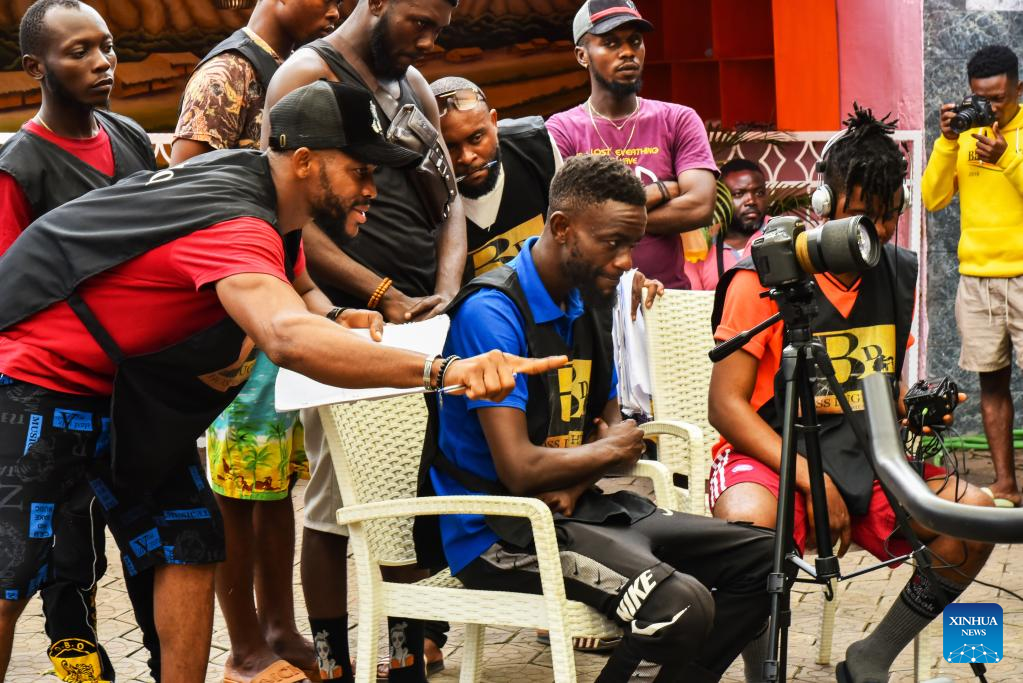
File photo taken on May 25, 2022 shows Jackson Stephanor (1st L, Front), director of Boss Daughters, giving instructions to his cameraman while shooting the film in the Southwest region, Cameroon. (Xinhua/Kepseu)

File photo taken on May 25, 2022 shows the scene of film shooting of Boss Daughters in the Southwest region, Cameroon. (Xinhua/Kepseu)

File photo taken on May 25, 2022 shows Jackson Stephanor (1st R), director of Boss Daughters, giving instructions to his cameraman while shooting the film in the Southwest region, Cameroon.
Culled from Xinhuanet






















14, August 2022
African bishops lament inability to stop young people from leaving 0
In the din of Yaoundé’s traffic, thousands of youths comb various offices, documents in hand, in search of jobs.
As frustration sets in, many see a future beyond the country’s shores. That is how Jannet left Cameroon two years ago.
A recruiter told her she would have a well-paying job upon arrival in wealthy Kuwait. Her family agreed to go into debt with the recruiter to pay for airfare and other associated expenses.
But the promise of a good job turned into a nightmare in Kuwait. A member of the recruiter’s network confiscated her passport, mobile phone and other personal documents and took her to the home of a wealthy family, where Jannet had to work long hours with little food.
“I wake up at 5 a.m. and go to bed at 1 a.m., at times no food,” she told Catholic News Service.
For over two years, Jannet slaved for that family, sleeping on the kitchen floor. She said she was forced to use the “toilets” reserved for cats.
“I used to call them (the cats) my brothers,” Jannet recalled, because “they were the only family I had out there.”
Hers is not an isolated story. Beatrice Titanji, vice president of Cameroon’s Trauma Centre for Victims of Human Trafficking, said these modern-day slave markets can be found throughout the Gulf states.
“They actually have booths as you would have in the market, and (people) are sold and bought for domestic service,” said Titanji.
“So they move them to their various owners as negotiated before, because there are linesmen here in Cameroon who actually negotiate, get money, sell them at higher prices, sell them depending on the outlook of the victim, as it happened 200 years ago during slave trade. Our children are sold and bought today in the Middle East.”
The situation has caught the attention of members of the Symposium of Episcopal Conferences of Africa and Madagascar.
Meeting in Accra, Ghana, July 25-Aug. 1, the bishops examined the causes of migration, the risks involved — particularly when it comes to irregular migration — and what the church needs to be doing to help.
“Migration is a normal social phenomenon that is linked to the history of humankind,” the bishops said in a statement signed by Cardinal-designate Richard Kuuia Baawobr of Wa, Ghana, president of SECAM.
“This is why migration cannot be considered illegal but could be irregular,” they added. They said while the suffering of migrants is not linked to migration as such, migration can involve suffering: “abuse of the social status … exploitation, ignorance” and fear of poverty.
“We wish to express our pain in seeing our youth leaving our countries, knowing that they are going to suffer and possibly lose their lives, and we lament our inability to stop them from leaving,” the bishops said.
They urged young people willing to exercise their right to migrate “to do so in a manner that is administratively acceptable and with full knowledge of the challenges that await them.”
“We encourage our youths not to lose hope and to hold on to God through a life of holiness.”
The church leaders also called on governments to put in place structures and conditions that discourage irregular migration, such as good governance, employment opportunities, multifaceted security, political and social inclusion, promotion of social justice.
“We urge transit and host countries to respect the rights and human dignity of migrants.”
They also challenged Christian communities to “develop an active pastoral care for migration” that should involve welcoming migrants, protecting them, promoting them and integrating them into society.
Jannet eventually returned to Cameroon, sick and frail, with nothing other than the clothes she was wearing. She said when she became sick, her slavers threw her onto the streets.
As she roamed the streets of Kuwait, not knowing exactly where she was going, Jannet eventually came across the Embassy of the Central African Republic. Embassy staff took her to a hospital, helped her replace her stolen passport, and paid for her flight back to Cameroon.
Still, young people in Cameroon say they will continue to risk leaving.
George Atanga, who has a master’s degree in chemistry, said he has been looking for a job for the past five years.
“Whether I get a visa or not, I have to leave this country,” he told Catholic News Service as he waited in line to take photos for his passport.
“If I don’t get a visa, I will travel through Algeria and see if I can get to Spain. My future lies out there,” he said.
It’s a trend across Africa, a continent where 51% of young women and 43% of young men are unemployed.
Source: Crux