30, August 2021
French Cameroun: Douala battles mounting flood peril 0
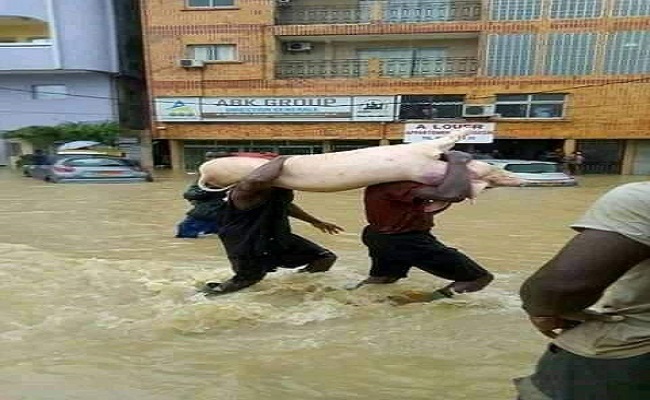
Douala was plunged into darkness, but cries pierced the silent night: the water was rising. Alerted by the neighbors, Hummel put some of his belongings to safety and hurriedly sent the children away. A few minutes later, the blackish liquid invaded the house.
In mid-August, like every year during the rainy season, the informal neighborhood of Makèpè-Missoké was invaded by water in the heart of Cameroon’s economic capital. Under the effect of global warming, floods are becoming more and more frequent in this port city of more than three million inhabitants, which is constantly expanding.
“Burned out TV, burned-out refrigerator… Everything is wasted,” sighs Hummel Tsafack, 35.
“As soon as the thunder rumbles, we raise the beds. We are always afraid here. The water comes so quickly,” agrees his neighbor François, in his fifties. He still has a bitter memory of the flood of the summer of 2020 that paralyzed the city and devastated the neighborhood.
In his small house soaked with humidity, all the household appliances are out of order. On the floor, the concrete is dotted with a few holes. “This place, we’ve already cemented it seven times. Every time it floods, it breaks and we have to start over.”
Population growth
“We moved here because it was cheaper. We’re not going to move,” he warns. This precarious neighborhood is in a flood zone that cannot be built on. But residents continue to pile in, driven by the lack of space in a city with a population growth rate of over 5.5% per year.
Each year, nearly 110,000 new city dwellers move into the megalopolis and the gap between supply and demand for available land is growing.
Douala is prone to flooding with nearly 250 km of rivers and heavy rainfall averaging 4,000 mm per year. It is located at the mouth of the Wouri River, on a low coastal plateau, bordering the Atlantic Ocean and is influenced by the tides.
Meteorological data for the last 20 years indicate a decrease in rainfall, which masks an increase in extreme events, and very violent rain episodes, causing flooding.
The temperature of the metropolis is increasing, as it is at the global level. According to the latest report of the UN climate experts (IPCC), coastal cities are in the front line of the climate crisis and risk being “wiped out by long-term flooding” and rising sea levels.
According to the IPCC, floods will displace an average of 2.7 million people in Africa and flood-related costs could increase tenfold by 2050, to $60 billion a year, in the 136 largest coastal cities.
Plastic waste
In Makèpè-Missoké, plastic waste litters the river. “Look at all the garbage thrown away by the residents. In addition to this, the soil is silting up and invasive plants are colonizing the riverbed. In case of heavy rains, the water overflows,” explains environmental specialist Didier Yimkwa.
To address the problem, the city has built about 40 kilometers of drains since 2012. Some at-risk, unsanitary and precarious neighborhoods have also been upgraded to allow access to city services, especially those for waste collection.
But garbage and garbage are everywhere in Douala’s poor neighborhoods, and the drains are often covered with plastic, preventing water from draining away.
“It is estimated that 30% of waste is lost in nature,” said Dr. Joseph Magloire Olinga, Deputy Director of Studies and Environmental Protection in Douala.
At the same time, another program has developed a hydro meteorological observatory to collect reliable local data on rainfall and prevent the risk of flooding. The participation of the French Development Agency and the World Bank is essential, says Olinga, who is in charge of monitoring the “Douala, sustainable city” project.
“The response is not enough,” he admits, however. “We need a serious alternative in terms of land to accommodate the population. This involves the densification of the city center, and the construction of high-rise buildings, but some sectors are blocked by real estate developers who have bought the land and no longer want to sell it,” he explains.
Some flood-prone areas also continue to be allocated to real estate projects, which is the responsibility of the state.
In neighborhoods like Makèpè-Missoké, the goal is to learn to live with the risk of flooding. “But it is certain that some inhabitants for whom the threat is too great will also have to leave,” concludes Mr. Olinga.
Source: AFP


















30, August 2021
Amba fighters ambush Cameroon military convoy in Mundemba, 2 soldiers dead: security sources 0
The carnage is continuing unabated as Ambazonian fighters keep on reducing the country’s military into a group of scouts who have lost their way in a massive wilderness. The country’s army soldiers are completely at the wit’s end.
Southern Cameroonian fighters have simply overwhelmed the country’s military as they gain more experience and acquire more sophisticated weapons in a war that is very likely to run for decades, especially as the government is reluctant to head to the negotiating table.
Some of the weapons are acquired when the brave Southern Cameroonian fighters attack and kill highly demoralized army soldiers who now understand that they are not a match for the Amba Boys who are hell-bent on liberating their fatherland.
The ragtag military group that started with machetes and hunting rifles has morphed into a sophisticated group of experienced and dedicated fighters and these boys are not shy to demonstrate their power by attacking the military and its equipment on a terrain the military knows nothing about.
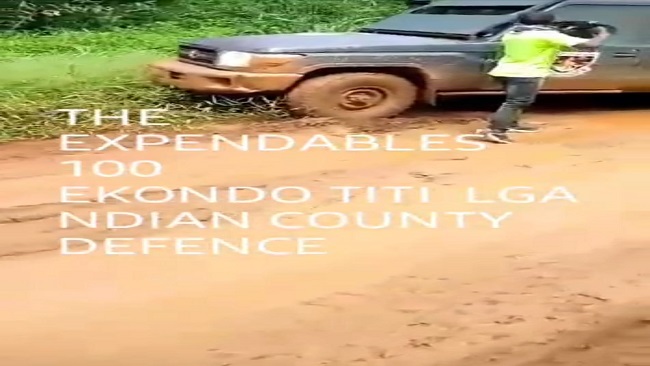
Ambazonia Restoration Forces ambushed a Cameroon government military convoy, providing security at an ENEO facility in Mundemba killing 2 soldiers security sources said today August 30, 2021.
The convoy came under heavy attack from the Amba fighters as it headed towards the electricity company’s post in Mundemba, the chief town in Ndian division on Monday, the sources hinted.
The attack was the latest in a Southern Cameroons conflict which has killed thousands of people and displaced hundreds since it began four years ago.
“We lost 2 soldiers in the terrorists’ ambush in Mundemba” a military officer, who asked not to be identified, told Cameroon Intelligence Report.
He said 4 government army soldiers, including two ENEO staffs, were wounded in the ambush.
The Cameroon government military convoy was on its way to supply troops protecting ENEO technicians when it came under fire, said another military source, who gave the same toll.
By Rita Akana