30, August 2021
Taliban in Kabul: Afghan ex-minister now delivers food in Germany 0
He was once a minister in Afghanistan but quit, fed up with the corruption. Now in Germany, Sayed Sadaat is making a living delivering meals as a bicycle courier.
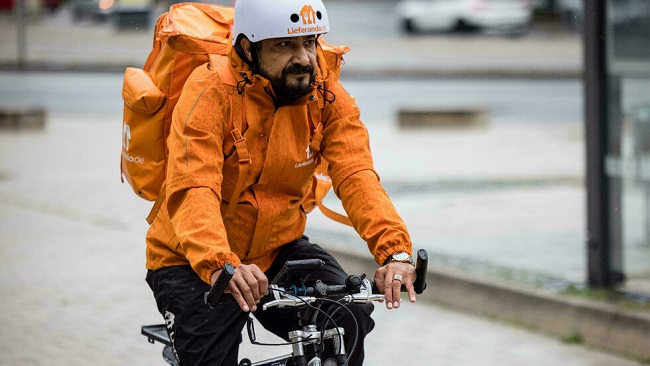
For six hours on weekdays and from noon to 10pm on Saturdays and Sundays, Sadaat dons his distinctive orange coat and big square backpack, shuttling pizzas or other orders to customers.
“There is no shame in the job at all. Work is work,” he told AFP.
“If there is a job, it means there is public demand… someone has to do it,” he said.
Sadaat is one of thousands of Afghans who have found a home in Germany over the last years.
Since 2015, when Europe saw a huge influx of people fleeing wars mostly from Syria and Iraq, around 210,000 Afghans have sought asylum in Germany.
This makes them the second biggest group of people seeking protection in Europe’s most populous country after Syrians.
With the Taliban’s return to power earlier this month, Germany has also evacuated around 4,000 Afghans, including those who worked with NATO forces and others who need protection.
– ‘For private benefit’ –
Sadaat’s journey to Germany was far less harrowing.
He was minister of communications in Afghanistan from 2016 to 2018.
But the 50-year-old said he quit his post because he was fed up with corruption in the government.
“When doing the job as a minister there was a difference between the president’s close circle and myself,” he explained.
“Their demands were for private benefit, I wanted the money for government projects to be implemented properly.
“So I could not fulfil their demands and then they tried to push me, put pressure on me from the president’s side.”
He took on a consultancy job in the telecommunications sector in Afghanistan.
But by 2020, the security situation had deteriorated, he said.
“So I decided to leave,” he told AFP.
As a dual Afghan-British citizen, he decided to move to Germany at the end of 2020 before Brexit made it no longer possible for Britons to obtain residency in the EU without conditions such as an offer of employment.
He could have secured a post in Britain, but said he saw more opportunities for his sector in Germany.
But without German, Sadaat, who came alone and refuses to talk about his family, said he has struggled to get employed.
– Advising the government? –
The coronavirus pandemic delayed his plans to learn to speak German.
But he is now taking language classes four hours a day, before getting on the bicycle for food delivery company Lieferando.
The job pays up to 15 euros ($18) an hour, enough for his living expenses, including rent of 420 euros a month.
Sadaat said he does not regret his decision to move to Germany.
“I know this challenge is for a short time, it is until I can get another job,” he said, touting the physical benefits of cycling 1,200 kilometres (745 miles) every month.
With the return to power of the Taliban and the withdrawal of NATO forces from his native country, he sees another possible opening for him in Germany.
“I can advise the German government on Afghanistan so that the Afghan people can benefit because I reflect the true picture there,” he said.
He admits however that no contact has yet been made with the German authorities on the issue.
As for the Taliban, he believes they may have “learnt from the past mistakes” in terms of human, women’s rights.
But he calls on the international community not to turn its back on Afghanistan and continue providing economic support.
As his shift begins at the stroke of midday, he flicks through his phone.
“I have to go now,” he says, riding off through the rain for his first delivery of the day.
Source: AFP



















30, August 2021
French Cameroun: Douala battles mounting flood peril 0
Douala was plunged into darkness, but cries pierced the silent night: the water was rising. Alerted by the neighbors, Hummel put some of his belongings to safety and hurriedly sent the children away. A few minutes later, the blackish liquid invaded the house.
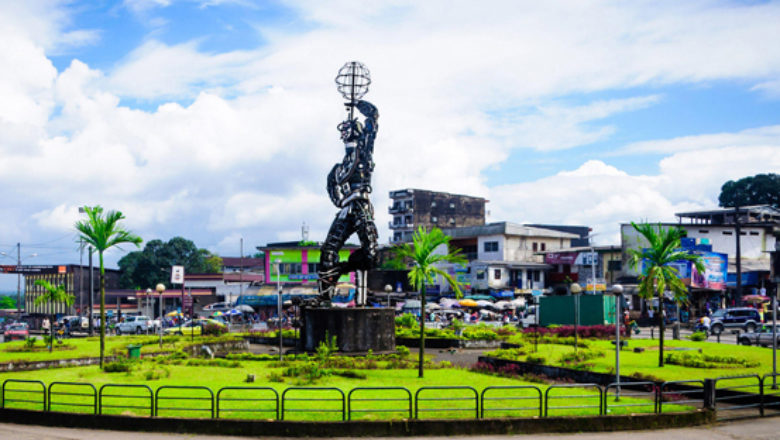
In mid-August, like every year during the rainy season, the informal neighborhood of Makèpè-Missoké was invaded by water in the heart of Cameroon’s economic capital. Under the effect of global warming, floods are becoming more and more frequent in this port city of more than three million inhabitants, which is constantly expanding.
“Burned out TV, burned-out refrigerator… Everything is wasted,” sighs Hummel Tsafack, 35.
“As soon as the thunder rumbles, we raise the beds. We are always afraid here. The water comes so quickly,” agrees his neighbor François, in his fifties. He still has a bitter memory of the flood of the summer of 2020 that paralyzed the city and devastated the neighborhood.
In his small house soaked with humidity, all the household appliances are out of order. On the floor, the concrete is dotted with a few holes. “This place, we’ve already cemented it seven times. Every time it floods, it breaks and we have to start over.”
Population growth
“We moved here because it was cheaper. We’re not going to move,” he warns. This precarious neighborhood is in a flood zone that cannot be built on. But residents continue to pile in, driven by the lack of space in a city with a population growth rate of over 5.5% per year.
Each year, nearly 110,000 new city dwellers move into the megalopolis and the gap between supply and demand for available land is growing.
Douala is prone to flooding with nearly 250 km of rivers and heavy rainfall averaging 4,000 mm per year. It is located at the mouth of the Wouri River, on a low coastal plateau, bordering the Atlantic Ocean and is influenced by the tides.
Meteorological data for the last 20 years indicate a decrease in rainfall, which masks an increase in extreme events, and very violent rain episodes, causing flooding.
The temperature of the metropolis is increasing, as it is at the global level. According to the latest report of the UN climate experts (IPCC), coastal cities are in the front line of the climate crisis and risk being “wiped out by long-term flooding” and rising sea levels.
According to the IPCC, floods will displace an average of 2.7 million people in Africa and flood-related costs could increase tenfold by 2050, to $60 billion a year, in the 136 largest coastal cities.
Plastic waste
In Makèpè-Missoké, plastic waste litters the river. “Look at all the garbage thrown away by the residents. In addition to this, the soil is silting up and invasive plants are colonizing the riverbed. In case of heavy rains, the water overflows,” explains environmental specialist Didier Yimkwa.
To address the problem, the city has built about 40 kilometers of drains since 2012. Some at-risk, unsanitary and precarious neighborhoods have also been upgraded to allow access to city services, especially those for waste collection.
But garbage and garbage are everywhere in Douala’s poor neighborhoods, and the drains are often covered with plastic, preventing water from draining away.
“It is estimated that 30% of waste is lost in nature,” said Dr. Joseph Magloire Olinga, Deputy Director of Studies and Environmental Protection in Douala.
At the same time, another program has developed a hydro meteorological observatory to collect reliable local data on rainfall and prevent the risk of flooding. The participation of the French Development Agency and the World Bank is essential, says Olinga, who is in charge of monitoring the “Douala, sustainable city” project.
“The response is not enough,” he admits, however. “We need a serious alternative in terms of land to accommodate the population. This involves the densification of the city center, and the construction of high-rise buildings, but some sectors are blocked by real estate developers who have bought the land and no longer want to sell it,” he explains.
Some flood-prone areas also continue to be allocated to real estate projects, which is the responsibility of the state.
In neighborhoods like Makèpè-Missoké, the goal is to learn to live with the risk of flooding. “But it is certain that some inhabitants for whom the threat is too great will also have to leave,” concludes Mr. Olinga.
Source: AFP