Cameroon Concord News
You Are What You Read
  • Home
  • News
    • Cameroon
    • Nigeria
    • Africa
    • Europe
    • World
  • Politics
    • Cameroon
    • Nigeria
    • Africa
    • Europe
    • World
  • Sports
    • Cameroon
    • Africa
    • Europe
    • World
  • Business
    • Africa
    • World
  • Life
    • Education
    • Health
    • Fashion
    • Entertainment
  • Religion
    • Cameroon
    • World
  • Contact
    • Online
    • Phone
    • Email
  • About
    • Us
    • Our Services
    • Advertising with Us

Categories

Recent Posts

  • Yaoundé earns CFA15 billion from Chad Oil Pipeline transit fees in 5 months
  • Most stocks rise, oil flat following peace deal-fuelled rally
  • Iran deal: the cards are now in Tehran’s favour
  • American musician Oliver Tree killed in mid-air helicopter collision in Brazil
  • Cameroon looks to Tunisia’s textile model to develop its cotton value chain

Archives

  • June 2026
  • May 2026
  • April 2026
  • March 2026
  • February 2026
  • January 2026
  • December 2025
  • November 2025
  • October 2025
  • September 2025
  • August 2025
  • July 2025
  • June 2025
  • May 2025
  • April 2025
  • March 2025
  • February 2025
  • January 2025
  • December 2024
  • November 2024
  • October 2024
  • September 2024
  • August 2024
  • July 2024
  • June 2024
  • May 2024
  • April 2024
  • March 2024
  • February 2024
  • January 2024
  • December 2023
  • November 2023
  • October 2023
  • September 2023
  • August 2023
  • July 2023
  • June 2023
  • May 2023
  • April 2023
  • March 2023
  • February 2023
  • January 2023
  • December 2022
  • November 2022
  • October 2022
  • September 2022
  • August 2022
  • July 2022
  • June 2022
  • May 2022
  • April 2022
  • March 2022
  • February 2022
  • January 2022
  • December 2021
  • November 2021
  • October 2021
  • September 2021
  • August 2021
  • July 2021
  • June 2021
  • May 2021
  • April 2021
  • March 2021
  • February 2021
  • January 2021
  • December 2020
  • November 2020
  • October 2020
  • September 2020
  • August 2020
  • July 2020
  • June 2020
  • May 2020
  • April 2020
  • March 2020
  • February 2020
  • January 2020
  • December 2019
  • November 2019
  • October 2019
  • September 2019
  • August 2019
  • July 2019
  • June 2019
  • May 2019
  • April 2019
  • March 2019
  • February 2019
  • January 2019
  • December 2018
  • November 2018
  • October 2018
  • September 2018
  • August 2018
  • July 2018
  • June 2018
  • May 2018
  • April 2018
  • March 2018
  • February 2018
  • January 2018
  • December 2017
  • November 2017
  • October 2017
  • September 2017
  • August 2017
  • July 2017
  • June 2017
  • May 2017
  • April 2017
  • March 2017
  • February 2017
  • January 2017
  • December 2016
  • November 2016
  • October 2016
  • September 2016
  • August 2016
  • July 2016
  • June 2016
Another CPDM baron has died in Yaoundé aged 85

17, January 2025

Another CPDM baron has died in Yaoundé aged 85 0

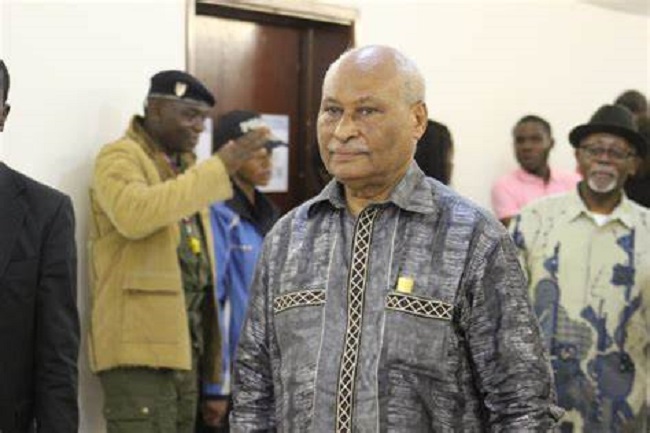
Professor Pierre Titi Nwel, a member of the Electoral Council (Elecam) has died aged 85.

Cameroon Concord News understands that Professor Titi Pierre passed away late on Thursday 16 of January 2025 in Yaoundé.

He was expected in Douala today Friday 17 January 2025 to begin a tour of ELECAM’s rigging facilities in the Littoral region.

Pierre Titi Nwel was born on 1 November 1940 in Matomb a district in the Nyong-et-Kéllé Division in the Centre region some 65 km south-west of Yaoundé. He held a doctorate in sociology from the University of Paris-X (Nanterre).

He worked at the Ministry of Education from 1973 to 2012 and has held a number of international consultancy positions.

By Rita Akana

Global Economy Stabilizes, But Developing Economies Face Tougher Slog

16, January 2025

Global Economy Stabilizes, But Developing Economies Face Tougher Slog 0

Developing economies—which fuel 60 percent of global growth—are projected to finish the first quarter of the 21st century with the weakest long-term growth outlook since 2000, according to the World Bank’s latest Global Economic Prospects report. Even as the global economy stabilizes in the next two years, developing economies are expected to make slower progress in catching up with the income levels of advanced economies. 

The global economy is projected to expand by 2.7% in both 2025 and 2026, the same pace as in 2024, as inflation and interest rates decline gradually. Growth in developing economies is also expected to hold steady at about 4% over the next two years. This, however, would be a weaker performance than before the pandemic—and insufficient to foster the progress necessary to alleviate poverty and achieve wider development goals. 

The World Bank’s analysis is its first systematic assessment of the performance of developing economies in the first quarter of the 21st century. It finds that, during the first decade, developing economies grew at the fastest clip since the 1970s. Yet progress ebbed after the Global Financial Crisis of 2008-09. Global economic integration faltered: as a share of GDP, foreign direct investment (FDI) inflows into developing economies are at about half the level of the early 2000s. New global trade restrictions in 2024 were five times the 2010-19 average. As a result, overall economic growth dropped—from 5.9% in the 2000s to 5.1% in the 2010s to 3.5% in the 2020s. Since 2014, with the exception of China and India, the average per capita growth rates of income in developing economies have been half a percentage point lower than that in wealthy economies, widening the rich-poor gap.

“The next 25 years will be a tougher slog for developing economies than the last 25,” said Indermit Gill, the World Bank Group’s Chief Economist and Senior Vice President for Development Economics. “Most of the forces that once aided their rise have dissipated. In their place have come daunting headwinds: high debt burdens, weak investment and productivity growth, and the rising costs of climate change. In the coming years, developing economies will need a new playbook that emphasizes domestic reforms to quicken private investment, deepen trade relations, and promote more efficient use of capital, talent and energy.”

Developing economies are more important for the global economy than they were at the start of the century. They account for about 45% of global GDP, up from 25% in 2000. Their interdependence has also grown: more than 40% of their goods exports go to other developing economies, double the share in 2000. Developing economies have also become an important source of global capital flows, remittances, and development assistance to other developing economies: between 2019 and 2023, they accounted for 40% of global remittances—up from 30% in the first decade of the century.

As a result, these economies now have greater sway on growth and development outcomes in other developing economies. For example, an increase of 1 percentage point in the GDP growth of the three largest developing economies—China, India, and Brazil—tends to result in a cumulative GDP boost of nearly 2% in other developing economies after three years. Those effects, however, are only about half the effect of growth in the three biggest economies: the United States, the euro area, and Japan. The welfare of developing economies, in short, is still strongly tied to growth in the big three advanced economies.

“In a world shaped by policy uncertainty and trade tensions, developing economies will need bold and far-reaching policies to seize untapped opportunities for cross-border cooperation,” said M. Ayhan Kose, the World Bank’s Deputy Chief Economist and Director of the Prospects Group. “A good start would be to pursue strategic trade and investment partnerships with the rapidly expanding markets of other developing nations. Modernizing transportation infrastructure and standardizing customs processes are critical steps to cut unnecessary expenses and foster greater trade efficiency. Finally, sound macroeconomic policies at home will fortify their capacity to navigate the uncertainties of the global outlook.”

Over the next two years, developing economies could face serious headwinds, the report notes. High global policy uncertainty could undercut investor confidence and constrain financing flows. Rising trade tensions could reduce global growth. Persistent inflation could delay expected cuts in interest rates. Yet the global economy could also do better than expected—especially if its largest engines, the United States and China, manage to gain steam. In China, additional stimulus measures could boost demand. In the United States, robust household spending could result in stronger-than-expected growth, with beneficial effects for developing economies.

The report argues that developing economies have many options to improve their growth prospects, despite the headwinds. With the right policies, these economies can even transform some challenges into significant opportunities. Addressing infrastructure needs, speeding up the climate transition, and improving human capital can improve growth prospects while also helping to achieve climate and development goals. All countries, meanwhile, should work together to strengthen global trade governance, with the support of multilateral institutions.

Source: World Bank

Former Secretary General at the Presidency David Abouem à Tchoyi dies aged 81

16, January 2025

Former Secretary General at the Presidency David Abouem à Tchoyi dies aged 81 0

The former Secretary General at the presidency of the republic David Abouem à Tchoyi has died at the age of 81.

The renowned civil administrator, who was governor of the South West and North West provinces died Wednesday 15 January 2025 in Yaoundé.

Family sources said Mr Abouem had lost consciousness. He collapsed and was pronounced dead at his home. His family believes the cause of death to be a heart attack.

David Abouem à Tchoyi was an outstanding administrator and politician not just of his generation but for generations far before who possessed extraordinary charm and a common touch which endeared him to so many in both French and English speaking Cameroon.

For many years David Abouem à Tchoyi was an incredibly significant figure in Cameroon who worked tirelessly and fought fearlessly for the country that he loved. He was last seen in public on 10 January 2025 at the ceremony to present New Year’s greetings to President Paul Biya at the Unity Palace.

Abouem à Tchoyi was born on 15 January 1944 in Kribi, a seaside town and port in the South Region. He did his primary education in his village in 1950.

He completed his secondary education at the Collège Évangélique de Libamba from 1957 to 1964. He then enrolled at the University of Yaoundé, where he obtained a law degree in 1967, before entering the National School of Administration and Magistracy (Enam) and graduated in 1969. He also studied at the IIAP in Paris.

At the Ministry of Territorial Administration, he became Head of the Coordination Department, Director of Territorial Organisation and Secretary General on 31 August 1972.

He had a meteoric rise in the Francophone dominated Cameroon system and he successively held the following positions:

Secretary General at the Ministry of Planning and Regional Development, Secretary General at the Ministry of the Economy and Planning, and Secretary General at the Prime Minister’s Office from 17 July 1975.

On 8 September 1976, he was appointed Governor of the North-West region, before holding the same position in the South-West region. On 4 February 1984, he was appointed Secretary General at the President of the Republic. From 24 August 1985 to 21 November 1986, he was Minister of Higher Education and Scientific Research. He was also a member of the National Commission for Bilingualism and Multiculturalism.

By Soter Tarh Agbaw-Ebai

Sisiku Ayuk Tabe leading the Ambazonia revolution from behind bars

15, January 2025

Sisiku Ayuk Tabe leading the Ambazonia revolution from behind bars 0

Sisiku Julius Ayuk Tabe has already served seven years of his life sentence at the Yaoundé principal prison in Cameroon, but he is not ready to budge an inch in the political beliefs that landed him there. “The fight for homeland is existential and non-negotiable – being part of the struggle is a calling and not a vocation,” he tells the Guardian.

The 59-year-old computer engineer and former president of a breakaway state is still fighting his revolution from jail. As Cameroon’s civil conflict festers, his quest remains the freeing of his anglophone community from what he sees as the shackles of a francophone Cameroonian state.

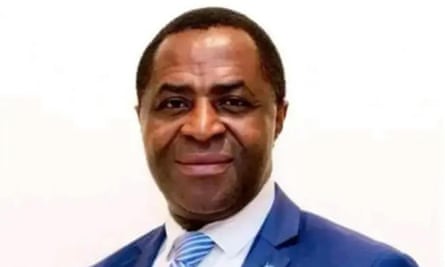
Undated photo of Sisiku Julius Ayuk Tabe, leader of the anglophone community in Cameroon.
Sisiku Julius Ayuk Tabe, leader of the anglophone community in Cameroon

“We have an obligation – dead or alive – to bequeath to our children a nation that they can call theirs, something we have been deprived of for too long,” he says.

On 1 October 2017, Ayuk Tabe declared the independence of “Ambazonia” – Cameroon’s English-speaking north-west and south-west regions, known during the colonial era as the British Southern Cameroons – after a government crackdown on protesters.

In November 2016, lawyers from the regions had marched against the government’s decision to appoint francophone magistrates in anglophone courts, seeing it as a threat to common law. Educators followed with their own protests after French-speaking teachers were imposed on anglophone schools.

Ayuk Tabe’s de facto presidency ended in January 2018 when he was arrested in the Nigerian capital, Abuja, allegedly by Nigerian special forces.

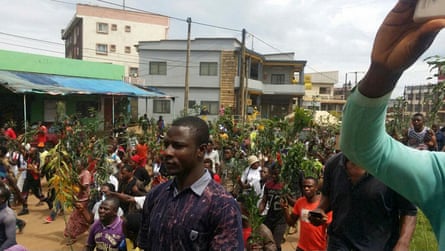
Demonstrators protest against perceived discrimination in favour of the francophone majority on 22 September 2017 in Bamenda, the main town in north-west Cameroon and an anglophone hub.
A protest against perceived discrimination in favour of the francophone majority in September 2017 in Bamenda, north-west Cameroon, an anglophone hub. Photograph: AFP/Getty Images

He was extradited with nine others to Cameroon, despite claims that many of them were refugees and asylum seekers. The move was later ruled illegal by the UN.

In August 2019, a military court in Cameroon sentenced Ayuk Tabe and his aides to life imprisonment on terrorism and secession charges. They were fined FCFA 273bn (about $428m).

The UN human rights council and three federal high court of Abuja judgments have ordered their release but none of these rulings have been respected, and the men remain in prison.

We will hoist the Ambazonian flag, we will sing the Ambazonian anthem – until that happens, the struggle won’t end

Sisiku Julius Ayuk Tabe

“How can civilians be charged and sentenced in military courts?” Ayuk Tabe asks. “Before any court in Cameroon, all Southern Cameroonians have a life sentence reserved for them just because of who they are. We are taking one for our nation and we pray it should be the last for all Southern Cameroonians.”

The declaration of Ambazonia’s independence triggered deadly clashes between anglophone armed separatists and the state security forces, which resulted in widespread atrocities against the civilian population.

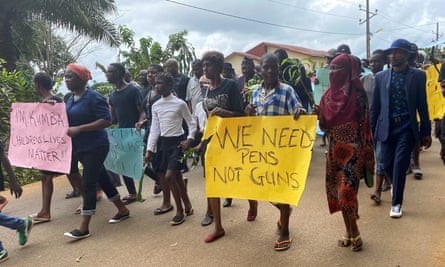
Protesters march with signs saying ‘we need pens, not guns’
Pupils, parents and teachers protest after gunmen opened fire at a school, killing at least six children, according to the authorities. Photograph: Josiane Kouagheu/Reuters

More than 6,000 people have since been killed, according to the International Crisis Group, although Ambazonia’s leadership claims the figure is far higher. More than a million people have been displaced within and outside the country. Thousands of people suspected of supporting the revolt have been detained and many are still awaiting trial.

When the Guardian arrives at Yaoundé prison it is teeming with visitors – mainly relatives, friends and acquaintances – who have come to see Ayuk Tabe and those detained with him.

With his customary charm, Ayuk Tabe speaks to everyone, telling them he has three key messages to send to his people back home: “Tell them that we will go to Buea whether [president] Mr Paul Biya likes it or not; come rain or shine. Tell them that we will hoist the Ambazonian flag in Buea and that once this is done, we will sing the Ambazonian anthem – until that happens, the struggle won’t end.

“Finally, tell them to take good care of the needy of the struggle – families who have lost loved ones, the internally displaced, refugees, those in detention, not forgetting the heroes of the struggle – the men and women who have opted to fight and die for the struggle,” he says.

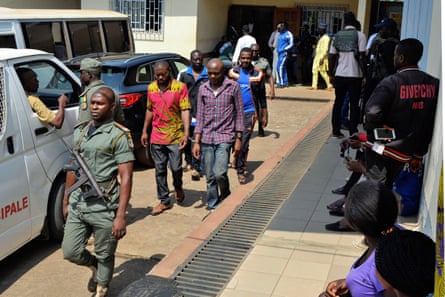
Four men walk down a street outside a building, led by an armed guard
Men arrested in connection with Cameroon’s anglophone crisis at the military court in Yaoundé, 14 December 2018. Photograph: AFP/Getty Images

After singing a few verses of the national anthem, Ayuk Tabe gets up to move around and hug a few of his visitors.

“We call them our guardian angels because they baby us,” he says, adding that these supporters have helped the Ambazonian inmates at the prison by bringing them food and bedding.

He says conditions at the prison are difficult: they’re given flimsy beds without mattresses and a single “terrible” meal a day.

“But Ambazonian detainees in this prison feed themselves twice a day, thanks to the generosity of our relatives and friends – they don’t consume anything offered by this prison except the water used for bathing,” he says.

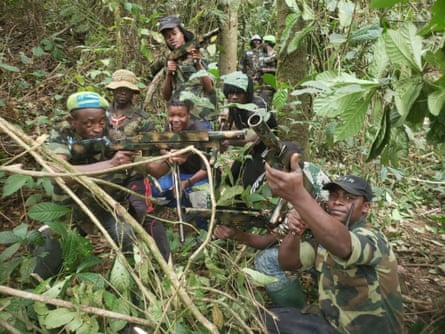
An undated photo showing a group of men in camouflage clothes, with one pointing a rifle towards the sky from behind some bushes
Anglophone separatist fighters training at an undisclosed location. Photograph: Chris Anu

Cameroon was first colonised by Germany between 1884 and 1916, then divided between France and Britain after the first world war. French Cameroon gained independence in 1960, joined by English-speaking Cameroonians through a federation a year later.

The French-speaking area makes up about 80% of the country and the English-speaking part about 20%, both in territory and population. A referendum in 1972 repealed the country’s federal structure which had guaranteed rights and secured a distinct educational, judicial and political system for the minority anglophone section.

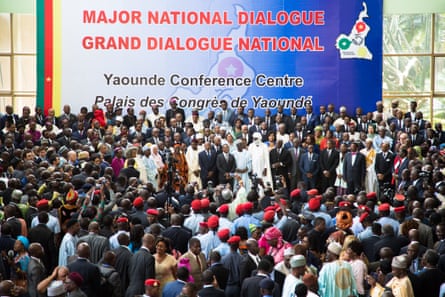
The group of officials stands in front of a large crowd of people. Behind them a banner reads: ‘Major national dialogue. Yaounde conference centre.
Cameroon’s prime minister, Joseph Dion Ngute, presides over the opening session of the national dialogue called in September 2019 by president Biya. Photograph: AFP/Getty Images

Close to the principal prison is the Yaoundé central prison, where nearly 300 anglophone detainees are being held. Abdul Karim Ali, 43, a Muslim scholar, IT engineer and business consultant, has been awaiting trial here since February 2023.

Ali was arrested in the north-west regional capital, Bamenda, on 11 August 2022, for criticising the injustices committed against his anglophone community. He was detained for three months in a windowless room with no toilet and denied access to his family and lawyers for three weeks, he says. Transferred to the dreaded State Defense Secretariat detention facility, he spent another three months there before being transferred to Yaoundé central prison.

I was abducted to be silenced. Not just because I believe in the right to self-determination for Southern Cameroons but because I defended those rights

Abdul Karim Ali

“I was abducted to be silenced. Not just because I believe in the right to self-determination of the people of Southern Cameroons, but because I defended those rights and called out the occupying regime of Yaoundé,” Ali says.

“Like other activists, I have been accused of terrorism and secession. I consider the military court incompetent to try a civilian like myself. I have made it known that I’m not going to court. I want to be tried in a civilian court and in my Bamenda home town where I was abducted.”

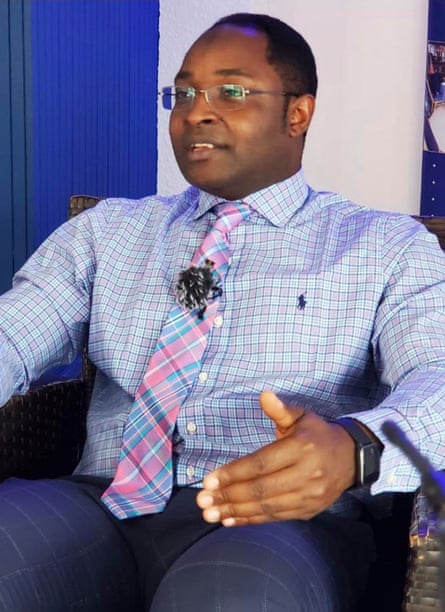
Abdul Karim Ali, Cameroonian activist
Abdul Karim Ali, who has been detained since August 2022

Ali says he has no issue with the Cameroon government, but that it has a problem with Southern Cameroons.

“I’m in their captivity just like every other freedom fighter. I don’t wish anybody to experience the prison conditions I have endured.”

He says the situation in Cameroon’s north-west and south-west regions is one of “torture, genocide, colonisation, incarceration and dehumanisation” – the consequence of the annexation that started in 1961.

He blames the current conflict on the “incomplete decolonisation” of Southern Cameroons by Britain and Cameroon’s annexation of the territory thereafter.

“The Cameroon government declared war on Southern Cameroons. They are the invading bully and illegitimate state actor. So, the burden to call for a ceasefire lies on them,” he says.

Peace, he says, would require the unconditional release of all Southern Cameroonians; the demilitarisation of the territory of Southern Cameroons; and dialogue between the two parties.

Ali eats once and prays five times a day. Otherwise, his daily schedule includes exercising in the prison courtyard and reading.

“History provides us with enough verdicts: every dictatorship collapses and every annexation comes to an end,” says Ali, whose political activism was inspired by Gandhi. “Today or tomorrow, the people of Southern Cameroons will be given the right to determine their political future,” he says.

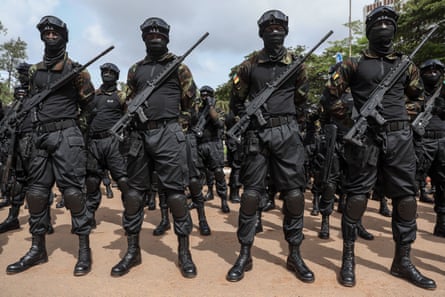
Soldiers of Cameroonian rapid intervention battalion line up
Members of the Rapid Intervention Battalion, an elite unit of the Cameroonian armed forces, on parade for Unity Day in Yaoundé, May 2023. Photograph: AFP/Getty Images

Sitting nearby in the prison hall is another detainee, Mancho Bibixy Tse, a 40-year-old journalist and activist.

In November 2016, Mancho mounted a coffin at a crowded roundabout in Bamenda to denounce the social and economic injustice of his anglophone community, which became known as the “coffin revolution”.

He was arrested, charged with terrorism, secession, rebellion, inciting civil war, and spreading false information through social media, and sentenced to 15 years.

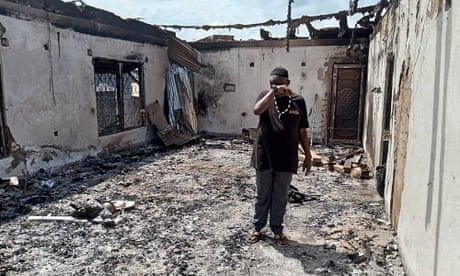
A man weeps among the ruins of a building razed by gunmen in Mamfe, south-west Cameroon, 6 November 2023.

In July 2019, Mancho led a protest against conditions at the prison, which earned him an additional 18 months.

Mancho says frustrations about 60 years of Cameroon’s occupation of Southern Cameroons led to his activism. The idea of using a coffin came about “spontaneously”.

“I have always wanted positive change wherever I found myself – I have been a freedom fighter all my life,” he says, maintaining that he has never regretted – and will never regret his actions.

“I am the first person who declared the Ambazonian revolution,” he says. “And I will do it over and over again if the opportunity shows up. I am ready to die for freedom.”

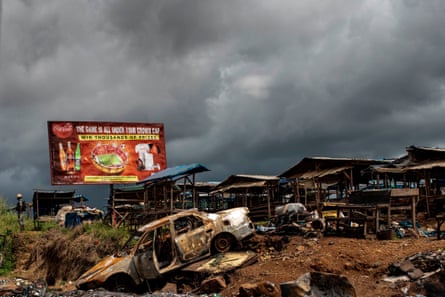
A car allegedly destroyed by separatist fighters in Buea, Cameroon
A burnt-out car beside an abandoned market after unrest in 2018 in Buea, capital of the anglophone south-west region. Photograph: Marco Longari/AFP/Getty Images

Back at the Yaoundé principal prison, Ayuk Tabe is hopeful of ultimate victory.

“Rather than waning, our independence ideology is gaining more ground. Proof is that we are in the eighth year of the struggle and a Cameroon military victory is still very far-fetched,” he says.

“No matter how long this darkness has been, victory is assured and on the way. We all, eight million Ambazonians, share a common pain and plight. We cannot continue this life of servitude and pass it on as a legacy to our future generations.”

Culled from The Guardian

French Cameroun: 3 killed in armed attack on military camp

15, January 2025

French Cameroun: 3 killed in armed attack on military camp 0

At least three security forces personnel were killed in an armed attack on a military camp in Cameroon, local media reported.

Suspected Boko Haram terrorists attacked Ngouma military camp on Monday in the Logone-et-Chari department of the Far North Region, according to the daily Journal de Cameroun.

The victims were members of the country’s Defense and Security Forces and the attackers also seized weapons and set fire to a military vehicle, it said.

Boko Haram launched a bloody insurgency in 2009 in northeastern Nigeria but later spread its atrocities to neighboring Niger, Chad and Cameroon, prompting a military response.

Source: Anadolu Agency

Cuba to release more than 550 prisoners after being cleared from US terror list

15, January 2025

Cuba to release more than 550 prisoners after being cleared from US terror list 0

Cuba said Tuesday it would release 553 prisoners in response to Washington removing the communist country from its list of terror sponsors in a deal hailed by relatives of jailed protesters.

The White House said President Joe Biden was removing Cuba from the list of state sponsors of terrorism in one of his last official acts before Donald Trump is sworn in next Monday.

The move will likely be overturned by Trump, who reinstated Cuba’s terror designation in the final days of his first term of office in 2021.

“An assessment has been completed, and we do not have information that supports Cuba’s designation as being a state sponsor of terrorism,” a senior Biden administration official told reporters.

The deal was negotiated with the help of the Catholic Church for the release of “political prisoners in Cuba and those who have been detained unjustly,” the official added.

Family members of jailed protesters hailed the announcement, including Liset Fonseca, mother of 41-year-old Roberto Perez, sentenced to 10 years’ imprisonment.

He had taken part in anti-government protests with thousands of other Cubans in July 2021, fueled by power blackouts and soaring food prices.

“All the mothers of prisoners want our children to be free and out of that suffering, out of that hell that is the prisons in Cuba. They should never have been in prison,” Fonseca told AFP.

One person was killed and dozens injured in the protests, which Havana accused Washington of orchestrating.

According to official Cuban figures, some 500 people were given sentences of up to 25 years in prison for participating, but rights groups and the US embassy say the figure is closer to 1,000.

Some have already been freed after serving their sentences.

‘Diverse crimes’

Cuba welcomed Washington’s announcement Tuesday as a step in the “right direction,” but lamented it was still under US sanctions in place since 1962.

The foreign ministry later announced that 553 people imprisoned for “diverse crimes” will be released.

Cuba blames the US blockade for its worst economic crisis in decades, marked by shortages of fuel, food, medicines and electricity.

Trump’s first presidential term from 2017 to 2021 saw a tightening of sanctions against Cuba that had been loosened during a period of detente under his predecessor Barack Obama.

Before assuming office, Biden had promised changes in US policy towards the island, but postponed these after Havana’s crackdown on the 2021 protests.

Analysts say the Covid-19 pandemic, which tanked tourism, and economic mismanagement by the government have contributed greatly to the poor state of the economy.

But Cuba’s President Miguel Diaz-Canel has described US sanctions as “genocidal” and said his country was prepared for “more difficult circumstances” after Trump’s election.

The incoming president’s allies immediately criticized Biden over Tuesday’s announcement, with Ted Cruz — a Cuban-American member of the US Senate’s Foreign Relations Committee — calling it a “rank appeasement of the Cuban regime.”

Trump has nominated Senator Marco Rubio, a Cuban-American highly critical of communism and the left at large, to serve as his secretary of state.

A White House statement said Biden would also waive part of the so-called Libertad Act underpinning the US embargo of Cuba.

Biden would also rescind a Trump-era policy called “National Security Presidential Memorandum 5,” ending restrictions on financial transactions with certain Cuban entities.

Colombia’s leftist President Gustavo Petro and a political party made up of the country’s disarmed ex-FARC guerrilla group, welcomed the White House announcement.

Cuba had hosted the talks from 2012 to 2016 that saw the FARC agree to lay down arms.

Source: AFP

Biya’s Justice Minister receiving emergency treatment in French hospital

15, January 2025

Biya’s Justice Minister receiving emergency treatment in French hospital 0

Justice Minister Laurent Esso had to be rushed to a hospital in France after becoming seriously unwell.

Esso had to be evacuated by a presidential directive after he fell ill at his home in Yaoundé.

Mr Laurent Esso is widely seen as one of President Biya’s most trusted acolytes and has served in his government holding numerous portfolios including being Secretary General at the presidency of the republic.

He is known for his arrogant style – a key facet for any Francophone politician – and was described in 2024 as “Finish the Job,”  by several media organizations in Cameroon following the role he allegedly played in the murder of journalist Martinez Zogo .

Mr Esso collapsed during National Day celebration inside the Unity Palace in 2024 but silenced critics who claimed that he could not juggle all his ministerial briefs by making a late night trip to the Kondengui Maximum Security Prison in Yaoundé to stop an internal revolt.

He has been reachable and available to act at any time against opponents of the Biya regime and this includes during emergencies, at night and at the weekends. And while he is adored by many CPDM militants, he is reviled by critics in equal measure.

The politician, who represents the Sawa people in the Littoral region, remains the main architect of President Biya’s failure as a statesman.

Despite his recent difficult relationship with aides close to the Cameroonian first lady Chantal Biya, he has remained firmly behind President Biya and was a key figure in the arrest and humiliation of the late Lord Justice Ayah Paul Abine.

More recently he has been key in green lighting plans for the continued detention of Southern Cameroons activists including President Sisiku Ayuk Tabe.

Rumour circulated recently that the Biya ally was denied authorization to leave the country for treatment abroad.

Etoudi attempted to downplay the seriousness of Esso’s health condition but doing so has become increasingly very difficult. His declining health has reignited public and media debates surrounding his role in the corrupt Biya regime.

By Soter Tarh Agbaw-Ebai

Mozambique:  new president sworn in despite opposition boycott

15, January 2025

Mozambique:  new president sworn in despite opposition boycott 0

Mozambique’s new President Daniel Chapo has been sworn in at a low-key ceremony in the capital, Maputo, more than three months after heavily disputed elections.

Most businesses in Maputo were shut after defeated presidential candidate Venâncio Mondlane called for a national strike to protest against Chapo’s inauguration.

Chapo won the election held in October with 65% of the vote, extending the 49-year-rule of the Frelimo party.

Mondlane – who contested the election as an independent – came second with 24% of the vote. He rejected the result, saying it was rigged.

Mondlane called for a strike on inauguration day “against the thieves of the people”.

Both of Mozambique’s leading opposition parties – Renamo and MDM – boycotted the swearing-in ceremony because they too do not recognise Chapo as the rightful winner.

Even those in Mozambique who do wish Chapo well openly question his legitimacy.

“Chapo is someone I admire greatly,” civil society activist Mirna Chitsungo tells the BBC.

“I worked with him for four years – I am familiar with his willingness to act, his openness to dialogue, and his readiness to follow recommendations from civil society on the ground.

“However, he is assuming an illegitimate power. This stems from a fraudulent electoral process… He is taking power in a context where the people do not accept him.”

‘He will face many enemies’

In addition to winning over a hostile public, Chapo will also have to deliver the economic turnaround and halt to corruption that he promised on the campaign trail.

“Chapo will face many enemies because it looks like Mozambique is run by cartels, including cartels of books, cartel of medicines, cartel of sugar, cartel of drugs, cartel of kidnappings, mafia groups,” says analyst and investigative journalist Luis Nhanchote.

“He needs to have a strong team of experts, willing to join him in this crusade of dismantling the groups meticulously,” he adds.

“But first, he has to calm down Mozambicans and do all in his power to restore peace in the country.”

Daniel Francisco Chapo was born on 6 January 1977 in Inhaminga, a town in Sofala province, the sixth of 10 siblings. This was during Mozambique’s civil war, and the armed conflict forced his family to move to another nearby district.

His secondary schooling in the coastal city of Beira was followed by a law degree from Eduardo Mondlane University then a master’s degree in development management from the Catholic University of Mozambique.

Now married to Gueta Sulemane Chapo, with whom he has three children, Chapo is also said to be a church-going Christian and fan of basketball and football.

Many current and former colleagues describe Chapo as humble, hard-working and a patient leader.

Source: BBC

Yaoundé, Riyadh sign Hajj agreement for smooth 2025 pilgrimage

15, January 2025

Yaoundé, Riyadh sign Hajj agreement for smooth 2025 pilgrimage 0

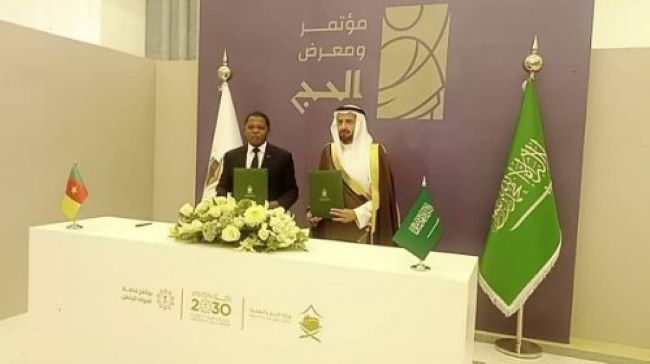
Cameroon and Saudi Arabia signed an agreement on Monday to ensure the smooth organization of the 2025 Hajj pilgrimage, scheduled for next June. The agreement was signed in Jeddah by Saudi Arabia’s Minister of Hajj and Umrah, Tawfiq bin Fawzan al-Rabiah, and Cameroon’s Minister of Territorial Administration, Paul Atanga Nji, who also chairs the National Hajj Commission.

The agreement covers several key aspects of Hajj organization. The main points addressed are the number of pilgrims Cameroon will be able to send in 2025, as well as logistical arrangements for transportation, accommodation, and reception services in Saudi Arabia.

The agreement also specifies health and safety requirements to be observed before, during, and after the pilgrimage. Additionally, it addresses financial aspects, including the costs associated with the pilgrimage and the management of these funds.

“This agreement between the two states ensures the smooth operation of processes aimed at enhancing Cameroonian Muslims’ participation in the upcoming Hajj. It emphasizes compliance with regulations and directives set by the Saudi government and agreed upon by all parties involved in the pilgrimage,” according to Cameroon’s Ministry of Territorial Administration.

Minister Nji said Saudi authorities commended Cameroon for its effective Hajj organization. He added that Cameroon is considered a “reference” among African countries in managing the pilgrimage to Mecca, stating, “because the organizational steps for the previous edition were meticulously followed, and this pillar of Islam was conducted satisfactorily,” according to state broadcaster CRTV.

This success, he noted, stems from reforms implemented to address past issues, such as scams by certain operators who embezzled pilgrims’ funds, as well as logistical problems related to air travel and accommodation.

Cameroonian authorities have introduced measures to improve Hajj organization, including providing accommodations near prayer sites and removing dishonest coordinators. A new 26-day travel schedule has also been adopted to ensure a more seamless and organized experience for pilgrims.

Source: Business in Cameroon

World Bank ends CFA45bn Swedd Project in Cameroon over poor results
14, January 2025

World Bank ends CFA45bn Swedd Project in Cameroon over poor results 0
The World Bank has decided to end the Sahel Women’s Empowerment and Demographic Dividend (Swedd) Project in Cameroon due to unsatisfactory outcomes. Though the decision was made months ago, it was formally communicated to Cameroon’s authorities on December 18, 2024, in a letter from Cheick Fantamady Kanté, the World Bank’s country director for Cameroon, to Economy Minister Alamine Ousmane Mey. The project is officially set to close on December 31, 2024.
The World Bank cited the project’s low disbursement rate as a key reason for its termination. By February 2024, only 8.3% of the allocated funds had been spent. This amounted to just $5.7 million (CFA3.6 billion) out of a total of $75 million (over CFA45 billion). A World Bank mission in February 2024 deemed this spending rate unacceptably low.

The Swedd project, aimed at empowering women in the northern regions of Cameroon (Adamawa, North, and Far North), failed to deliver significant benefits to its target groups. The World Bank described progress as “unsatisfactory.”

The project management under Alphonse Glory Mbah Ngami also came under scrutiny. Cameroon’s Swedd team was found to be the largest among 16 African countries implementing the project, leading to inflated operational costs and reduced efficiency. According to the February 2024 report, most performance indicators were red, except for midwife training. Moreover, teachers involved in remedial courses for beneficiaries reported not being paid.

The World Bank’s recommendations to improve fund utilization yielded little progress. For example, between July 1 and December 31, 2024, the project was supposed to spend CFA2.5 billion. Planned expenditures included a CFA308.3 million ($512,336) agreement with UNICEF for vehicle purchases. However, by December 18, 2024, none of the vehicles had been delivered. Other key purchases, such as mobile clinic vehicles, campaign vehicles, IT equipment for 15 midwifery schools (CFA549 million), and motorcycles (CFA167 million), were also unfulfilled.

The World Bank has granted a four-month grace period, ending April 30, 2025, for eligible payments to be made. Any unpaid expenses after this period will become ineligible and must be covered by the Cameroonian government. In a letter dated December 23, 2024, Cheick Fantamady Kanté confirmed that the government would fund operational costs during this time.
The Swedd project has been operational in Africa since 2015 and was slated to launch in Cameroon in 2020 for a four-year term. However, delays related to credit readiness pushed the official start to 2022. The financing agreement was signed on October 12, 2021, and the project began on February 8, 2022.

Source: Business in Cameroon

«< 108 109 110 111 112 >»

Featured

  • Iran deal: the cards are now in Tehran’s favourIran deal: the cards are now in Tehran’s favour
  • Exam leaks in CPDM Cameroon: A symptom of a deeper corruption crisisExam leaks in CPDM Cameroon: A symptom of a deeper corruption crisis
  • Biya is already in Hell as Yaoundé unravelsBiya is already in Hell as Yaoundé unravels
  • What does President Biya really want? Money, women or cigarettes?What does President Biya really want? Money, women or cigarettes?
  • Biya, how long must the nation wait for the government it was promised?Biya, how long must the nation wait for the government it was promised?

Most Commented Posts

  • 4 Anglophone detainees killed in Yaounde4 Anglophone detainees killed in Yaounde
    18 comments
  • Chantal Biya says she will return to Cameroon if General Ivo Yenwo, Martin Belinga Eboutou and Ferdinand Ngoh Ngoh are sackedChantal Biya says she will return to Cameroon if General Ivo Yenwo, Martin Belinga Eboutou and Ferdinand Ngoh Ngoh are sacked
    13 comments
  • The Anglophone Problem – When Facts don’t LieThe Anglophone Problem – When Facts don’t Lie
    12 comments
  • Anglophone Nationalism: Barrister Eyambe says “hidden plans are at work”Anglophone Nationalism: Barrister Eyambe says “hidden plans are at work”
    12 comments
  • Largest wave of arrest by BIR in BamendaLargest wave of arrest by BIR in Bamenda
    10 comments

Latest Tweets

→ Follow me

Featured

  • Yaoundé earns CFA15 billion from Chad Oil Pipeline transit fees in 5 months

    Yaoundé earns CFA15 billion from Chad Oil Pipeline transit fees in 5 months

  • Most stocks rise, oil flat following peace deal-fuelled rally

    Most stocks rise, oil flat following peace deal-fuelled rally

  • Iran deal: the cards are now in Tehran’s favour

    Iran deal: the cards are now in Tehran’s favour

  • American musician Oliver Tree killed in mid-air helicopter collision in Brazil

    American musician Oliver Tree killed in mid-air helicopter collision in Brazil

  • Cameroon looks to Tunisia’s textile model to develop its cotton value chain

    Cameroon looks to Tunisia’s textile model to develop its cotton value chain

  • Trump marks 80th birthday with White House UFC spectacle

    Trump marks 80th birthday with White House UFC spectacle

  • Ex-Israeli PM Ehud Barak says Netanyahu must be removed ‘with sticks and stones’

    Ex-Israeli PM Ehud Barak says Netanyahu must be removed ‘with sticks and stones’

Log In

  • Register
  • Log in
  • Entries feed
  • Comments feed
  • WordPress.org
© Cameroon Concord News 2026

We are using cookies to give you the best experience on our website.

You can find out more about which cookies we are using or switch them off in .

Powered by  GDPR Cookie Compliance
Privacy Overview

This website uses cookies so that we can provide you with the best user experience possible. Cookie information is stored in your browser and performs functions such as recognising you when you return to our website and helping our team to understand which sections of the website you find most interesting and useful.

Strictly Necessary Cookies

Strictly Necessary Cookie should be enabled at all times so that we can save your preferences for cookie settings.

3rd Party Cookies

This website uses Google Analytics to collect anonymous information such as the number of visitors to the site, and the most popular pages.

Keeping this cookie enabled helps us to improve our website.

Cookie Policy

More information about our Cookie Policy