Cameroon Concord News
You Are What You Read
  • Home
  • News
    • Cameroon
    • Nigeria
    • Africa
    • Europe
    • World
  • Politics
    • Cameroon
    • Nigeria
    • Africa
    • Europe
    • World
  • Sports
    • Cameroon
    • Africa
    • Europe
    • World
  • Business
    • Africa
    • World
  • Life
    • Education
    • Health
    • Fashion
    • Entertainment
  • Religion
    • Cameroon
    • World
  • Contact
    • Online
    • Phone
    • Email
  • About
    • Us
    • Our Services
    • Advertising with Us

Categories

Recent Posts

  • American musician Oliver Tree killed in mid-air helicopter collision in Brazil
  • Cameroon looks to Tunisia’s textile model to develop its cotton value chain
  • Trump marks 80th birthday with White House UFC spectacle
  • Ex-Israeli PM Ehud Barak says Netanyahu must be removed ‘with sticks and stones’
  • US denies visa to Palestine football chief for World Cup attendance

Archives

  • June 2026
  • May 2026
  • April 2026
  • March 2026
  • February 2026
  • January 2026
  • December 2025
  • November 2025
  • October 2025
  • September 2025
  • August 2025
  • July 2025
  • June 2025
  • May 2025
  • April 2025
  • March 2025
  • February 2025
  • January 2025
  • December 2024
  • November 2024
  • October 2024
  • September 2024
  • August 2024
  • July 2024
  • June 2024
  • May 2024
  • April 2024
  • March 2024
  • February 2024
  • January 2024
  • December 2023
  • November 2023
  • October 2023
  • September 2023
  • August 2023
  • July 2023
  • June 2023
  • May 2023
  • April 2023
  • March 2023
  • February 2023
  • January 2023
  • December 2022
  • November 2022
  • October 2022
  • September 2022
  • August 2022
  • July 2022
  • June 2022
  • May 2022
  • April 2022
  • March 2022
  • February 2022
  • January 2022
  • December 2021
  • November 2021
  • October 2021
  • September 2021
  • August 2021
  • July 2021
  • June 2021
  • May 2021
  • April 2021
  • March 2021
  • February 2021
  • January 2021
  • December 2020
  • November 2020
  • October 2020
  • September 2020
  • August 2020
  • July 2020
  • June 2020
  • May 2020
  • April 2020
  • March 2020
  • February 2020
  • January 2020
  • December 2019
  • November 2019
  • October 2019
  • September 2019
  • August 2019
  • July 2019
  • June 2019
  • May 2019
  • April 2019
  • March 2019
  • February 2019
  • January 2019
  • December 2018
  • November 2018
  • October 2018
  • September 2018
  • August 2018
  • July 2018
  • June 2018
  • May 2018
  • April 2018
  • March 2018
  • February 2018
  • January 2018
  • December 2017
  • November 2017
  • October 2017
  • September 2017
  • August 2017
  • July 2017
  • June 2017
  • May 2017
  • April 2017
  • March 2017
  • February 2017
  • January 2017
  • December 2016
  • November 2016
  • October 2016
  • September 2016
  • August 2016
  • July 2016
  • June 2016
Football: N’Golo Kante joins Benzema at Saudi football club Al-Ittihad

21, June 2023

Football: N’Golo Kante joins Benzema at Saudi football club Al-Ittihad 0

Saudi Arabian soccer champion Al-Ittihad has another high-profile French player to accompany Karim Benzema at the team next season.

N’Golo Kante completed his move on a three-year deal on Wednesday after leaving Chelsea, with Al-Ittihad welcoming the 32-year-old midfielder with a series of tweets containing the hashtag “WelcomeBox2Box” — referring to his hard-running style of play.

He will reportedly earn more than $100 million across the length of the deal at a club based in Jeddah and coached by former Tottenham and Wolverhampton manager Nuno Espirito Santo. It recently won the Saudi league ahead of Cristiano Ronaldo’s Al-Nassr.

Kante, who won the World Cup with France in 2018, the Champions League with Chelsea in 2021 and has been one of the best players in the Premier League in recent years as a back-to-back champion with Leicester and Chelsea, has struggled with injuries over the past two seasons.

That hasn’t put off Al-Ittihad from apparently spending big on Kante, a few weeks after bringing in Benzema after the expiry of the reigning world player of the year’s contract at Real Madrid.

“It is part of the club’s efforts to establish itself as a top choice for world-class players in the Saudi Professional League,” Al-Ittihad said.

The big names — albeit players nearing the end of their careers — are being enticed to the Saudi league, where spending is being fueled by a move by the kingdom’s sovereign wealth Public Investment Fund to take a majority ownership stake in four of the country’s top clubs, including Al-Ittihad and Al-Nassr. The move is part of a nationalization project that encourages public sector organizations to invest in sports, with soccer teams a priority under the initiative backed by Crown Prince Mohammed bin Salman.

Another of those four teams, Al-Hilal, tried to buy Lionel Messi but Argentina’s World Cup winner decided to join Inter Miami in the United States.

A slew of leading players are being linked with moves to Saudi Arabia in this European offseason, including Manchester City winger Riyad Mahrez, Chelsea goalkeeper Edouard Mendy and Wolverhampton midfielder Ruben Neves.

Source: AP

What difference does Jesus Christ make? (Part 2)

21, June 2023

What difference does Jesus Christ make? (Part 2) 0

In the first part of our reflection on the topic of what difference Jesus makes that we published this past Easter, we ended on the position that the Temptations constitute, at their innermost core, a theological debate between Satan and Jesus. The hectic nature of my schedule did not allow for the completion of this reflection until now. I apologize to my readers for this belatedness. Now, let us return to where we break off this past Easter on this topic, namely, the challenge for Jesus to prove his identity as the Son of God. It is likewise important to keep the overarching question in view, that is, Jesus’ identity in the light  of the difference that Jesus makes in today’s world. In effect, if Jesus is who he claims to be, if Jesus is authentic – if you are the Son of God – as Satan threw at him, then there must be a difference in the world with the coming of Jesus. Within the context of the Temptations, Jesus does not take the bait put forth by Satan. He refuses to turn stones into bread, or to fall from the lofty heights of the Temple pinnacle. The Cardinal Inquisitor has it right in The Grand Inquisitor when he laments before Jesus: You refused the offer of the Mighty Spirit because you wanted men and women to follow you out of freedom! In other words, succumbing to the Temptations would have been an easier and faster part for Jesus to accomplish his mission. But the fastest and easiest do not always translate into the truly enduring, beautiful and good.

To Ratzinger, the Temptations are not only Christological, that is, pertaining only to the person of Christ. They likewise have an inherent Ecclesiological character, in that the Church down the ages has often faced the challenge to prove itself, to prove its credibility. If you are the Church of Christ, then demonstrate it in a more convincing manner. If you are the Church of Christ, then why is there so much sin and evil in your members? Why couldn’t Christ make you as perfect as he Jesus is? And this temptation to prove one’s identity and authenticity can be very overwhelming even for the priest of today, with all the media hype. In my own life as a Christian and as a priest, I am learning, with every passing day, the wisdom in Jesus’ refusal to take the bait. I am learning that the most meaningful response to the challenge to prove one’s identity and authenticity is to create time for more prayer before God, the all-knowing One. In prayer, the priest and the Christian feels the Lord’s closeness and support, and if my own limited experience in the spiritual life is anything to go by, there is really no substitute for prayer in the life of a priest and a Christian.
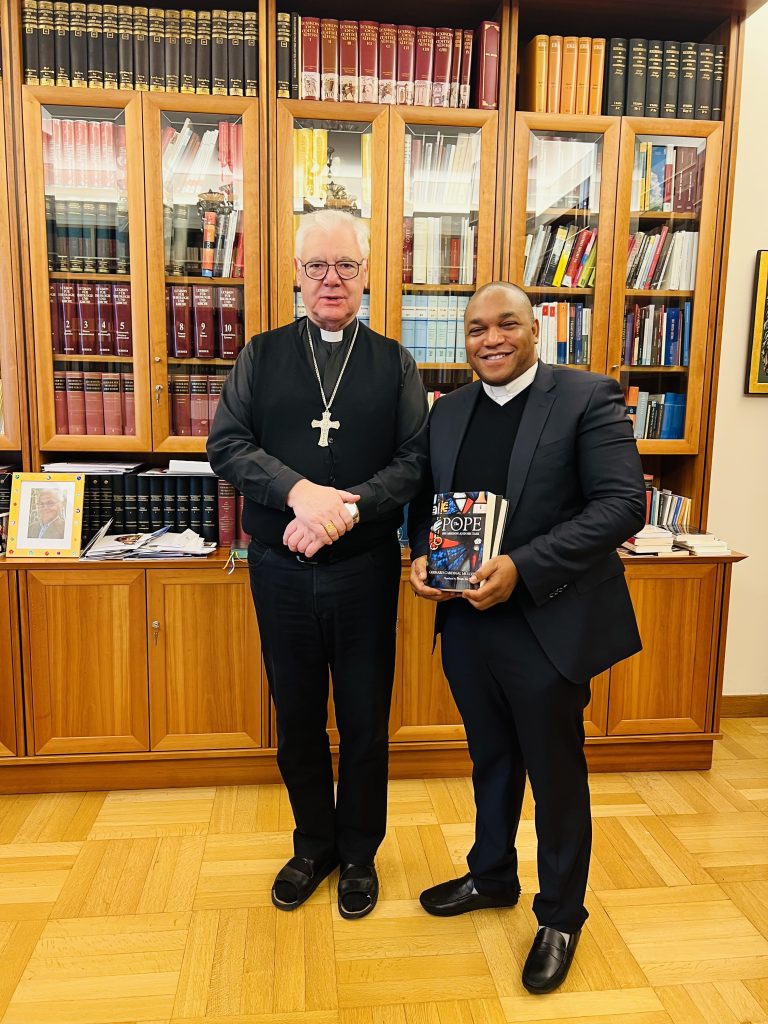
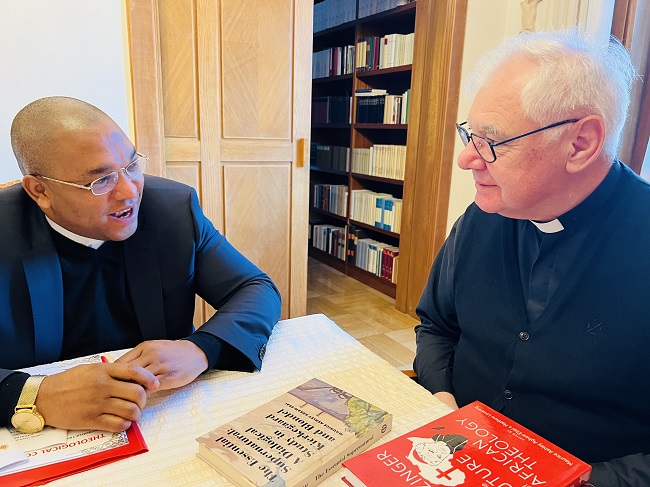
Fr Maurice with Gerhard Cardinal Müller, Prefect Emeritus of the Congregation for the Doctrine of the Faith, Custodian of Ratzinger’s Theological Legacy (Meeting at Vatican City)

When one enters into an Ignatian contemplation of the Temptations of Jesus, one can discern, overtime, that the issue of the Temptations boils down to the question about the fulfillment of the human heart. What really satisfies the human heart? Wealth (bread), Power (Temple Pinnacle/the cities of the world)? I believe that to understand Jesus’ resistance to the seductive offers of Satan provides the definitive response to the central question of the difference that Jesus makes in our lives today. And a proper understanding of this question possesses a historical pedigree to it, namely, engaging Jesus’ identity and uniqueness from the living faith of Israel, specifically with the figure and mission of Moses.

With Moses at the helm, Israel left Egypt for the promised land. What shaped this journey in large measure was the sense of hope, for a promised land that would meet the aspirations and yearnings of Israel. The particular issues and demands met by manna and other nutritional and safety needs embodied the need for hope in an otherwise hopeless context. The question of difference Jesus makes appears in an antecedent format at this point: What difference does the God of Israel make, to the people of Israel? In a sense, the yearnings of Israel’s heart is captured in the request Moses makes to Yahweh: Show me your face. Some translations render  it as show me your glory (Exodus 33:18). God strikes a compromise with Moses that from the angle of a retrospective reading, lays the foundation for the difference that the coming of Christ makes in history. Moses will still have the privilege and joy of encountering, somewhat, the beatific vision while still on this side of human existence, that is, the Back of God, but no more, for the human being cannot see the face of God and live (Exodus 33:20). In the event of Moses, the light of faith (lumen fidei) and the light of glory (lumen gloriae) converge, a rarity, because the light of faith is meant to accompany us in this earthly life, while the light of glory is what enables us to see God in the next life. As I think further about this mysterious text of Exodus 33, this interpretation already much present especially in Eastern Theology occurs to me: the light of faith could correspond to the Back of God, and the light of glory, the Face of God, to the extent that only in followership/discipleship captured in the image of the back, would one eventually arrive at the longing that moves or drives the human heart, captured in the image of the face. From this incident of Moses, there emerged, in the consciousness of Israel’s faith and later on taken up in Christian mysticism, the theology of the Face of God as the fulfilment of the greatest longing of the human heart, as we see in the lives of the saints and Doctors of the Church.

Let’s remain a little bit more with the figure of Moses and the images of the Back and Face of God. In his The Life of Moses, St. Gregory of Nyssa offers a truly moving Christological  reading of this mystical event as narrated in the Book of Deuteronomy. Gregory asks:

What is his back which God promised to Moses when he asked to see him face-to-face? (…) But when the Lord who spoke to Moses came to fulfill his own law, he likewise gave a clear explanation to his disciples, laying bare the meaning of what had previously been said in a figure when he said, ‘if anyone wants to be a follower of mine.’ And to the one asking about eternal life he proposed the same thing, for he said, ‘Come, follow me’ (18:22). Now, he who follows sees the back. So, Moses, who eagerly seeks to behold God, is now taught how he can behold him: to follow God where ever he might lead is to behold God. His passing by signifies his guiding the one who follows, for someone who does not know the way cannot complete his journey safely in any other way than by following behind his guide. HE who leads, then, by his guidance shows the way to the one following. He who follows will not turn aside from the right way if he always keeps the back of his leader in view. (Gregory of Nyssa, The Life of Moses, HarperCollins Publishers, 2006), 106 & 110.

Some spiritual insights from this engagement between Moses and God:

Firstly, as Aquinas beautifully expresses it – and as many Christians likewise get a glimpse of it particularly during moments of prayer, – only God can satisfy the human heart – Nil Nisi Te Domine. Augustine had said it best centuries before Aquinas: You have made us for yourself, and our hearts are restless until it rest in Thee.

Secondly, notwithstanding all the material blessings that come our way in this life, there remains that longing that nothing corporeal is capable of filling. There is a void, what the French philosopher Maurice Blondel trenchantly characterizes as the wedge between the willed will and the willing will, in his philosophy of action.

Thirdly, because this quest for God is in the DNA of the human being, we are somewhat impatient for the beatific vision, for what Aquinas calls the light of glory. Even in this life, which is guided by the light of faith, we want to have the fullness that the light of glory brings with it. And this is quite understandable, for who wants to live with half measures?

But even more, we cannot deny that our brokenness and sinfulness, what Blaise Pascal calls our wretchedness, is likewise a motivation for our desire for the fullness that comes with the light of glory, the Face of God. I love Dante’s DivineComedy precisely because sin is not presented in a despairing form, but as a starting point for the journey to the Face of God, as the soul moves from the Inferno through the Purgatorio and finally, Paradiso. Too often, Christians get chained in the melancholy of their sinful past and present, forgetting to realize that our sins, my own sins as Maurice, is really the raw material that God uses to place me on the journey towards Him.

And this is the context in which Jesus Christ enters the scene, making all the difference, as particularly captured in the dual dynamisms of Deuteronomy 18 and Matthew 17. (To be continued…)

By Maurice Agbaw-Ebai
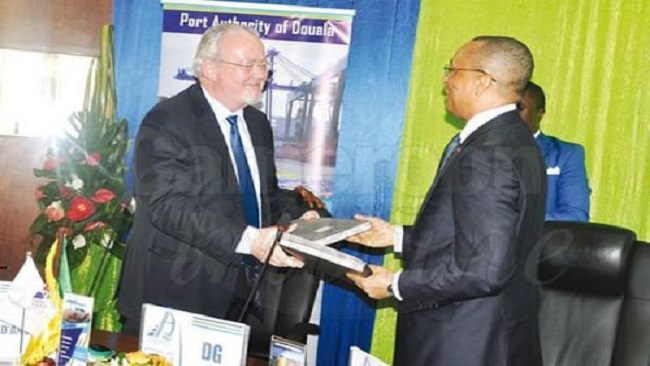
Port of Douala says its partnership with Port of Antwerp is the most beneficial

21, June 2023

Port of Douala says its partnership with Port of Antwerp is the most beneficial 0

The partnership with the Dutch port of Antwerp is the most beneficial that the port of Douala has. This was stated by the Douala Autonomous Port (PAD), the State company that manages the eponymous port.

The PAD made the statement in a technical note issued on the sidelines of a mission of Antwerp port officials to Douala, Cameroon’s economic capital. The mission began on June 19, 2023.

“To date, the collaboration has yielded 14 capacity-strengthening grants for PAD employees and a project supporting the establishment of a port-related professions training center,” the note reads.

The visit aims to renew the partnership between the two ports with an enhanced focus on accelerating the modernization of the port of Douala. Throughout the mission, “the PAD will outline its requirements for the development of specific economic zones at the Douala port, towards implementing the principles of an industrial-port complex”.

Besides the Douala port, the Port of Antwerp works in partnership with the deep-water port of Kribi, southern Cameroon. “The Autonomous Port of Kribi (PAK) and the Port of Antwerp have been diligently formulating a new, more ambitious agreement that covers a broader range of activities and better aligns with the Port of Kribi’s challenges,” said Patrice Melom, Director General of PAK, on July 1, 2021.

According to Melom, the PAK’s challenges include “increasing its reception capabilities and operational performances, making its industrial zone more appealing to foster value and traffic generating logistical and transformational activities; improving accessibility and connectivity with the hinterland; and ensuring harmonious integration into its environment through sustainable and inclusive development of its zone of influence.”

Source: Business in Cameroon

Southern Cameroons Crisis: Bill passed to recognise English and French as two sub-systems

21, June 2023

Southern Cameroons Crisis: Bill passed to recognise English and French as two sub-systems 0

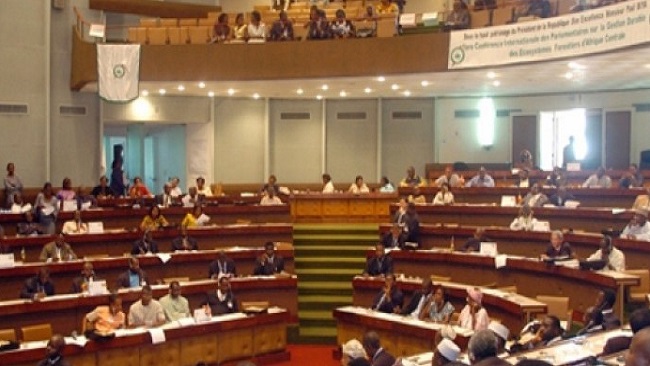
Cameroon’s Parliament has approved a higher education reform bill aimed at modernising and improving the quality of university education – and, significantly, it will officially recognise the two sub-systems of public university education in the country – one English, and one French.

According to officials, two key reforms the new legislation envisages include the strengthening of the economic autonomy of universities and addressing the challenge of having a public system in which nine institutions are francophone and two are anglophone.

“The higher education system used this far was developed since 2001. After 22 years, things have evolved in university programmes. That is why we had to introduce some innovations. There was also a need to address the concerns of the English sub-system of education,” said Wilfred Gabsa Nyongbet, secretary general in the ministry of higher education.

The 2001 higher education law and the 1998 law to lay down guidelines on education in Cameroon (which covers early childhood, primary, secondary, technical, and teacher training education) existed, he said, after the bill was defended in parliament on 16 June.

Recognising two sub-systems

Article 4(3) of the 2023 Higher Education legislation now provides that “the state shall ordain and organise the system of higher education by taking into account the specificities of the two education sub-systems, Anglo-Saxon and francophone, as a contributing ingredient to the influence and performance of the higher education system”.

Each sub-system, according to the lawmakers, is “characterised by a body of specific and cohesive principles, which reflect its historical, cultural and philosophical peculiarities”.

According to Professor Simo Bobda of the University of Yaoundé 1, there has been no recognition of the existence of two education sub-systems in higher education (universities) in Cameroon prior to the bill.

By contrast, as far back as 1998, the law that governs the other tiers of education (primary, secondary, teacher training) had already explicitly recognised that Cameroon had two education sub-systems, each preserving specificities in its certification and assessment methods (as well as in pedagogic approaches), he explained.

Prior to the June 2023 bill, the only texts which recognised the existence of sub-systems in higher education were the decrees establishing the universities of Buea and of Bamenda (in 1993 and 2010 respectively) which chartered them as universities “in the Anglo-Saxon tradition”.

Language division contributes to conflict

Only on the basis of this provision was it obtained that English would constitute the language of instruction in both universities, for all substantive programmes other than French language learning. He said that injustice and discrimination, especially in the higher education sector, has proved a flashpoint in the ongoing anglophone crisis.

“This discrimination has been one of the causes of Cameroon’s anglophone crisis, which started off in the education and legal sectors before spiralling into political demands, strikes and armed activity in 2016,” Bobda said.

The anglophone crisis running for its seventh year is a source of turmoil in the two English-speaking regions of the Southwest and Northwest with armed groups and government forces in continuous battle.

Separatists, who have violently enforced a boycott on education since 2017, continued to attack schools, students and education professionals, destroying buildings and depriving hundreds of thousands of children of their fundamental right to education, according to a Human Rights Watch 2023 report.

He added that the fact that the recognition of the two systems and the recognition of common law as the legal system in anglophone regions built up resentment among Anglo-Saxon higher education lecturers, leading to a public protest in 2017.

“We had to go to the streets in protest, especially after the union got information of plans to harmonise the two curricula of all state universities in Cameroon. The reason the government advanced, was to enhance student mobility between universities,” he said.

The lecturers’ union at the universities of Buea and Bamenda objected, on grounds that harmonising their programmes directly with the other French-speaking universities would dilute their Anglo-Saxon specificities, especially since the templates for harmonisation used were strongly inspired by the French-dominant universities, Bobda said.

“After a hard struggle, we obtained the resolution to allow the universities of Buea and Bamenda to harmonise their programmes between themselves (and future universities in the Anglo-Saxon tradition could harmonise their programmes within them). We are happy the new law now comes to lay to rest the long-existing discrimination,” Bobda said.

Protection of both sub-systems

Experts say the new law will protect the Anglo-Saxon system of education from abuse just as the reforms that recognised the common law did in the legal system.

“Before the crisis, we had cases of French-speaking lecturers sent to teach in the two English-speaking universities, French-speaking magistrates who could not express themselves in English were sent to work in the anglophone regions, with challenges in communication.

The new law will protect each of the systems and prevent any unwarranted invasion or dominance of one language over the other,” Dr Livinus Esambe Njume, a lecturer and a member of the Extractive Industries Transparency Initiative Cameroon, told University World News.

Another key innovation in the June 2023 higher education reforms is the creation of entrepreneurial universities. The new law permits universities to create and run their own businesses.

“The government cannot do it all alone with the surge in university population and unemployment challenges. Building en entrepreneurial spirit in our universities provides opportunities for additional sources of income for them,” Jacques Fame Ndongo, the minister of higher education, explained after defending the bill in parliament.

Fame Ndongo said innovation in higher education is a continuous process that must reflect the realities of every country. “Higher education reforms are the key to quality growth. We are permanently in this process, moving at a pace that reflects the realities of the country,” he said.

Source: University World News

Cough syrup suspected of killing 12 kids in Cameroon might be Made in India

20, June 2023

Cough syrup suspected of killing 12 kids in Cameroon might be Made in India 0

A variety of cough syrup suspected by Cameroonian authorities of killing a dozen children in the central African country in recent months bears markings indicating it was made in India.

Photographs of a box of Naturcold medication show a manufacturing license number matching that of Riemann Labs Pvt. Ltd., based in Indore in the Indian state of Madhya Pradesh. The photos, provided by Eko Eko Filbert, a regional health official in Cameroon, don’t show a manufacturer’s name.

The drugs in the photo “look like ours,” said a director at Riemann, Navin Bhatia, in a phone interview. He said Riemann follows strict quality controls and couldn’t have made tainted medicine, and that counterfeiting is common.

The revelation raises the prospect of a third mass death event linked to exported Indian cough syrups in less than a year. Medicines from two other Indian companies killed more than 60 children in Gambia and about 20 in Uzbekistan last year. In those cases, the syrup medications were found to have been contaminated with two toxic chemicals, ethylene glycol and diethylene glycol. Two more Indian companies are suspected of making similarly tainted syrups found in Liberia and in the Marshall Island.

“Based on your questions, we have sent a team to investigate and we are waiting for the reports,” an official at the Madhya Pradesh Food and Drugs Administration told Bloomberg.

The Cameroonian authorities are still investigating the cause of the outbreak and plan to test the Naturcold samples connected to the deaths, Filbert said in a text message on June 5. The death toll stood at 12 children as of that date, he said.

Filbert said the medicine was not authorized to be imported into Cameroon and was probably smuggled into the country. He said authorities don’t have information about the drugs’ origin.

According to the product label visible in the photos, the bottle of cough syrup was made in March 2022. It bears the name and logo of Fraken International, a marketing company with a UK address. Attempts to reach people at that address by email and LinkedIn messages were unsuccessful.

Bhatia said that Riemann last produced a batch of Naturcold under contract for Fraken in early 2022 and provided it to an exporter who reported sending it to Cameroon. Riemann is one of several Indian companies that have made the product, he said.

Propylene glycol and glycerin are key raw materials for syrups. Riemann buys these chemicals only in sealed containers from name-brand manufacturers, and then hires a third-party lab to test them prior to use, Bhatia said.

“We pay extra attention to quality,” he said. “Everything is done to ensure safety.”

Duplicacy, a term for when a drug is disguised to look like another company’s product, is common in some parts of Africa, Bhatia said.

“They look like ours, but we cannot be sure. There is so much duplicacy there. Based on the quality of our product, it is doubtful,” he said. “I am 110% sure that my product is not contaminated — what we sent from here.”

Culled from Bloomberg

Yaoundé: Vice President Ngoh Ngoh freezes $44.8m pipeline agreement between SNH and Savannah Energy

20, June 2023

Yaoundé: Vice President Ngoh Ngoh freezes $44.8m pipeline agreement between SNH and Savannah Energy 0

The first annual meeting of the board of directors of Société Nationale des Hydrocarbures (SHN) was held on 13 June, where the initial purchase deal of Savannah Energy’s assets in the Chad-Cameroon pipeline was put on the shelf.

Adolphe Moudiki, managing director of Société Nationale des Hydrocarbures (SNH), has suffered another setback in his bid to buy shares in Cameroon Oil Transportation Company (Cotco), which manages the Cameroon side of the Chad-Cameroon pipeline.

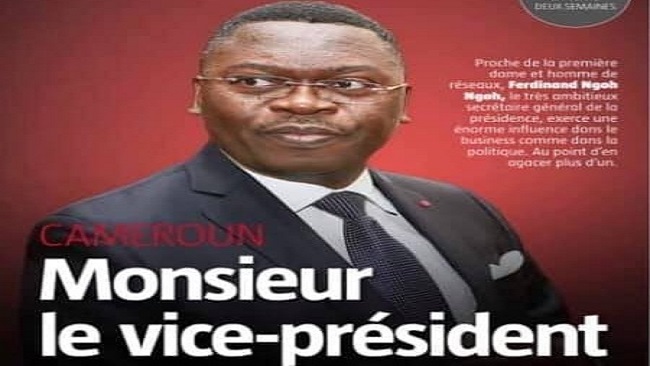
Following the board of directors’ meeting held in the Cameroonian capital Yaoundé on 13 June, the acquisition by SNH of 10% of Savannah Energy’s assets in Cotco was “frozen” following a decision by the chairperson of the board Ferdinand Ngoh Ngoh, who is also secretary general of the presidency.

Arm wrestling

Contested by Chad, the initial agreement – which was concluded on 19 April and amounted to $44.8m – has been at the heart of a tug-of-war between the Chadians and Cameroon.

The quarrel came to a head the following day, on 20 April, with the recall of the Chadian ambassador based in Yaoundé. Since then, Cameroon has stepped up its efforts to mollify tensions, with President Paul Biya sending Ngoh Ngoh to N’Djamena for talks with Chadian President Mahamat Idriss Déby Itno.

Biya also asked his trade minister, Luc Magloire Mbarga Atangana, to pass on Cameroon’s agreement for Chad to buy out the assets of Malaysia’s Petronas in Cotco to the Central African Economic and Monetary Community (CEMAC).

This “corporate open sesame” – essential under regional agreements – should enable N’Djamena to hold 53.7% of the shares in the company that manages the Cameroonian section of the pipeline – an objective that Déby Itno and his government were particularly keen to achieve.

A freeze, before the rest

However, N’Djamena did not accept Savannah Energy’s presence and remained determined to oust it from Cotco. A new round of negotiations was then held in Paris on 24 May at the Cotco board meeting.

The Chadian side – supported by Menguele Judith Clairence, the Cameroonian finance ministry representative on Cotco’s board – came up against Moudiki, who was in favour of maintaining the agreement with Savannah. The meeting ended without a definitive winner.

A few days later, however, the SNH chief attempted to replace Clairence. On 8 June, he was turned down by the presidency, which thereby signalled its agreement with Chad. Five days later, in a new round of talks, Ngoh Ngoh, obtained a freeze on the deal between Savannah and the Cameroonian oil and gas company.

The Chadian government has taken note of this decision, quietly welcoming it. But the decision is not yet final, as further negotiations are undoubtedly still to come on Cotco’s shareholding structure.

It appears that this oil dispute being contested by N’Djamena and Yaoundé is far from over.

Source: Africa Report

Premier League: Bournemouth announce shock sacking of boss Gary O’Neil

19, June 2023

Premier League: Bournemouth announce shock sacking of boss Gary O’Neil 0

Bournemouth have sacked Gary O’Neil as manager even though he kept the club in the Premier League last season.

O’Neil replaced Scott Parker at the end of August and led the team to a 15th place finish in the English top-flight.

Bournemouth owner Bill Foley said in a statement: “Gary’s achievement last season is one I will always be grateful for.

“This has been a difficult decision, but it has been made with great consideration to best position ourselves ahead of the coming season.”

The statement said the appointment of a new head coach will be announced imminently.

O’Neil initially replaced Parker on an interim basis following a 9-0 hammering at Liverpool before being appointed permanently in November.

The 40-year-old took 36 points from his 34 top-flight games in charge.

“We have also identified a number of significant targets in the transfer market this summer and believe this change in direction will provide us with the best platform from which to build,” Foley said.

“Gary will go on to have a long career as a head coach or manager, but we feel that, at this moment in time, a change is in the best interests of this football club.”

Source: AFP

World leaders headed to Paris summit in push for global debt, climate reform

19, June 2023

World leaders headed to Paris summit in push for global debt, climate reform 0

World leaders will gather in Paris this week with ambitions to reimagine global financing for a new era shaped by climate change, as a cascade of crises swamps debt-burdened countries.

French President Emmanuel Macron has said the Summit for a New Global Financial Pact is aimed at building a “new consensus” to meet the interlinked global targets of tackling poverty, curbing planet-heating emissions and protecting nature.

Ideas on the table range from taxation on shipping, fossil fuels or financial transactions, to innovations in lending and a structural rethink of the International Monetary Fund (IMF) and World Bank.

France says the two-day summit, which begins on Thursday and will bring together some 50 heads of state and government, was more of a platform for ideas sharing ahead of a cluster of major economic and climate meetings in the coming months.

In particular, the French Presidency said on Friday it wanted to give “political impetus” to the idea of an international tax on carbon emissions from shipping, with hopes of a breakthrough at a meeting of the International Maritime Organization later in June.

With trust in short supply over broken climate financing promises from richer countries, developing nations are looking for tangible progress.

The V20 group of countries on the climate frontlines, which now includes 58 member nations, has said restructuring the global financial system to align with climate targets must be completed by 2030.

“It’s great we are talking about the international financial architecture, but we have to see timelines and we have not seen those timelines,” Sarah Jane Ahmed, V20 global lead and finance adviser, told AFP.

“If we’re starting to do this stuff in the 2030s, it’s going to be so much more expensive and the trade-offs are going to be far steeper.”

Leaders arriving in Paris to champion that message include Kenyan President William Ruto and Ghana’s President Nana Akufo-Addo, as well as Barbados Prime Minister Mia Mottley, who has become a powerful advocate for reform and will speak at the summit opening on Thursday.

Other attendees include Chinese Premier Li Qiang, US Treasury Secretary Janet Yellen and European Commission head Ursula von der Leyen.

Ajay Banga is also expected in Paris, in his first international meeting since taking the helm of the World Bank, promising to embrace change.

With fewer leaders from wealthier countries attending, Friederike Roder of Global Citizen said the conference could fall short of hopes for a show of unity. 

“We need everyone coming together,” she told AFP, stressing that major economies are needed to agree reforms.

‘Failed’

Economies have been battered by successive shocks in recent years, including Covid-19, Russia’s invasion of Ukraine, spiking inflation and the increasingly expensive impacts of weather disasters intensified by global warming.

United Nations chief Antonio Guterres has said the pandemic and its aftermath amounted to a “stress test” for a financial system that was set up nearly eight decades ago.

“It largely failed,” he said earlier this month, adding that 52 developing countries are in, or near, debt distress.

The World Bank plans to increase its lending capacity by $50 billion over 10 years.

Last week it also called for drastic reform to rechannel trillions of dollars in harmful and unnecessary subsidies for fossil fuels, agriculture and fishing into action on climate and nature.

Currently the world is far off track in its aims to limit warming to 1.5 degrees Celsius above pre-industrial temperatures, risking enormous costs for nature, human societies and the global economy.

Last year, a UN experts committee said developing countries other than China will need to spend more than $2 trillion a year by 2030 on development and to respond to the climate and biodiversity crises.

Ambition ‘gap’

Roder said one key signal from the Paris summit would be for richer nations to show they can fulfil existing promises, like the still-unmet pledge of $100 billion annually by 2020 to help developing nations cut emissions and boost climate resilience.

Increasing the money available — potentially using hundreds of billions of the IMF’s liquidity-boosting “special drawing rights” — is among the calls from emerging economies, as well as a new lending strategy.

One idea championed by Barbados is a disaster clause so loan repayments can be paused for two years in the wake of a climate disaster or pandemic.

Another key point of debate is the scale of existing debts.

That will also focus attention on China, which has become a significant lender to African countries, but has been reluctant to participate in the common framework for debt restructuring.

The Paris summit can bring a lot of issues “out of their niche”, said Louis-Nicolas Jandeaux of Oxfam, noting, however, “a gap between the initial stated ambition of the summit and the reality”.

Source: AFP

Douala: Biya regime installs surveillance cameras to boost security

19, June 2023

Douala: Biya regime installs surveillance cameras to boost security 0

Cameroon has installed surveillance cameras in Douala to enhance security, an official has said.

The newly installed cameras are aimed at ensuring wider online monitoring and surveillance as well as helping police curb crime, said Ferdinand Ngoh Ngoh, secretary general of the presidency.

The move is one of the answers to new forms of crime and persistent terrorist attacks and threats to public order in some parts of the country, Ngoh said Thursday while officially inaugurating the National Command Center for video surveillance in Douala, the economic capital of the country.

Cameroon aims to eventually install 24,000 surveillance cameras in its 10 regional capitals as well as border towns, Ngoh said.

Source: Xinhuanet

Leading Roman Catholic cleric says Cameroon is dancing toward self-destruction

19, June 2023

Leading Roman Catholic cleric says Cameroon is dancing toward self-destruction 0

A leading Cameroonian priest has warned that the country is “dangerously dancing toward self-destruction,” blasting a series of corruption scandals and acts of violence that have marred the west African nation.

“These are very uncomfortable atrocities that have happened in our midst, and which sometimes, we rather tacitly” accept them through silence, said Father Humphrey Tatah Mbuy, Director of Communications at the Catholic Bishops’ Conference of Cameroon.

In one of his weekly programs, “Faith Seeking Understanding,” broadcast this week, Mbuy catalogued several incidents that have rocked Cameroon of late.

He began with the murder of journalist Martinez Zogo, who was kidnapped January 17, and whose mutilated body was found near the capital Yaoundé five days later. Zogo was a constant voice of criticism against government corruption.

Mbuy also discussed scandals surrounding the construction of a Yaoundé-Douala motorway. The first 60 kilometers of the highway have now cost in excess of $1 billion, with much of that amount believed to have been stolen by corrupt officials.

COVID-19 funds that were also allegedly stolen, Mbuy mentioned. Several government officials, including the Prime Minister Joseph Ngute, have been questioned about the theft of about $300 million allocated for the fight against COVID, but so far, no one has been arrested in connection with the investigation.

The same goes with the theft of funds allocated for the construction of sports stadiums in the country. Recently, another corruption scandal was unraveled at the country’s finance ministry in which a cluster of private individuals and government entities had benefited from ‘miscellaneous expenses’ contained in line items in the state budget to the tune of about $9 billion between 2010 and 2021.

Mbuy lauded the oldest Member of Cameroon’s National Assembly, Koa Mfegue Laurentine Mbede, who recently warned that “all this must stop, or our beautiful and dear fatherland will be transformed into a land of scandals.”

“Perhaps the honorable lady was truly referring to the shock and feelings of betrayal suffered by those who are surprised and disgusted to learn of the complicity of their leaders in wrong-doing,” the priest said.

A nation of roughly 30 million, Cameroon is roughly half Christian, with Catholics making up the largest single religious group in the country.

Mbuy said it’s critical for Cameroonians to speak out in the face of scandal and corruption, because “One who keeps quiet instead of unveiling evil that is going on consents to such evil.”

He said although God fashioned man in his image, he also respects man’s freedom to freely choose between good and evil, and this could partly explain the preponderance of scandals in society today.

“Each and every baptized Christian is called upon to evangelize and bring the good news to the poor, the lame, and the blind, to bring liberty to captives and to set the down-trodden free,” Mbuy said.

“The Church, as a teacher, is called to investigate, to find out, to teach and to defend the truth. The Church can never at any time stand on what is evil.”

Mbuy said the need to build a moral society void of scandals arises out of the theological definition of scandal as “moral outrage.”

In other words, “a word or an action which leads to the spiritual ruin of another person…The problem with scandal is not with the person committing even the scandal, it’s already bad enough that he commits. The problem with scandal is that it induces others to sin. It is because of others that scandals become worrisome,” Mbuy said.

He called on Church leaders to be the moral compass of society, and notwithstanding their human weaknesses, “there is a certain amount of discretion that each church leader must possess and which society has a right to expect from each of them. The same applies to those in public service, called to be servants of the people in their administration and political choices.”

He said a few moral principles are necessary to handle the many scandals in Cameroonian society today.

“First, public scandals must be handled and resolved publicly, while private scandals are to be handled privately. Second, there is absolute necessity to make amends, repair or restitution in cases of public scandals. Third, public scandals deserve sanctions to act as deterrents so that others may not follow the bad example. Since a scandal is a moral poisoning of the society, each deserves to be handled with absolute cold headedness and skill, ensuring that the impression is not given that we condone evil. Evil is to be fought at all costs and with the utmost ferociousness.”

Mbuy expressed regret that society has been besieged by “such a nauseating secularism and Marxist materialism that we tend to act with shocking levity of mind over issues which would otherwise frighten anyone with a disciplined mind.”

“If our society is dangerously dancing towards self-destruction, part of the central reason lies in our insensitivity towards what is wrong and inadmissible,” he said.

“For people who still think about the future and those coming after, there is every reason to continue to stand on the side of good against evil, upholding integrity, rather than give in to licentiousness, but apparently, the beautiful ones are not yet born, or the gods must be crazy,” he said.

Culled from Crux

«< 246 247 248 249 250 >»

Featured

  • Exam leaks in CPDM Cameroon: A symptom of a deeper corruption crisisExam leaks in CPDM Cameroon: A symptom of a deeper corruption crisis
  • Biya is already in Hell as Yaoundé unravelsBiya is already in Hell as Yaoundé unravels
  • What does President Biya really want? Money, women or cigarettes?What does President Biya really want? Money, women or cigarettes?
  • Biya, how long must the nation wait for the government it was promised?Biya, how long must the nation wait for the government it was promised?
  • Cameroonians in Leicester: funeral contributions must never become a marketplace for corruptionCameroonians in Leicester: funeral contributions must never become a marketplace for corruption

Most Commented Posts

  • 4 Anglophone detainees killed in Yaounde4 Anglophone detainees killed in Yaounde
    18 comments
  • Chantal Biya says she will return to Cameroon if General Ivo Yenwo, Martin Belinga Eboutou and Ferdinand Ngoh Ngoh are sackedChantal Biya says she will return to Cameroon if General Ivo Yenwo, Martin Belinga Eboutou and Ferdinand Ngoh Ngoh are sacked
    13 comments
  • The Anglophone Problem – When Facts don’t LieThe Anglophone Problem – When Facts don’t Lie
    12 comments
  • Anglophone Nationalism: Barrister Eyambe says “hidden plans are at work”Anglophone Nationalism: Barrister Eyambe says “hidden plans are at work”
    12 comments
  • Largest wave of arrest by BIR in BamendaLargest wave of arrest by BIR in Bamenda
    10 comments

Latest Tweets

→ Follow me

Featured

  • American musician Oliver Tree killed in mid-air helicopter collision in Brazil

    American musician Oliver Tree killed in mid-air helicopter collision in Brazil

  • Cameroon looks to Tunisia’s textile model to develop its cotton value chain

    Cameroon looks to Tunisia’s textile model to develop its cotton value chain

  • Trump marks 80th birthday with White House UFC spectacle

    Trump marks 80th birthday with White House UFC spectacle

  • Ex-Israeli PM Ehud Barak says Netanyahu must be removed ‘with sticks and stones’

    Ex-Israeli PM Ehud Barak says Netanyahu must be removed ‘with sticks and stones’

  • US denies visa to Palestine football chief for World Cup attendance

    US denies visa to Palestine football chief for World Cup attendance

  • Yaoundé, Abu Dhabi explore new trade and investment framework

    Yaoundé, Abu Dhabi explore new trade and investment framework

  • Southern Cameroons Crisis: 2 gov’t soldiers killed in Ambazonia ambush

    Southern Cameroons Crisis: 2 gov’t soldiers killed in Ambazonia ambush

Log In

  • Register
  • Log in
  • Entries feed
  • Comments feed
  • WordPress.org
© Cameroon Concord News 2026

We are using cookies to give you the best experience on our website.

You can find out more about which cookies we are using or switch them off in .

Powered by  GDPR Cookie Compliance
Privacy Overview

This website uses cookies so that we can provide you with the best user experience possible. Cookie information is stored in your browser and performs functions such as recognising you when you return to our website and helping our team to understand which sections of the website you find most interesting and useful.

Strictly Necessary Cookies

Strictly Necessary Cookie should be enabled at all times so that we can save your preferences for cookie settings.

3rd Party Cookies

This website uses Google Analytics to collect anonymous information such as the number of visitors to the site, and the most popular pages.

Keeping this cookie enabled helps us to improve our website.

Cookie Policy

More information about our Cookie Policy