27, April 2023
World Bank says commodity prices to register sharpest drop since the pandemic 0
Global commodity prices are expected to decline this year at the fastest clip since the onset of the COVID-19 pandemic, clouding the growth prospects of almost two-thirds of developing economies that depend on commodity exports, according to the World Bank’s latest Commodity Markets Outlook report.
The drop in prices, however, is expected to bring little relief to the nearly 350 million people across the world who face food insecurity. Although food prices are expected to fall by 8% in 2023, they will be at the second-highest level since 1975. Moreover, as of February this year, annual food price inflation is at 20% globally, the highest level over the past two decades.
“The surge in food and energy prices after Russia’s invasion of Ukraine has largely passed due to slowing economic growth, a moderate winter, and reallocations in the commodity trade,” said Indermit Gill, the World Bank’s Chief Economist and Senior Vice President for Development Economics. “But this is of little comfort to consumers in many countries. In real terms, food prices will remain at one of the highest levels of the past five decades. Governments should avoid trade restrictions and protect their poorest citizens using targeted income-support programs rather than price controls.”
Overall, commodity prices are expected to fall by 21% in 2023 relative to last year. Energy prices are projected to decline by 26% this year. The price of Brent crude oil in U.S. dollars is expected to average $84 a barrel this year—down 16% from the 2022 average. European and U.S. natural-gas prices are forecast to halve between 2022 and 2023, while coal prices are expected to decrease 42% in 2023. Fertilizer prices are also projected to fall by 37% in 2023, which would mark the largest annual drop since 1974. However, fertilizer prices are still near their recent high last seen during the 2008-09 food crisis.
Ayhan Kose, the World Bank’s Deputy Chief Economist and Director of Prospects Group, said: “The decline in commodity prices over the past year has helped reduce global headline inflation. However, central bankers need to remain vigilant as a wide range of factors, including weaker-than-expected oil supply, a more commodity-intensive recovery in China, an intensification of geopolitical tensions, or unfavorable weather conditions, could push prices higher and reignite inflationary pressures.”
Despite the large declines expected this year, prices of all major commodity groups will remain well above their 2015-2019 average levels. European natural gas prices will hover at almost three times the average in 2015-19. Energy and coal prices will also remain above the pre-pandemic average.
“Metal prices, which increased slightly early in the year, are expected to fall by 8% relative to last year, primarily because of weak global demand and improved supplies,” said Valerie Mercer-Blackman, Lead Economist in the World Bank’s Prospects Group. “In the longer term, however, the energy transition could significantly lift the demand for some metals, notably lithium, copper, and nickel.”
A Special Focus section of the report evaluates the performance of a wide range of approaches used to forecast prices of seven industrial commodities (oil and six industrial metals). A key finding of the study is that futures prices, which are widely used for price forecasts, often lead to large forecast errors. Econometric models based on multiple independent variables tend to outperform other approaches as well as futures prices. The analysis suggests that augmenting model-based forecasting approaches—by incorporating the dynamics of commodity prices over time and controlling for other economic factors—enhances forecast accuracy.


27, April 2023
Cameroon, Chad agree to resolve dispute over Exxon Mobil sale 0
Cameroon and Chad have agreed to resolve their dispute over assets belonging to a multinational oil giant, Exxon Mobil, an official said Wednesday.
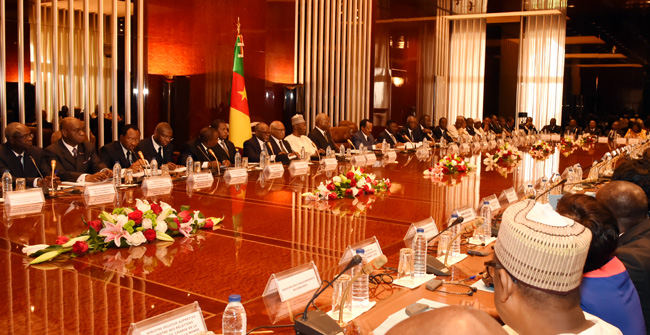
Ferdinand Ngoh Ngoh, a Cameroonian presidential official, announced this after a meeting with Chad’s transitional president, Mahamat Idriss Deby, in the capital N’Djamena, according to Chad Information Agency.
The centuries-old relations between our two countries, which have “always been excellent remain the same” and the two heads of state are “willing to continue to work to strengthen these relations for the well-being of their states and their peoples,” Ngoh was quoted as saying.
“Some misunderstandings have been dispelled and there is really no cloud in the relationship between Cameroon and Chad.”
Ngoh, who visited the country as a special envoy, days after Chad recalled its ambassador to the neighboring country over the dispute, handed Deby “a message of friendship, a message of fraternity” from his counterpart Paul Biya.
Chad recalled its ambassador to Cameroon on April 21 amid a dispute over assets belonging to a multinational oil giant, Exxon Mobil, which the Chadian government nationalized.
Last month, the Chadian government nationalized assets of Exxon Mobil which include the company’s interest in the more than 1,000 km (621 miles) Chad-Cameroon pipeline from Chad to the Atlantic Gulf of Guinea coast used to export crude.
The controversial move came months after ExxonMobil had in December closed the sale of its operations in Chad and Cameroon to British-listed Africa-focused oil and gas energy company, Savannah Energy, in a $407 million deal.
The sale was contested by the Chadian military government.
Chad was infuriated over reports that Savannah Energy had decided to sell its 10% stake in a company that controls the Cameroonian section of the Chad-Cameroon oil export pipeline to Cameroon state oil company, at $44.9 million — which the Chadian authorities were against.
The Chadian presidency accused the Cameroonian authorities of being dishonest in negotiations aimed to resolve the disputes regarding the acquisition of the assets of ExxonMobil by Savannah Energy.
Gali Ngothe Gatta, a Chad presidential official, had warned that the “dispute undermines relations between the two countries and could have consequences on economic and political cooperation.”
Source: Cameroon Info.Net