16, April 2023
More children die after taking fake cough syrup in Cameroon 0
More children have died in Cameroon after consuming a fake cough syrup, health authorities have revealed.
The deadly fake medicine is branded “Naturcold”, purportedly made by a company named “Fraken Group”, the regional delegate for public health in Northwest Province, Dr Kingsley Che Soh said.
The drug caused fatal kidney failure in six children in the Northwest region, all were under the age of five.
In March, health officials in Southwest Cameroon said three children died from consuming the same fake medicine.
The Directorate of Pharmacy, Drugs and Laboratories at the Ministry of Public Health, Dr Eko Eko warned the drug contained two dangerous ingredients that caused the death of the children.
Their families are said to have bought the drugs along the roadside from unauthorised dealers. These unlicensed dealers often move around selling the medication door-to-door, or out of boxes in markets.
Street dealers
Dr Kingsley Che Soh has warned the population to avoid consuming the product and stay away from drugs sold along the roadside as it may be dangerous to health.
At markets, and other public places, many unlicensed medicine stores operate under the watchful eyes of the government, yet they lack basic documents authorising them to do so.
Drugs displayed in Cameroon’s national capital Yaoundé
Alex Efiti, who lives in Douala, says it is easy for him to buy drugs along the roadside because it is cheap and accessible.
“Drugs are very expensive in pharmacies. It is not my level. I prefer buying from the guys who move around with it because I trust them and they are cheap”, he said.
Asked about the dangers of consuming these fake drugs, Alex said he has been consuming street medication for years and it has not affected him negatively.
Many believe in these medicine dealers, despite the news of the children’s deaths.
“My aunt got so mad at me for buying her drug at the pharmacy. She wanted me to get it from her usual drug dealer,” said another customer called Samira. “When I tried to tell her it was dangerous, she kept asking me why has it not killed her.”
Deaths
The United Nations Office on Drugs and Crime warns that fake medical products kill almost half a million sub-Saharan Africans every year.
Its new threat assessment report says as many as 267,000 deaths per year are recorded in Sub-Saharan Africa, all linked to falsified and substandard antimalarial medicines.
“In addition, up to 169,271 are linked to falsified and substandard antibiotics used to treat severe pneumonia in children”, it added.
The government of Cameroon has made some strides in stopping the circulation of fake drugs, yet the population is still exposed to them.
Sources say the majority of fake drugs are smuggled into the country from neighbouring countries through porous border control. Cameroon made a series of arrests last year related to illicit drug circulation.
Punished
Running an unlicensed pharmacy in Cameroon is illegal.
The same law prohibits the display and distribution of drugs on the public road, in fairs or markets. It further forbids even those with a degree in pharmacy to sell drugs by the roadside.
Anyone selling fake or expired drugs, or intends to sell a fake drug, altered or harmful to human health, can be punished with a jail sentence of up to three years and a fine of up to 3,000,000 CFA francs.
Despite all these laws, the fake drug stores continue to operate in complicity with health agents, forces of law and order and the population. People even sometimes refuse to point out these dealers when health operators carry out controls.
Government Health Minister Manaouda Malachie announced last year his ministry was working on the creation of a national agency for medicines, that will regulate the drug market and strengthen the fight against street drugs.
Source: Humangle


17, April 2023
Southern Cameroons Crisis: Yaoundé Government Engages in Wrong Negotiation 0
As the killings and maiming of innocent civilians in Cameroon’s two English-speaking regions continue to play out, the Yaoundé government has instead decided to send a delegation to Washington D.C. to address the issue of the country’s eligibility for the African Growth and Opportunity Act (AGOA), an American program which aims at granting duty-free treatment to goods of designated Sub-Saharan African countries. This access granted to African countries is contingent upon the human rights records of these African countries.
Cameroon once had access to the American market under AGOA, but when the Yaoundé government decided to use weapons designed to fight Boko Haram terrorists in the country’s northern regions on innocent civilians in the country’s two English-speaking regions where the English-speaking minority was indicting the Yaoundé government of marginalization and injustice, the American Administration of Donald Trump promptly cut off the Central African country from the attractive perks offered by the program.
Losing its privileges under AGOA also meant Cameroon could no longer have access to American sophisticated weapons, especially the night vision goggles, which made it possible for the poor Central African country to keep the terrorists at bay.
Since 2018, the Biya regime has been struggling to roll back Boko Haram terrorists and the absence of the right weapons has made their effort real hard labor, especially as the country’s army has lost and continues to lose many if its soldiers in a battle many experts say will be drawn out.
Cameroon’s numerous loses in its northern region against Boko Haram and its inability to bring about peace in its two English-speaking regions have resulted in massive frustrations, with the Yaoundé government clearly staring down the barrel of defeat.
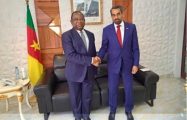
The country’s Minister of Economy, Planning and Regional Development, Alamine Ousmane Mey, is currently leading a delegation to the American capital to plead for a forgiveness of the sins and crimes of the Yaoundé government.
When the Trump Administration pulled the plug on its deal with the Biya regime, the Yaoundé government’s surrogates and spin doctors were on many news channels to prove that the American decision would not hurt the Yaoundé government.
The Yaoundé government has been in the business of creating troll farms which will help it fight its fights in the media. Strangely, the government’s trolls are usually young and hungry people who hardly see beyond the next meal. They were blissfully oblivious of the consequences of their actions and those consequences have shown up today and they are biting the desperate government where it hurts the most.
At the time the American Administration rolled back its military help to Cameroon, the North American country had clearly pointed to Cameroon’s dismal human rights record. The Trump Administration did not mince its words but left a little window for the Central African country to return with a view to enjoying AGOA-related benefits if and when it addresses those human rights issues.
But the Yaoundé government is wont to placing the cart before the horses. The human rights abuses in the country’s two English-speaking regions have not been improved, with civilians still being killed like game by the country’s army soldiers.
In the North, Boko Haram remains a real threat and even the government’s worst enemies acknowledge that without external support, Boko Haram terrorists will, without a doubt, make that part of the country ungovernable.
Despite this unanimity, many rights groups have demonstrated that the Yaoundé government and its soldiers are not conducting the war against Boko Haram according to universally- accepted norms. Desperation sometimes pushes the soldiers into committing massive and despicable abuses on the civilian population and this is diminishing the country’s image on the global stage.
It is clear that it is impossible to wean the government from its old and bad ways. The Yaoundé government has only one major tool in its huge arsenal – violence – and this is usually employed to intimidate civilians suspected of aiding and abetting the terrorists and, in many cases, the soldiers get it terribly wrong as lost civilian lives cannot be restored.
Regarding the two English-speaking regions of the country, the international community, led by the United States, Canada and the United Kingdom, has been calling on the Yaoundé government to adopt a more humane and diplomatic approach in its efforts to find a permanent solution to a crisis which has already claimed close to ten thousand lives.
The international community has been backing any peaceful efforts which could result in lasting peace in the two English-speaking regions of the country, although not much has been achieved given that the Yaoundé government only believes in war as the only and ideal method which can restore peace in the two English-speaking regions.
The world was optimistic when the Swiss Talks were launched and the Vatican’s full support of the talks gave Cameroonians a real moment of hope. But in its characteristic manner, the Yaoundé government walked away from the talks, hoping that time would deliver the results it was looking forward to. Unfortunately, that is not happening.
The Yaoundé government holds that only time will address the Southern Cameroons crisis which has brought untold hardship to Cameroonians.
A war which started as a protest by lawyers and teachers has already lasted seven years and it has brought out the worst in humans as unnecessary killings and atrocities have become the order of the day. Schools in rural parts of the regions remain closed, with more than a million children being denied access to education which could help them unlock their potential and opportunities in the future.
The Southwest region, in particular, was, before the war, considered as the country’s bread basket, but following the war, food production has taken a nosedive, with food-related inflation hitting many Cameroonians like a ton of bricks.
The Southwest region alone accounted, before the war, for about 50% of the country’s cocoa production, but for more than five years, cocoa production has witnessed a huge decline as many farmers have escaped to the cities and towns where they can find some relative peace and many of them will not be returning to those farms anytime soon, especially after having had a taste of city life.
Despite the Yaoundé government’s withdrawal from the Swiss Talks, the international community has continued to find ways to bring the protagonists to the negotiating table.
The international community understands that without a full discussion on the core issues which caused Southern Cameroonians to pick up arms against the Yaoundé government, genuine peace would continue to be elusive in a country many hold, is responsible for the Central African region’s stability.
It was on these grounds that the international community designated Canada, a country noted for its diplomacy and experience in negotiating with linguistic minorities and leading intergovernmental negotiations, to lead talks between Cameroon’s separatists and the Yaoundé government.
The Yaoundé government accepted to come to the negotiating table and its Prime Minister, Joseph Dion Ngute, stood firmly behind the talks hoping that Canada’s experience and honesty would help to bring back peace to the country.
Three pre-talks had taken place in Canada. One in Toronto, Canada’s economic nerve centre and home to many rich Southern Cameroonians who have overtly and solidly stood behind the separatists, while two had taken place in Québec, Canada’s purely French-speaking province.
But when the Canadian Foreign Affairs Minister, Melanie Joly, announced early this year that Canada had been designated by the separatists and Yaoundé government to lead the talks, the Yaoundé government promptly issued a press release advising that it had not authorized anybody or any country to seek solutions to the crisis in the country’s two English-speaking regions.
Once again, the Yaoundé government had thrown a massive monkey-wrench into the works and this immediately destroyed the enthusiasm and hope the Canadian press release had generated across the globe.
The Yaoundé government took a lot of flax for its recklessness and constant refusal to be part of global efforts at finding lasting peace in the country after its unpopular press release.
But that did not dampen the enthusiasm and determination of the international community in general and that of Canada in particular. The U.S. and the UK promptly congratulated Canada on accepting to play such a key and positive role in a conflict which was destroying the country’s economy and offered their support when and if it would be needed.
The separatists, for their part, immediately formed a common front, proving that the Yaoundé government was the problem and not Southern Cameroonians who have been calling for peace. They accepted to attend any talks and urged the international community to support Canada in its efforts to engineer peace in Cameroon, though they have since failed to call for a resumption of schooling in the rural parts of the two English-speaking regions of the country.
Today, a delegation of the Yaoundé government is in Washington D.C. for reasons mentioned above, but before the delegation left the country to the U.S, the Yaoundé government on April 7, 2023 cancelled a planned visit by the Canadian deputy foreign affairs minister, Peter Macdougall, to Cameroon, once more underscoring that it had no appetite for peace.
However, if it has no appetite for peace, it has a huge appetite for money and this will bring it to the negotiating table as it has to deal with those who have been calling for peace talks with the separatists.
Now that the Yaoundé government needs American financial support, will Americans yield to Cameroon’s plea for readmission into AGOA when its human rights record still leaves much to be desired? Will Americans just open the doors to Cameroon when the Yaoundé government has no plan to sit with Southern Cameroonian separatists for those issues which triggered the war to be discussed? Cameroon needs America more than America needs Cameroon.
If America truly believes in human rights, then it should oblige the Yaoundé government to immediately start talks with Southern Cameroonians with Canada moderating the talks. Cameroon should engage, first, in the right talks before going to Washington D.C. to ask for a forgiveness of its sins.
By Dr. Joachim Arrey