29, March 2022
War in Ukraine: Latest developments 0
Here are the latest developments in the war in Ukraine:
Talks begin in Turkey
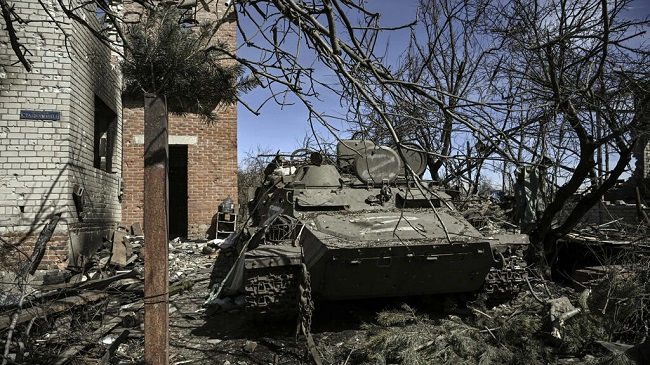
Russia and Ukraine begin their first face-to-face talks in weeks at Dolmabahce palace in Istanbul to try and end the nearly five-week-old war which has killed an estimated 20,000 people.
Welcoming the delegations, Turkish President Recep Tayyip Erdogan says “both parties have legitimate concerns” and urges them to “put an end to this tragedy”.
“The whole world is waiting for good news from you,” he says.
‘We don’t trade sovereignty’
Russian President Vladimir Putin has demanded the “demilitarisation” and “denazification” of Ukraine, that it become a neutral country and that Kyiv recognize the breakaway Donbas region and Russian-annexed Crimea peninsula as no longer part of Ukraine.
Ukraine’s Foreign Minister Dmytro Kuleba says the talks will focus on easing the humanitarian situation. He says there is little room for agreement on Putin’s territorial demands, saying “We do not trade people, land and sovereignty.”
– Evacuations resume –
Ukraine says it is resuming the evacuation of civilians from war-scarred regions after a one-day pause over what it called the threat of Russian attacks.
“Three humanitarian corridors were agreed for today,” Deputy Prime Minister Iryna Vereshchuk says on Telegram.
Key Kyiv suburb recaptured
Ukrainian forces have “liberated” the much fought-over western Kyiv suburb of Irpin, the country’s interior minister says.
Ukraine says Russia is still trying to break through to Kyiv, despite Moscow saying it plans to focus on the Donbas region
But fighting appeared to be continuing around the area, from where Russian forces were attempting to advance towards the capital, AFP journalists report.
Ukraine says Russia is still trying to break through to Kyiv, despite signals from Moscow that it is planning to scale back its offensive to focus on the eastern Donbas region.
Mykolaiv government building hit
A Russian strike has hit the regional government building in the southern Ukrainian city of Mykolaiv, a key port that has been under heavy assault for weeks, the regional governor says.
Governor Vitaly Kim says most people inside the building “escaped miraculously” but several civilians and soldiers are unaccounted for.
– Poisoning report –
Russian oligarch Roman Abramovich and Ukrainian negotiators were targets of a suspected poison attack at peace talks earlier this month, the Wall Street Journal reports, citing people familiar with the matter.
Ukrainian officials decline to confirm the incident, advising people to follow “only the official information” and warning about “various conspiracy theories”.
Abramovich and the negotiators reportedly developed symptoms including red eyes and peeling skin, though they later recovered.
Wagner group in Ukraine: UK
Britain’s defence ministry says Russia’s Wagner Group has deployed its mercenaries to eastern Ukraine, adding that more than 1,000 fighters are expected to participate in the war after Russian setbacks.
Biden continues damage limitation
US President Joe Biden is again forced to defend his remarks that Putin “cannot stay in power”, saying the comments did not signal a push for regime change but merely expressed his “moral outrage”.
The White House unveils budget plans, including $6.9 billion (6.3 billion euros) in funding for Ukraine and NATO, with another $1 billion towards countering Moscow’s influence.
5,000 dead in Mariupol
A senior Ukrainian official says at least 5,000 people have been buried in the besieged southern city of Mariupol since the invasion began, but that bodies have gone uncollected for the past 10 days amid continuing Russian shelling.
The foreign ministry describes the humanitarian situation in the city as “catastrophic”.
$565 billion hit
Ukraine’s Economy Minister Yulia Svyrydenko says the invasion has cost her country an estimated $564.9 billion, including immediate damage and expected hits to trade and economic activity.
Source: AFP

















29, March 2022
Chinese-built port, highway in Cameroon boost economy, regional trade 0
When the Chinese arrived in Cameroon in 2011 to begin building the first phase of Kribi Deep Seaport, the Central African nation was hopeful of having a new transport corridor that would link its vast southwestern coastal area and neighboring nations.
The main existing port in the commercial hub of Douala, some 150 km to the north of Kribi was virtually worn out by congestion. To increase transport capacity, the China Harbour Engineering Company Ltd (CHEC) set out to construct the Kribi port, and in three years works were completed.
The new port has stimulated the country’s economy and provided relief for the harbor at Douala port, the country’s most populous city, while also providing dock space for larger ships, said Alain Patrick Mpila Ayissi, Manager of Land development and Environment department of Port Authority of Kribi.
“Since the construction works ended in 2014 and the start of port operations in 2018, there has been notable increase in economic growth. The first indicator is the hikes in the custom revenues as a result of the port. We left from 750 million XAF (US$1.26 million) to practically 150 billion XAF per annum,” said Ayissi.
As a cheap logistics mode, the port is a fundamental foundation of Cameroon’s industrialization process, said Xu Huajiang, general manager of China Harbour Central Africa Division of CHEC who oversaw the construction of the first phase of the port.
“So far, after Kribi (port) was founded, it has attracted a lot of external investment. For example, there is already a cocoa factory invested by Cote d’Ivoire. There are two cement plants under construction. Many logistics enterprises have settled in to build their own yards and warehouses. There are also some Chinese enterprises coming to discuss investment with them in this area,” Xu said.
Kribi port is located on the Atlantic coast some 285 km from the capital Yaounde. It is strategically positioned in the center of the Gulf of Guinea and is surrounded by the 262 square km Kribi Industrial Area, destined to host new industrial and logistical developments.
With Cameroon being a growing market, Kribi is expected to become a regional hub for the African Atlantic coast. Ship-owners will no longer run the risk of offloading part of their cargo elsewhere before docking in Cameroon, said Ayissi.
“With the coming of the Kribi port, Cameroon has once again placed herself as the port entry to the sub-region. This (the port) has added more value to certain industrial projects in Chad, Central African Republic and Congo,” he added.
As part of the project, CHEC also constructed the Kribi-Lolabe highway that will cater to the requirements of the port transportation and logistics and make a contribution to local prosperity.
The highway which includes the construction of 20 bridges, the total length of which is 2 km will serve as an important traffic artery in the Kribi region.
Currently, CHEC is busy constructing the Kribi Deep Sea Port Phase II. After the completion of the project, it is expected to become a large container transit port and comprehensive hub port in Central and West Africa.
Xu revealed that during the process of port and highway construction, over 1,000 jobs had been provided. Cameroonian workers employed by CHEC, including Eric Defo Fotso, Larissa Ekale Koule and Fran Mbofris told Xinhua that building their country’s largest port is an opportunity to update their own skills and contribute to the country’s industrialization.
“We have project coordinators with a lot of experience be it in administrative affairs, project management and I got to live the Chinese culture. We get to see different things from what we heard since childhood. Just working with them is like you traveled to China to learn about this (skills),” said Fotso, 32, who coordinates projects at the site.
“Every nation, like Cameroon aspires to emerge. So it’s an honor for us to have China and her expertise and who willingly accepted to share it with us,” added 26-year-old Koule whose main assignment is to ensure that all onsite workers are in good health and that there are no job-related illnesses.
“They (CHEC) have given us a great opportunity. Our livelihoods have improved significantly,” said Mbofris who spent seven years in China teaching the English language and now works as an interpreter with CHEC.
Ayissi said the Kribi port project is a glaring example of Cameroon’s participation in the China-proposed Belt and Road Initiative, adding that the country is committed to unlocking the potential of interlinked production networks and value chains.
Source: Xinhua