29, July 2021
Civilians bear brunt of Southern Cameroons Conflict, Amnesty International warns 0
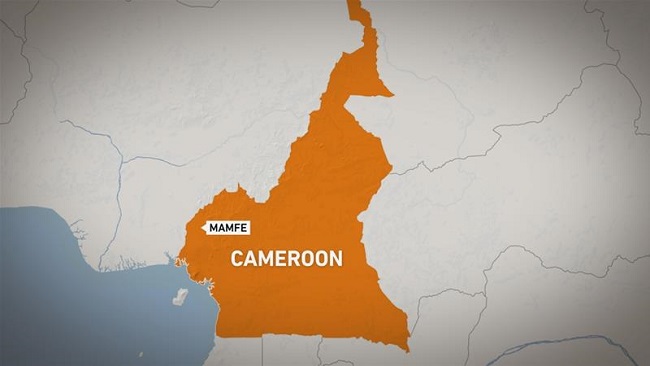
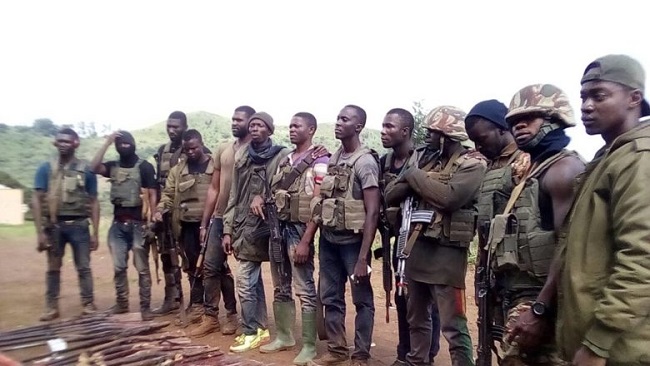
Civilians have borne the brunt of three years of fighting between Cameroonian soldiers and Ambazonia Restoration Forces in British Southern Cameroons, Amnesty International said Wednesday.
The human rights watchdog collected witness accounts and analysed satellite images to assess the fallout from the fighting.
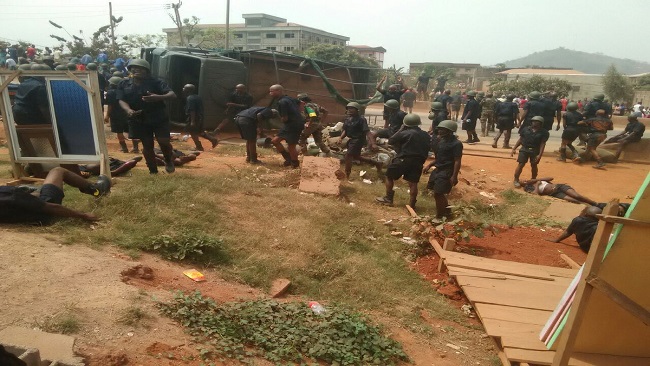
Releasing its report, Amnesty said: “Civilians (bear) the brunt of unlawful killings, kidnappings and widespread destruction of houses and villages.
“Government intervention has been limited, and there has been near-complete silence from the international community,” it added.
Members of the anglophone minority in the country’s westernmost provinces have long complained of being marginalised by the French-speaking majority and 88-year-old President Paul Biya, in power for 38 years.
Their demonstrations devolved into a bloody conflict, and rebels have extended attacks against police and soldiers to civilians.
Separatists accuse members of the Fulani ethnic group of siding with authorities and taking up arms against them.
“All parties to the conflict… have committed human rights violations and abuses, and civilians are caught in the middle,” Amnesty’s Central Africa researcher Fabien Offner said in a press release.
He cited an example in which separatists gunned down two elderly women and one in which Fulani vigilantes burned hundreds of homes and killed four people.
The report describes a surge in violence in February, with the Nwa subdivision on the northwest border with Nigeria targeted in particular.
“At least 4,200 people were displaced from seven villages in Nwa following attacks by Fulani vigilante groups in which at least eight people were killed” between February 22 and 26, it says.
The report cites the Centre for Human Rights and Democracy in Africa (CHRDA) as saying Fulani herders carried out over a dozen raids on Nwa villages in less than a month.
Amnesty says satellite images from February confirmed the destruction of the villages.
“It is unclear whether Fulani vigilante groups attacked the villages or whether the destruction took place during clashes with armed separatist groups,” it said, however.
Amnesty also said separatists have targeted Mbororo people — a Fulani subgroup — in particular.
In the absence of official figures, Mbororo witness accounts report some 162 deaths, 300 homes burned and 102 kidnappings since 2017.
In the release, Offner pleaded for the government to take action to stop the violence, including accepting a proposed fact-finding mission by the African Commission on Human and Peoples’ Rights.
“The Cameroonian authorities must deliver on their responsibility to protect the entire population indiscriminately,” he said.
Reported by AFP with additional editing from Camcordnews


29, July 2021
CPDM Crime Syndicate Asks People Who Fled Boko Haram to Return 0
Cameroon’s government has sent ministers to its northern border with Nigeria to convince villagers who fled Boko Haram militants to return. Cameroon invested $10 million on reconstruction efforts after damage caused by the Islamist terrorist group in some villages. But, in northern Cameroon, many villagers are reluctant to go home, and authorities acknowledge the militants are still a threat.
Bulldozers of Cameroon’s Ministry of Public Works fill destroyed portions of the 30-kilometer road linking Cameroon’s northern town of Mora to Banki, a town in northeast Nigeria.
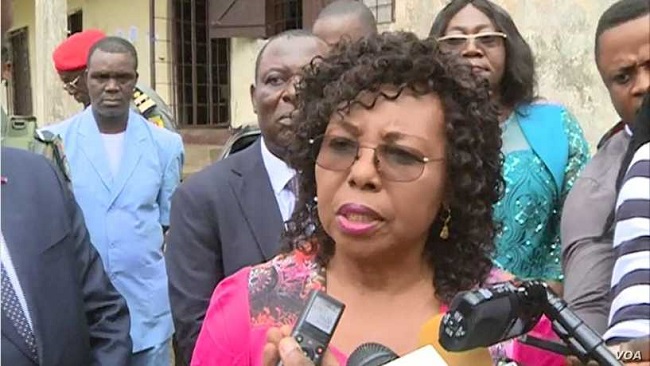
Celestine Ketcha Courtes, Cameroon’s minister of housing and urban development, and Talba Malla Ibrahim, minister of public contracts, traveled to the site this week.
Courtes said they went to find out the effectiveness of reconstruction work on infrastructure damaged during fighting by Cameroonian troops and Boko Haram combatants.
She said Cameroonian President Paul Biya instructed her and the minister of public contracts to visit markets rebuilt to facilitate the purchase and sale of goats, cattle, table birds and food. She said they also saw roads built to ease travel between Cameroon and Nigeria and to facilitate trade between the two neighbors. She said Cameroon’s government is planning to rebuild infrastructure destroyed by the jihadist militant group Boko Haram.
Cameroon said the $10 million was invested this year for reconstruction of schools, hospitals and markets destroyed by Boko Haram. Alamine Ousman Mey is the minister of economy. He said civilians who fled can return and occupy infrastructure that has been reconstructed.
“It started with the reconstruction be it [of] the police as well as custom administrative facilities [buildings]. It has gone further to train those involved in protecting the population and also the community to be part of the stabilization process. It is about bringing back economic life,” he said.
Mey acknowledged Boko Haram is still a threat. He said civilians should return as the military will protect people to help in the development of their towns and villages.
But this week, Cameroon reported two Boko Haram deadly attacks that claimed the lives of 13 troops and civilians in the border villages of Sagme and Zigi. The latest attack was in Zigi on Tuesday. Authorities say five troops and six civilians were killed.
Cameroon said several hundred civilians fled the two villages.
There has been no comment from Nigeria, but a Multinational Joint Task Force (MNJTF), established by Lake Chad Basin countries to combat Boko Haram, consists of troops from Nigeria, Cameroon, Benin, Niger and Chad. The troops, which have a base in Mora, are posted along Cameroon’s border with Nigeria.
Gregory Bonglam is a teacher. He said on Tuesday, he fled Mozogo, a northern administrative unit on the border with Nigeria after yet another Boko Haram attack.
“You never can identify who is Boko Haram and who is not. We were sitting outside and discussing. Little did we know that Boko Haram was around and before we knew it, there were already explosives. Luckily, we were a little far from the incident otherwise we would have been killed. Going back there is really very dangerous,” he said.
Philemon Ndula, conflict resolution specialist with the Cameroon NGO Trauma Center, said Cameroon should ensure there is peace before reconstruction.
“What I will suggest is for the government to talk about recovery. In recovery, there is the physical aspect of building the schools, building the houses, building the hospitals and so on. So that is why I am saying that reconstruction is just a starting point. The psychological aspect is actually the heart of the matter. People can only go out to do their businesses, to go to their farms when they have that minimum security,” said Ndula.
Cameroon says security will improve if civilians collaborate with authorities and report to authorities if they see suspicious activities in towns and villages. The government is also asking for the creation of militias to assist the military fight Boko Haram.
Boko Haram has been fighting for 11 years to create an Islamic caliphate in northeast Nigeria and parts of Cameroon, Chad, Niger and Benin.
The violence has cost the lives of 30,000 people and displaced about 2 million civilians, according to the United Nations.
Source: VOA